Hindu woman deceived by Muslim man posing as Hindu, subjected to forced conversion, beef consumption and imposition of Islamic practices
 Rohtas, Bihar, India
  23 March, 2022
Case Summary
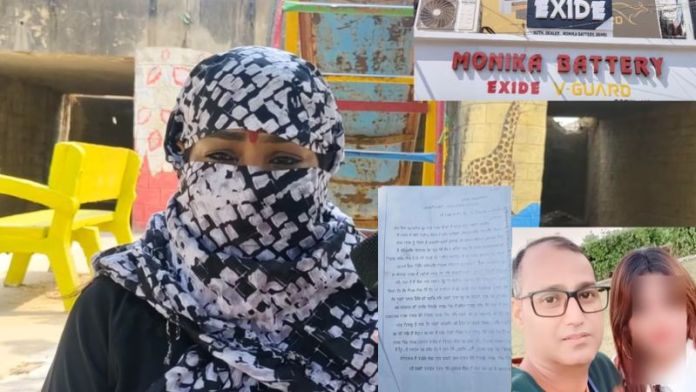
A Hindu woman from Dehri, Rohtas district, Bihar was deceived into a relationship by a Muslim man named Ali Asgar Ansari who concealed his Muslim identity, presented himself as a Hindu man named Paddu Sardar, and applied a tilak on his forehead to strengthen the deception. He subsequently subjected her to four years of sustained sexual exploitation, physical torture, blackmail, forced beef consumption attempts, forced conversion pressure, and death threats. Despite the victim possessing video and photographic evidence, Ali Asgar Ansari remained at large, with the Hindu woman alleging that police and administration were actively protecting the perpetrator. Ali Asgar Ansari first encountered the Hindu woman at a shop in Dehri, where he introduced himself as Paddu Sardar and, after gaining the trust of her husband and children, began visiting her home regularly. When she fell ill, he took her to Varanasi under the pretext of purchasing medicine, drugged her juice, rendered her unconscious, raped her, and recorded a compromising video without her consent. He used this video to blackmail her into four years of sustained sexual exploitation, also taking her to Delhi, where he assaulted her again and threatened to kill her children if she did not comply. When the Hindu woman discovered Ansari's true Muslim identity and protested, he and his brothers beat her brutally. He attempted to force her to eat beef, and when she refused, he attempted to break her teeth. He subjected her to sustained pressure to wear a burqa, wear a hijab, and convert to Islam. He burned her with cigarettes and issued explicit death threats. In February 2026, he entered her home armed with a pistol and assaulted her again. The Hindu woman had filed a complaint in 2023, but police took no concrete action. She possessed video and photographic evidence of the crimes, but alleged that police and administration were protecting Ansari, allowing him to move freely. She appealed for justice, stating that no other woman should fall into such a trap. Significant outrage was reported locally in response to the incident.
Case Images
Why it is Hate Crime ?
The primary category for this case is "Crimes against women in relationships and other sexual crimes". The sub-category for this case is "Man pretends to be Hindu". The tertiary categories here are as follows "Name changed", "Wears symbol of Hinduism" and "Raped and/or murdered after Hindu woman finds the real identity". When a non-Hindu man pretends to be a Hindu to deceive a Hindu woman into a relationship, the act is seen as triggered by malafide intentions. In some cases, the woman eventually accepts the man’s original religious identity and converts after the man’s identity is revealed. These cases could be argued as cases of religious brainwashing and a result of the pressure a woman feels after getting into a relationship with a man. The woman, it can be argued, also changed her religious identity because of the stigma she believes she might face if she chooses to walk out of a deceptive relationship. However, for the purpose of documenting hate crimes, the cases in this subcategory are limited to those where there is explicit violence aimed at religious conversion against the wishes of the victim (force-feeding beef, blackmailing with intimate videos, rape on refusal to convert, etc), or if the woman herself complains of the man’s religious deception. In such cases, it is established that the deception of the non-Hindu man had a specific aim of religious conversion or targeting of the victim due to her Hindu religious identity, therefore, making it a religiously motivated hate crime. Another subcategory this case qualifies for is "Blackmailed to convert". When Hindu women are in a relationship with non-Hindu men, there are cases where the woman is blackmailed to convert to another religion, owing to her religious identity as a Hindu. Such relationships may be consensual with the religious identity of the non-Hindu man known to the victim; however, there could be cases where the relationship is not consensual, and the non-Hindu man starts blackmailing a Hindu woman to convert her religion. In these cases, it is often seen that the Hindu woman is blackmailed with intimate photos and/or videos, threats of harm to her or her family, threats of violence etc. Such cases are driven by specific religious motivations and against the religious identity of the victim and are therefore qualified as hate crimes. One other sub-category here is "Rape for refusal to convert". When Hindu women are in a relationship with non-Hindu men, there are cases where the woman faces pressure/threats/violence to convert and change her religious identity by the non-Hindu man. Such relationships may be consensual with the religious identity of the non-Hindu man known to the victim. Somewhere along the relationship, the non-Hindu man starts pressuring the Hindu woman to convert. In some of these cases, the association could be non-consensual as well or, the religious identity of the non-Muslim man could be previously unknown to the Hindu victim. As the case may be, in such cases, the non-Hindu man forces himself sexually on the Hindu woman when she refuses his advances and pressures to convert her religion. The rape of the woman is often seen as either a punishment for the woman refusing to convert. Such cases are driven by specific religious motivations and against the religious identity of the victim and are therefore qualified as hate crimes. Another sub-category this case falls under is "Assault or threat upon refusal to convert". When Hindu women are in a relationship with non-Hindu men, there are cases where the woman faces threats or assault after she refuses to convert and change her religious identity owing to pressure/force by the non-Hindu man. Such relationships may be consensual with the religious identity of the non-Hindu man known to the victim. Somewhere along the relationship, the non-Hindu man starts pressurizing the Hindu woman to convert to Islam and upon her refusal, assaults or threatens the victim. Such cases are driven by specific religious motivations and against the religious identity of the victim and are therefore qualified as hate crimes. Cases where the Hindu woman converts to Islam and does not file a complaint about the force or threat, are not considered a part of the hate tracker, even though, it may be argued that the woman was brainwashed or threatened to convert to Islam. This case qualifies as a religiously motivated hate crime because a Muslim man concealed his identity, assumed a false Hindu persona, and used deception to target a Hindu woman. He then subjected her to prolonged sexual exploitation, blackmail, physical abuse, and coercive pressure to convert, demonstrating a sustained pattern of religiously driven targeting. The foundational act of this predatory operation was Ansari's deliberate assumption of the false Hindu name Paddu Sardar and the wearing of tilak on his forehead to present himself as a Hindu man. In Hindu society, religious identity carries profound significance in determining the boundaries of trust and intimacy, and a woman's willingness to allow a man into her home and family is deeply shaped by his perceived religious identity. By presenting himself as a Hindu man through a false name and sacred Hindu religious symbols, Ansari deliberately bypassed the Hindu woman's faith-based boundaries and those of her entire family, creating a false sense of shared identity and trust that formed the foundation of the entire predatory operation. The wearing of a tilak by a Muslim man specifically to deceive a Hindu woman and her family reflected a conscious and calculated act of desecration of one of Hinduism's most sacred and personally significant religious identity markers. The grooming operation carried out by Ansari was systematic and calculated. Rather than targeting the Hindu woman directly, he first gained the trust of her husband and children, embedding himself within the family unit before exploiting her vulnerability during illness to take her to Varanasi under false pretences. This deliberate strategy of family-level infiltration reflected a premeditated and patient approach to grooming designed to maximise his access to the Hindu woman whilst minimising any possibility of family resistance or intervention. The drugging and rape of the Hindu woman in Varanasi, combined with the non-consensual recording of the assault, transformed a single act of violence into a permanent instrument of sustained blackmail and control. By using the recorded footage as a tool of blackmail, Ansari converted the initial rape into a four-year campaign of sustained sexual exploitation, using the threat of releasing the footage to maintain complete psychological and physical control over the Hindu woman. The extension of this exploitation to Delhi, where he assaulted her again and threatened to kill her children, reflected a deliberate strategy of maximising the geographic and psychological dimensions of the Hindu woman's entrapment. Another important religious marker here is that the accused forced her to consume beef and follow Islamic practices like wearing a burqa and performing namaz. Forcing a Hindu to consume beef is not only a profound disrespect to their religious beliefs but also constitutes a religiously motivated hate crime. In Hinduism, cows are revered as sacred animals, symbolising life and sustenance, and the act of consuming beef is considered highly sacrilegious by many Hindus. Therefore, compelling a Hindu to eat beef goes beyond mere dietary imposition; it is an intentional violation of their religious principles and an assault on their cultural and spiritual identity. In the broader context of hate crimes, forcing someone to engage in behaviour that is expressly forbidden or offensive in their religion is a clear manifestation of religious intolerance. It demonstrates a blatant disregard for the victim's rights to practice their faith freely. Here, the actions of the perpetrator clearly point towards the deep disdain he harboured for Hindus and their religious beliefs. It is evident that the perpetrator targeted the victim because of her religious identity and that his motivation was driven by religious hate. Further, when the Hindu woman discovered Ansari's true Muslim identity and protested, the nature of the violence directed at her escalated dramatically and immediately. He and his brothers beat her brutally, burned her with cigarettes, and issued explicit death threats. In February 2026, he entered her home armed with a pistol and assaulted her again. The immediate and sustained escalation to extreme physical violence upon the discovery of his true identity confirmed that the violence was not incidental but a deliberate and premeditated response to her resistance to his conversion demands, reflecting a conscious strategy of using physical terror as the ultimate instrument of religious coercion. The sustained pattern of rape, physical assault, and armed assault directed at the Hindu woman, specifically in response to her discovery of Ansari's true identity and her resistance to his conversion demands, reflected a documented and escalating pattern of sexual violence used as an instrument of religious coercion. The four-year duration of the sexual exploitation, combined with the escalation to armed assault in February 2026, confirmed the organised and sustained nature of the predatory operation directed at the Hindu woman and the depth of Ansari's commitment to maintaining control over her through any means necessary. Given that this case met the parameters of a religiously motivated hate crime, it was added to the hate crime database of the Hinduphobia tracker. Disclaimer: The Hinduphobia Tracker records incident dates based on when a crime occurred, or a victim's ordeal began, rather than when the media reported it. In this case, the exact date on which Ali Asgar Ansari first made contact with the Hindu woman and began grooming her is not confirmed in the sources. The article was published on March 24, 2026, and the sources confirm that the grooming and sexual exploitation began approximately four years prior to publication. Therefore, March 24, 2022, has been chosen as the indicative incident date as it represents the approximate date on which the Hindu woman's ordeal began, based on the four-year period of grooming and sexual exploitation confirmed in the sources. It is important to note that the most recent assault took place in February 2026, confirming that the ordeal was ongoing at the time of publication and had not been resolved despite the Hindu woman having filed a complaint in 2023. This was recorded for documentation purposes only.
Victim Details
Total Victim
1
Deceased
0
Gender
- Male 0
- Female 1
- Third Gender 0
- Unknown 0
Caste
- SC/ST 0
- OBC 0
- General 0
- Unknown 1
Age Group
- Minor 0
- Adult 1
- Senior Citizen 0
- Unknown 0


Case Status
Complaint filed


Perpetrators Details
Perpetrators
Muslim Extremists
Perpetrators Range
One Person
Perpetrators Gender
male
 Sources




