Celebration of Hindu festival 'Ram Navami' curtailed; devotees subjected to administrative restrictions violating their rights in Sitamarhi, Bihar
 Sitamarhi, Bihar, India
  26 March, 2026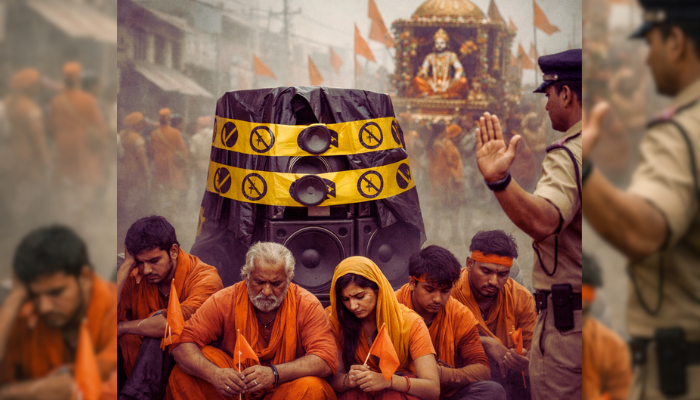
Case Summary
In the Sitamarhi district of Bihar, under the Belsand police station area, Hindus were curtailed in celebration of the Hindu festival by the State administration. As per reports, Hindu devotees preparing for Ram Navami and Chaiti Durga Puja were subjected to administrative restrictions during a meeting held at the police station. The meeting was chaired by Station House Officer Jango Ram, where members of both communities and local representatives were present, and directions were issued regarding the conduct of the religious events. In the meeting, the Hindu devotees organising Ram Navami processions were directed not to play DJ music during the religious procession. The administration imposed a complete ban on the use of DJs during the event. Further, Hindu organisers were instructed to strictly follow a pre-determined route chart for taking out the Ram Navami procession. They were warned that any deviation from the prescribed route would invite action. The directions were issued in the presence of officials and members of both communities, with the stated aim of maintaining law and order during the festival. Additionally, the administration deployed police forces, including patrolling vehicles and magistrates, to monitor the processions and ensure compliance with the imposed conditions.
Why it is Hate Crime ?
This case is being added to the tracker under the primary category- Restriction/ban on Hindu practices. The subcategory selected is- Administration restricting religious practice. In several cases, it is seen that the administration/state disallows a religious practice owing to prejudicial orders and concerns, targeted specifically against the Hindu community. Such restriction/prohibition would be considered documented as a hate crime because the orders are often a result of pressure by groups that harbour animosity towards Hinduism and Hindus. Often, the restriction by the authorities is driven by bias, hostility, or prejudice against the specific community being stopped from holding a religious practice, by pressure groups that harbour animosity towards Hindus, intrinsic to their faith. Since practices are intrinsic to the faith of the Hindus, such prejudicial restriction is considered a curtailing of the fundamental rights of the Hindu community. In several cases, for example, the authorities ban a Hindu religious practice due to pressure from groups opposed to the religion. In other instances, the prohibition is selectively enforced against one religious group (Hindus) while others are allowed to proceed. There are still other cases where the authorities preemptively restrict a religious practice by Hindus because those who hold animosity towards Hindus may get “provoked”, leading to them being violent, thereby assuaging the sentiments of those who hold animosity towards Hindus by curtailing the religious rights of Hindus. Such acts and orders are prejudiced, indicating discriminatory motives owing to the capitulation to groups that harbour animosity towards Hindus and therefore, would be categorised as a religiously motivated hate crime since the original pressure leading to the order itself is a result of hatred/bias/prejudice/religious hate against Hindus. The other sub-category is- Restriction on the expression of Hindu identity. An example of the state-affected prejudicial and targeted orders against the Hindu community would be a government denying the right of a Hindu or a group of Hindus to hold a religious procession owing to the animosity of non-Hindu groups. Denial of the religious right of the Hindus to assuage the non-Hindu group, which harbours animosity to a point where it could lead to violence against Hindus, is not only a failure of law and order but is a prejudicial order against Hindus, denying them their fundamental rights to express their religious identity. An example of a hate crime against Hindus by a non-Hindu would be a non-Hindu institution forcing its Hindu employees to abandon religious symbols that a Hindu would wear as an expression of faith owing to inherent prejudice against the faith professed by the victim or a non-Hindu group of people restricting a Hindu group from constructing a place of worship simply because the demography of the area in which the temple is being built is dominated by non-Hindus. Such actions are driven by religious animosity and/or prejudice against Hindus and their faith and would therefore be categorised as a hate crime. This case has been recorded as a hate crime under institutional discrimination as it involves administrative actions that selectively restrict Hindu religious expression during a major festival. Hindu devotees were subjected to restrictions while preparing to celebrate Ram Navami and Chaiti Durga Puja. The imposition of conditions such as banning DJs, restricting procession routes, or imposing additional procedural hurdles on Ram Navami celebrations reflects a pattern in which Hindu religious practices are subjected to heightened scrutiny and control. Public religious processions form an integral part of Hindu festivals such as Ram Navami, where devotees take out shobhayatras, play devotional music, and celebrate collectively in public spaces. These practices are not incidental but central to the expression of faith. When administrative authorities impose restrictive conditions specifically on such practices, it directly interferes with the ability of Hindus to freely and fully observe their religion. A key concern in such cases is the selective nature of these restrictions. The rationale often cited for these diktats is the need to maintain law and order or to avoid “provocation” of a particular community. However, this effectively places the burden of maintaining peace on Hindu devotees alone, requiring them to curtail their religious expression in anticipation of potential reactions from others. Such an approach shifts responsibility away from those who may pose a threat of disruption and instead penalises those engaging in lawful religious practices. This creates a situation where Hindus are compelled to modify or dilute their religious observances not because their actions are inherently unlawful, but because of the perceived sensitivities of another group. The repeated use of such reasoning reflects a form of administrative appeasement, in which restrictions are imposed pre-emptively on one community rather than ensuring equal enforcement of the law and protection for all. The impact of these measures goes beyond individual events. When Hindu festivals are routinely subjected to conditions, route limitations, or bans on customary practices, it fosters a perception of unequal treatment under the law. If similar restrictions are not applied uniformly across all religious gatherings, it raises concerns about bias and selective enforcement. Over time, such patterns can normalise the curtailment of Hindu religious expression in public spaces. Furthermore, regulating the routes of processions, especially when they involve traditional or historically established paths, disrupts longstanding cultural practices and community traditions. These routes often carry historical and religious significance, and altering them under pressure or precaution undermines the continuity of religious customs. Taken together, the selective imposition of restrictions on Hindu festivals, the justification for them based on avoiding reactions from another community, and the absence of equivalent constraints in other contexts demonstrate a pattern of differential treatment. Such actions reflect an institutional bias that disproportionately affects Hindus and limits their ability to practice their religion freely and equally. Accordingly, this case displays clear markers of discriminatory restriction on Hindu religious practices and has been recorded in the Hinduphobia Tracker database. Disclaimer: The Hinduphobia Tracker recorded the perpetrator count as one (1) in this case, including only the Station House Officer, Jango Ram, as the official responsible for issuing the administrative order that banned the use of DJs in the Ram Navami procession. The Hinduphobia Tracker records incident dates based on when the victim's ordeal began, rather than when the media reported it. In this case, the report does not mention the meeting date; therefore, the publication date has been recorded as the indicative incident date for documentation purposes.


Case Status
Unknown


Perpetrators Details
Perpetrators
State and Establishment
Perpetrators Range
One Person
Perpetrators Gender
male
 Sources




