Hindu religious procession celebrating Ram Navami obstructed, DJ forcibly stopped by Muslim men in Garhwa, Jharkhand
 Garhwa, Jharkhand, India
  26 March, 2026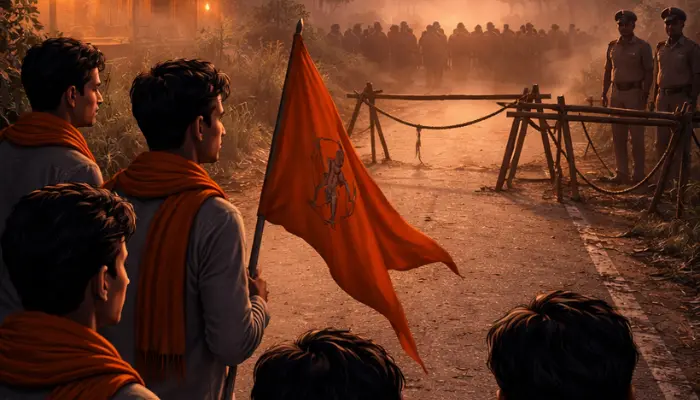
Case Summary
In the Garhwa district of Jharkhand, under the Ramkanda police station area, the celebration of the Hindu festival was obstructed by Muslim men. The Hindus, Ram devotees, were celebrating by taking out a Ram Navami religious procession, which was stopped by Muslim men. According to reports, Hindu men were prevented from proceeding and taking out their religious procession. The Muslim men even stopped the DJ from playing in the procession. Angered by the event, the Hindus staged a protest by blocking the road. The obstruction led to a confrontation between Hindu men and Muslim men at the spot. As the protest intensified, clashes broke out between the two groups, leading to a law-and-order situation in the area. The incident created tension in the locality, with both sides engaging in heated exchanges. Police and administrative officials arrived at the scene to control the situation and prevent further escalation. Efforts were made to disperse the crowd and restore normalcy. Authorities deployed additional police forces as a precautionary measure and took steps to ensure the situation remained under control.
Why it is Hate Crime ?
The primary category for this case is "Attack not resulting in death". The sub-category for this case is "Attack on religious procession". The outward celebration and display of religious symbols is an intrinsic part of Hinduism. Religious processions on various festivals are age-old traditions and a way to manifest faith and form a part of the religious practices of Hindus. On several occasions, such religious processions come under attack by non-Hindu mobs, in a manifestation of their animosity towards Hinduism and its practices. The reasons cited for such violent attacks are many and range from crossing a non-Hindu resident-dominated area to playing loud music, crossing from an area where there is a religious structure of another faith, etc. The violent attacks are triggered by the outward display of religiosity by Hindus. The attacks are mainly a manifestation of religious supremacist doctrine, which believes that idolatry, essentially the Hindu faith, deserves to be annihilated since the very tenets of Hinduism, its practices and traditions, are considered a sin in those doctrines. Since these attacks emanate from intrinsic and doctrinal animosity towards Hindus and Hinduism, it is considered a religiously motivated hate crime under this category. The other subcategory is: "Attack against Hindu devotees". Hindu devotees are a few of the easiest targets of religiously motivated hate crimes because, during the festival/procession/puja, etc., for non-Hindus, it is easy to profile their victims based on religion. Hindu devotees come under attack on several occasions by individual non-Hindus or mobs of non-Hindus owing to their animosity against Hinduism, its symbols and tradition/practices. There are several instances of Hindu devotees being attacked while they worship in temples or temporary religious structures, during religious processions, doing bhajan/kirtan/puja in their own homes, in the residential society, etc. These attacks are perpetrated by non-Hindus primarily because of their animosity towards Hindus and their faith. In some cases, the trigger for the violence may be non-religious; however, two elements make these hate crimes. First, the Hindus who come under attack are attacked violently while indulging in religious activity. Whether they are in a place of worship or not is immaterial to the crime. When individuals are attacked while indulging in religious practices, the attack in itself is a hindrance to their freedom to practice religion and therefore constitutes a hate crime. Secondly, religious supremacist doctrines and ideologies deem religious practices of Hindus to be offensive ab initio since they are considered “sinful” by these ideologies, worthy to be annihilated by force or coercion. Driven by these religious supremacist ideologies and doctrines, the attacks against Hindu devotees stem from intrinsic animosity towards Hinduism. In some cases, the trigger for the violence may be non-religious; however, it develops into a religiously motivated crime during the course of the violence. Since these attacks stem from animosity towards Hindus and Hinduism, they are considered religiously motivated hate crimes under this category. The other subcategory selected is- Communal Clash/Attack. Communal clash is a form of collective violence involving conflicts between groups with different religious identities. For a communal clash between Hindus and non-Hindus to qualify as a religiously motivated hate crime, the trigger of the violence itself would have to be anti-Hindu in essence. For example, if there is a Hindu religious procession that comes under attack from a non-Hindu mob and after the initial attack, Hindus retaliate in self-defence, leading to a communal clash between the two religious communities. While at a later stage, both communities are involved in the clash/violence, the initial trigger of the violence was by the non-Hindu mob against the Hindus, and therefore, it could safely be termed as an anti-Hindu violence. Further, the trigger would also have to be religiously motivated. In the cited example, the attack by the non-Hindu mob was against religious processions and therefore can be concluded to be religiously motivated. In some cases, the trigger may be non-religious; however, it develops into religious violence against Hindus at a later stage. In such cases, too, the foundational animosity towards Hindus becomes the motivating factor of the crime, and therefore, it would be classified as a religiously motivated hate crime against Hindus under this category. This case constituted a clear instance of a religiously motivated hate crime, as Hindu devotees were stopped while carrying out a religious activity. The trigger of the incident lay in the very act of practising and expressing their faith in public. The obstruction was not incidental; it directly targeted a religious procession, which is an integral and age-old form of Hindu worship. Further, preventing the devotees from proceeding amounted to direct interference with their religious practice. Hindu processions are not merely gatherings but expressions of devotion, identity, and collective faith. By halting their movement, the accused effectively curtailed their ability to practise religion freely, striking at the core of their religious rights. Moreover, the escalation into confrontation and violence reinforced the targeted nature of the act. What began as an obstruction soon turned into clashes, indicating that the initial act was not a momentary disagreement but rather one rooted in underlying hostility. The fact that Hindu men were attacked while engaged in a religious activity made them identifiable and vulnerable targets, thereby deepening the gravity of the offence. Importantly, such incidents often follow a pattern where the outward display of Hindu faith becomes the point of provocation. It is important to mention here that no such act was done by the devotees to provoke the Muslim men, but just the procession itself, the act of Hindus celebrating their festival, acts as a provocation. The visibility of the procession, the collective assertion of identity, and the religious symbolism associated with it are frequently met with resistance. This reflects a deeper intolerance towards Hindu practices, where their public expression is treated as something to be curtailed. Additionally, the incident also reflected a restriction on the expression of Hindu identity. The devotees were not allowed to continue their religious activities, thereby limiting their right to openly manifest their faith. This was not a neutral act of crowd control but a targeted obstruction that prevented Hindus from practising their traditions in their natural form. From a constitutional perspective, this incident took on greater significance. Article 25 of the Constitution of India guarantees every citizen the right to freely profess, practise, and propagate their religion. The obstruction of a peaceful religious procession directly undermined this fundamental right, reducing it from a guaranteed freedom to a conditional exercise subject to interference. Further, while the situation later escalated into a clash between the two sides, the conflict's origins remained crucial. The initial act of stopping Hindu devotees during a religious activity set the chain of events in motion. Even if there was subsequent retaliation, the foundational trigger was an act directed against Hindus and their religious practice. Taken together, the deliberate obstruction of a Hindu religious procession, the targeting of devotees during worship, and the resulting violence established a clear pattern of hostility towards Hindu practices. The incident, therefore, qualified as a religiously motivated hate crime, as it infringed upon both the physical safety of devotees and their fundamental right to practise and express their faith. Disclaimer: The Hinduphobia Tracker records incident dates based on when the victim's ordeal began, rather than when the media reported it. In this case, the report does not mention the date the procession was stopped; therefore, the publication date has been recorded as the indicative incident date for documentation purposes.


Case Status
Unknown


Perpetrators Details
Perpetrators
Muslim Extremists
Perpetrators Range
Unknown
Perpetrators Gender
unknown
 Sources




