Hindu woman lured and abducted; family abused with casteist slurs by Muslim men in Kannauj, Uttar Pradesh
 Kannauj, Uttar Pradesh, India
  22 March, 2026
Case Summary
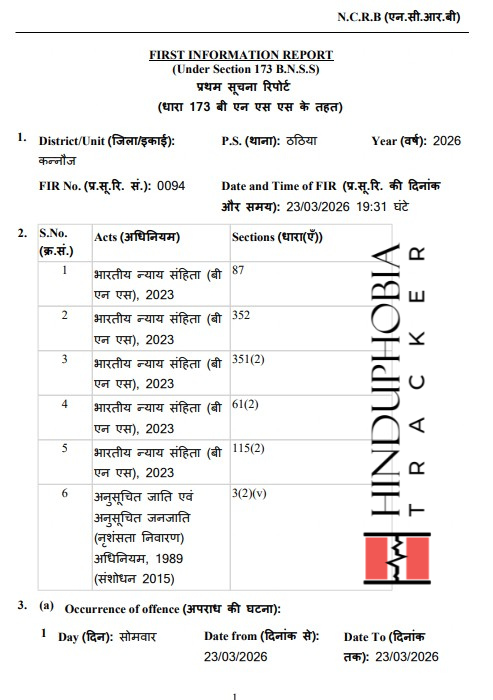
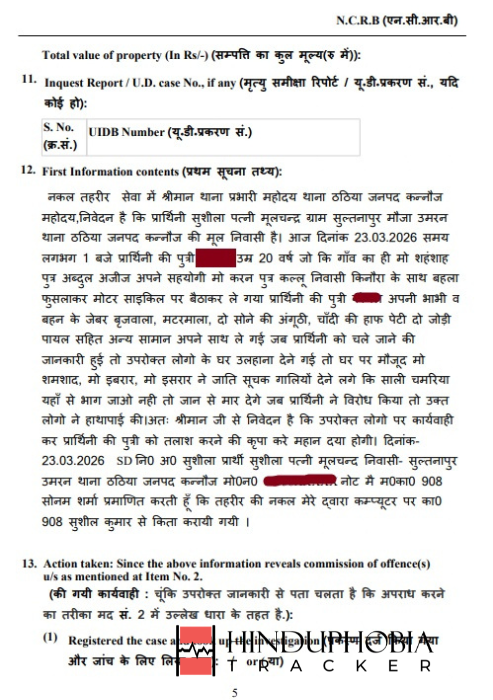
In Kannauj district, under the Thathiya police station area, a 20-year-old Hindu girl was lured and abducted by a Muslim man. Upon complaint, the Hindu family was assaulted and abused with casteist slurs by the Muslim family. According to the written complaint submitted by the victim’s mother, on Monday afternoon, 23 March 2026, the accused, identified as Mohd. Shahenshah, son of Abdul Aziz, a resident of Sultanapur, along with his associate Mohd. Karan, son of Kallu, a resident of Kinaura, had lured the woman and taken her away on a motorcycle. It was further stated that the woman had carried with her valuables kept at home, including jewellery such as a necklace (brijwala), matar mala, two gold rings, a silver waist chain, and two pairs of anklets, among other items. When the complainant went to the accused persons’ house to inquire about her daughter, she stated that individuals present there, namely Mohd. Shamshad, Mohd. Ibrar and Mohd. Israr had misbehaved with her. They had used caste-based abusive language, issued death threats, and assaulted her when she protested. Based on the complaint, the police had registered a case against the named accused under relevant sections and had initiated an investigation. A police team had been formed to recover the woman and arrest the accused.
Case Images
Why it is Hate Crime ?
The primary category selected here is- Hate speech against Hindus. The selected subcategory is - Anti-Hindu slurs, mocking faith. Anti-Hindu slurs and the deliberate mocking of the Hindu faith owing to religious animosity involve the usage of derogatory terms, stereotypes, or offensive references to religious practices, symbols, or figures. One of the common anti-Hindu slurs used against Hindus is “cow-worshipper” and “cow piss drinker”. The intention of using this term is to demean and mock Hindus as a group and their religious beliefs since Hindus consider the cow holy. Additionally, some symbols and the slurs attached to them have a historical context that exacerbates the insult, hate, stereotyping, dehumanisation and oppression against Hindus. Cow worship has been used for centuries to denigrate Hindus, insult their faith and oppress Hindus specifically as a religious group. There has been overwhelming documentation about how cow slaughter has been used to persecute Hindus, with cow meat being thrown in temples and places of worship. There has also been overwhelming documentation where cow meat (beef) has been force-fed to Hindus to either forcefully convert them to Islam or denigrate their faith. Apart from cow worship, the Swastika – which holds deep religious significance for the Hindus – has also been misinterpreted and distorted to use as a slur against Hindus. Similarly, the worship of the Shivling has been used by supremacist ideologies and religions to denigrate Hindus owing to religious animosity. Such slurs and denigration stem from inherent animosity and hate towards Hindus and their faith; therefore, it is categorised as hate speech targeted at Hindus specifically owing to their religious identity. The other category selected is- Attack not resulting in death, and within this, the subcategory selected is- Attacked for opposing radicals or trying to save victim. In several cases, Hindus are attacked for opposing religiously motivated crimes being committed against a fellow Hindu or simply for voicing an opinion opposing radical elements, who either have in the past or continue to persecute Hindus. In such cases, the initial attack against the victim, against which the Hindu was trying to defend the victim, would also need to be classified as a religiously motivated hate crime. Since the initial crime itself was religiously motivated and the subsequent crime of attempting to save the victim or speaking against the radical elements ends up inviting a violent attack, it would also be classified as a religiously motivated hate crime under this category. This case presents elements that require careful distinction between individual agency and targeted hostility. The woman at the centre of the incident was an adult, approximately 20 years old, and therefore legally and mentally capable of making her own decisions regarding relationships and movement. In the absence of clear evidence of coercion or deception directed at her, her departure cannot be conclusively categorised as a hate crime in itself. However, the events that followed, particularly the treatment of her family, display clear indicators of religiously motivated hostility. When the victim’s mother approached the accused individuals’ residence to inquire about her daughter, she was subjected to physical assault, caste-based abuse, and death threats. The use of casteist slurs in this context is significant, as it reflects not merely personal hostility but an attempt to demean and target the family’s Hindu identity and social background. Many might argue that a caste-specific slur in this instance targeted her caste-specific identity and not her Hindu identity as a whole. However, it was important to consider that, as far as Abrahamic religions were concerned, the micro-identities of caste, region, and language remained secondary, and it was the broader religious identity of the victim that often drove animosity. Such behaviour reflects a pattern in which, even if the initial relationship may involve individual choice, the surrounding actions reveal an underlying communal animosity. The targeting of the family through abuse rooted in caste and identity transforms the nature of the incident, as it introduces a clear element of hostility directed at Hindus as a group rather than a purely interpersonal dispute. Moreover, the family was also assaulted, and death threats were directed at them. This escalation from a personal matter to violence against the family demonstrates that the hostility was not limited to the relationship between two individuals but extended to the broader Hindu family unit. The response of the accused and their associates, involving intimidation, abuse, and physical assault, indicates an assertion of dominance and an attempt to silence or deter the family from seeking accountability. Therefore, while the woman’s actions as an adult do not, in isolation, meet the threshold for classification as a hate crime, the subsequent assault, threats, and caste-based abuse directed at her family demonstrate religiously motivated aggression. These actions establish that the incident, in its broader context, carries markers of identity-based hostility and intimidation. Accordingly, the case reflects elements of targeted hostility against Hindus, specifically through the abuse and assault of the victim’s family, and is assessed within that framework in the Hinduphobia Tracker database. Disclaimer: Media reports stated that the Hindu victim and her family were targeted by Muslim perpetrators; however, the total number of victims was not specified. Only two victims, the Hindu girl and her mother, were specified. Therefore, the victim count was recorded as two (2). This is a conservative estimate, as the total number of victims could be higher.
Victim Details
Total Victim
2
Deceased
0
Gender
- Male 0
- Female 2
- Third Gender 0
- Unknown 0
Caste
- SC/ST 2
- OBC 0
- General 0
- Unknown 0
Age Group
- Minor 0
- Adult 2
- Senior Citizen 0
- Unknown 0


Case Status
Complaint filed


Perpetrators Details
Perpetrators
Muslim Extremists
Perpetrators Range
From 2 To 5
Perpetrators Gender
male
 Sources




