Vulnerable Hindus targeted; lured, induced, brainwashed by American evangelical preacher for conversion to Christianity in remote areas in India
 Anantapur, Andhra Pradesh, India
  31 December, 2008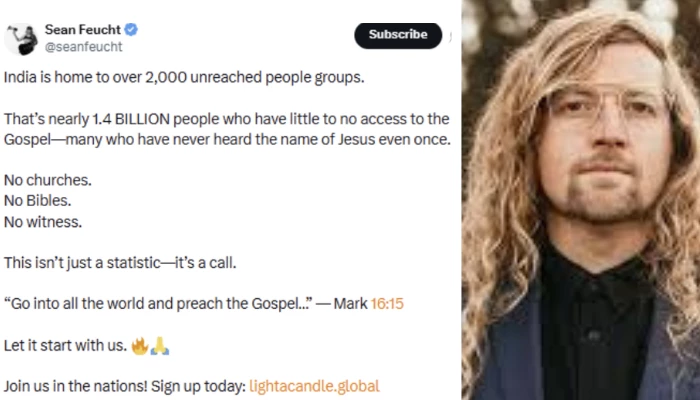
Case Summary
Poor and economically vulnerable Hindus were targeted and induced to convert to Christianity by American evangelical preacher Sean Feucht. He had built an international religious network to spread Christianity across multiple countries, including India, with a clear focus on conversion. Sean Feucht visited India and dedicated the “Zion Centre”, a three-storey facility comprising a community hub and an underground church. The facility was located on Settur Road in Kalyandurgam Municipality in Andhra Pradesh’s Anantapur district. He took to X on March 21 to share a video of the opening day, in which he was seen attending what appears to be a ribbon-cutting ceremony, dressed in Indian attire and holding a Bible in one hand. He was associated with the “Let Us Worship” movement, through which he organised large-scale religious gatherings, concerts, and prayer events globally. These events were presented as worship programmes but were used to expand evangelical outreach. His network operated through a combination of religious events, music-led gatherings, and digital outreach, creating a global platform to influence audiences and encourage religious conversion. His activities were concentrated on multiple regions, including India, where outreach was directed towards local Hindu populations. As per reports, the missionary couple, Sean Feucht and his wife, associated with the conversion activities, stated that they had been engaged in Christian conversion efforts in India for over a decade. Sean Feucht publicly stated, “India is home to over 2,000 unreached people groups. That’s nearly 1.4 BILLION people who have little to no access to the Gospel—many who have never heard the name of Jesus even once. No churches. No Bibles. No witness. This isn’t just a statistic—it’s a call. ‘Go into all the world and preach the Gospel…’ — Mark 16:15 Let it start with us.” These initiatives were supported by organised structures and funding mechanisms, enabling sustained evangelical campaigns. The outreach model combined physical events with online engagement, allowing the network to expand its reach and maintain continuous contact with followers. India was one of the key focus areas of these efforts, with organised religious programmes and outreach activities directed towards Hindu communities as part of a broader attempt to influence religious beliefs and facilitate conversion. Sean Feucht’s actions included inaugurating the Zion Centre, conducting large public Christian worship events, performing rituals such as anointing doors, and openly speaking about plans to convert over 2,000 unreached groups to Christianity. These activities were documented and shared publicly on social media platforms. Thus, Feucht was on a tourist and he breached the visa conditions. Amid outrage over him and the Ministry of Home Affairs, and amid a legal case, Sean Feucht and his wife, Kate, left India.
Why it is Hate Crime ?
This case has been added to the tracker under the primary category of Predatory Proselytisation. Within it, the sub-category selected is- Conversion/ attempts to convert by inducement. Predatory Proselytisation is not just limited to threat, harassment, force and violence, but it also has contours of stealth. In several cases, the Hindu victim is exploited to convert, with non-Hindus taking advantage of their poverty. In such cases, the Hindu victim who is suffering financially is offered monetary benefits, including lucrative offers for jobs, health treatment, education, etc, to induce the victim into changing his/her religion. In such cases, the religious identity of the victim and the aim to disenfranchise him from his faith form the heart of the crime. Also, taking advantage of and exploiting an individual’s economic vulnerabilities is widely acknowledged as exploitation, forms of which are often penalised by law. Such cases, therefore, are considered religiously motivated hate crimes since the victim’s religious identity forms the very heart of the crime itself. The other selected sub-category is Predatory Proselytisation. Within it, the sub-category selected is- Proselytisation by grooming, brainwashing, manipulation or subtle indoctrination. The tertiary category selected within it is - Pattern of targeting Hindus, Conversion of minors Religious brainwashing essentially means the often subtle and forcible indoctrination to induce someone to give up their religious beliefs to accept contrasting, regimented ideas. Religious grooming or brainwashing also involves propaganda and manipulation. It involves the systematic effort, driven by religious malice and indoctrination, to persuade “non-believers’ to accept allegiance, command, or doctrine to and of a contrasting faith. Cases of such grooming or brainwashing are far more nuanced than direct threats, coercion, inducement and violence. In such cases, it is often seen that there is repeated, subtle and continual manipulation of the victim to induce disaffection towards their own faith and acceptance of the contrasting faith of the perpetrator. While subtle indoctrination is widely acknowledged as predatory, an element which is often understated in such conversions or the attempts of such conversion is the role of loyalty and trust which might develop between the perpetrator and the victim. Fiduciary relationships are often abused to affect such religious conversion. For example, an educator transmitting religious doctrine of a competing faith to a Hindu student. The Hindu student is likely to accept what the teacher is transmitting owing to the existence of the fiduciary relationship. The exploitation of the fiduciary relationship to religiously indoctrinate victims would also be included in this category. Since the underlying animosity towards the victim’s faith forms the basis of predatory proselytisation, such cases are considered religiously motivated hate crimes. This case was added to the tracker because poor and economically vulnerable Hindus were deliberately targeted through organised evangelical activities and structured outreach aimed at inducing conversion. The actions were not incidental or random; they reflected a coordinated effort to influence a specific religious community, the Hindu community. Firstly, the trigger lay in the religious identity of the victims. The outreach was directed towards Hindus, particularly those living in remote and less accessible areas where economic hardship was more pronounced. These were not affluent or secure populations. They were communities with limited resources and exposure, making them more susceptible to external influence. Their identity as Hindus, combined with their vulnerability, made them the primary targets. Secondly, the approach adopted was calculated and layered. Large gatherings, music-led events, and community programmes were used as entry points. These were not neutral religious interactions. They were structured platforms designed to attract attention, build trust, and gradually introduce ideological influence. By presenting these events as worship or community support, the process masked its underlying objective of conversion. Thirdly, the establishment of infrastructure such as the Zion Centre reflected a long-term strategy. This was not a one-time interaction but the creation of a permanent base to sustain outreach. Setting up such facilities in areas with Hindu populations ensured continuous engagement and influence. It allowed the process of persuasion to move from occasional contact to regular and embedded presence within the community. Furthermore, the accused boasted with pride that he had converted a large number of minors. The fact that the victims were minors is a critical aggravating factor. By definition, a minor lacks the legal and psychological capacity to give informed consent, particularly in matters involving religious change, relationships or cohabitation. This means that any claim of voluntary involvement or genuine change of belief is invalid from the outset. Legally, a minor's consent is no consent; it's void ab initio. The minors, due to their young age and lack of maturity, are particularly vulnerable to manipulation and coercion. They may not have the ability to fully understand the implications of converting to another religion, and the Christian perpetrator in this case deliberately exploited this vulnerability. The targeting of a minor, therefore, demonstrates a heightened level of predation, where the victims were chosen precisely because they were easier to influence and control. Moreover, the explicit focus on “unreached groups” revealed the intent behind the outreach. These were populations identified precisely because they had limited access to alternative perspectives and were deeply rooted in their traditional faith. Targeting such groups was not about offering choice; it was about entering spaces where resistance would be minimal, and influence could be maximised. This showed a deliberate strategy of approaching Hindus in remote areas where social and economic vulnerabilities could be leveraged. Additionally, the use of organised networks, funding, and digital amplification demonstrated that this was not an isolated effort. It was part of a wider, sustained campaign. The combination of on-ground presence and online outreach ensured that messaging remained consistent and persistent. This continuity increased the likelihood of gradual influence, especially among those already facing hardship. Further, the narrative employed framed large sections of the Indian Hindu population as lacking access to the Gospel, portraying them as subjects for conversion. This language did not recognise the existing religious identity of the Hindu communities but instead positioned them as targets to be reached and transformed. Such framing reduced individuals to numbers in a larger mission, overlooking their cultural and religious roots. The Christian faith, by its very theological foundations, places a strong emphasis on proselytisation. In pursuit of conversion objectives, Christian evangelists often employ unethical means, ranging from psychological pressure and misinformation to inducements such as money or jobs. This systematic attempt to erode the religious foundation of individuals and replace it with allegiance to another faith reflects deep religious malice and animus against the Hindu identity. Finally, inducing vulnerable Hindus to move away from their faith through sustained influence, emotional appeal, and structural presence amounted to a direct interference with their religious identity. The imbalance of power between an organised, well-funded network and economically weak individuals compromised genuine choice. What appeared as outreach was, in effect, a systematic attempt to alter belief by leveraging vulnerability. Notably, the accused had been carrying out such activities repeatedly over a long period, with instances tracing back to 2009. This was not an isolated or sporadic effort, but a prolonged and systematic campaign. Taken together, these elements showed a clear and sustained pattern of targeted engagement, exploitation of economic and social vulnerabilities, and deliberate attempts to influence religious identity. Disclaimer: It is important to note that none of the media reports on this case mentioned the exact date of the first conversion, but the accused arrived in India in 2009. Therefore, to document this case, we have chosen a date, 1 January 2009, which is not accurate but only indicative of the year. Disclaimer: The Hinduphobia Tracker records incidents based on the location where the core activity or event occurred. In this case, Andhra Pradesh has been selected as the primary location because the inauguration of the “Zion Centre” and the associated religious outreach activities were carried out in Kalyandurgam Municipality in Anantapur district. While the broader evangelical network operated across multiple regions and countries, the on-ground execution of the activities described in this case occurred in Andhra Pradesh, making it the appropriate geographic classification for this entry.


Case Status
Complaint filed


Perpetrators Details
Perpetrators
Christian Extremists
Perpetrators Range
From 2 To 5
Perpetrators Gender
both
 Sources




