Hindu festivities curtailed with blanket ban on DJ's and restrictive condition imposed on Hindu devotees by Police administration in Chaibasa, Jharkhand
 Chaibasa, Jharkhand, India
  23 March, 2026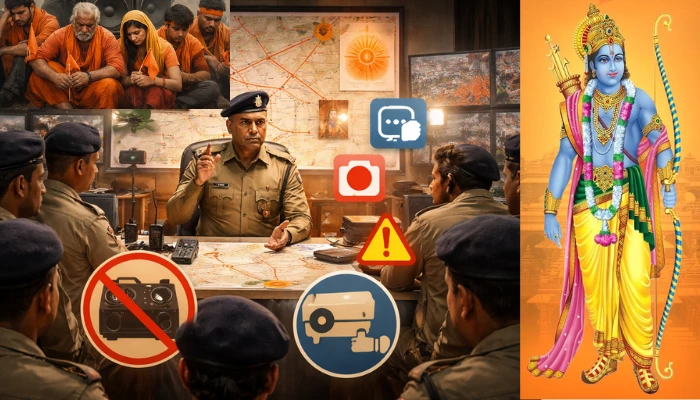
Case Summary
In the Seraikela-Kharsawan district of Jharkhand, Hindu festival celebrations were curtailed by the district administration ahead of the Ram Navami and Chaiti Chhath festivals. The administration banned the DJ and imposed severe conditions on Hindu processions and gatherings. As per the report, Superintendent of Police Mukesh Kumar Lunayat issued clear instructions that the use of DJ systems during Ram Navami processions would be completely prohibited. The Hindu devotees and organisers were directed to strictly follow the routes prescribed by the administration, with no deviation permitted under any circumstances. The authorities warned that any negligence or violation of the rules would invite immediate legal action against the individuals concerned. The administration emphasised strict enforcement of the guidelines to ensure compliance during the processions. Additionally, measures were put in place to monitor and control information flow, with instructions for 24-hour surveillance of social media platforms to prevent the spread of rumours or misleading content. Strict action was warned against those attempting to disturb communal harmony. The administration also planned the deployment of additional police forces in sensitive areas and ensured continuous patrolling at key locations to prevent any untoward incidents.
Why it is Hate Crime ?
This case is being added to the tracker under the primary category- Restriction/ban on Hindu practices. The subcategory selected is- Administration restricting religious practice. In several cases, it is seen that the administration/state disallows a religious practice owing to prejudicial orders and concerns, targeted specifically against the Hindu community. Such restriction/prohibition would be considered documented as a hate crime because the orders are often a result of pressure by groups that harbour animosity towards Hinduism and Hindus. Often, the restriction by the authorities is driven by bias, hostility, or prejudice against the specific community being stopped from holding a religious practice, by pressure groups that harbour animosity towards Hindus, intrinsic to their faith. Since practices are intrinsic to the faith of the Hindus, such prejudicial restriction is considered a curtailing of the fundamental rights of the Hindu community. In several cases, for example, the authorities ban a Hindu religious practice due to pressure from groups opposed to the religion. In other instances, the prohibition is selectively enforced against one religious group (Hindus) while others are allowed to proceed. There are still other cases where the authorities preemptively restrict a religious practice by Hindus because those who hold animosity towards Hindus may get “provoked”, leading to them being violent, thereby assuaging the sentiments of those who hold animosity towards Hindus by curtailing the religious rights of Hindus. Such acts and orders are prejudiced, indicating discriminatory motives owing to the capitulation to groups that harbour animosity towards Hindus and therefore, would be categorised as a religiously motivated hate crime since the original pressure leading to the order itself is a result of hatred/bias/prejudice/religious hate against Hindus. The other sub-category is- Restriction on the expression of Hindu identity. An example of the state-affected prejudicial and targeted orders against the Hindu community would be a government denying the right of a Hindu or a group of Hindus to hold a religious procession owing to the animosity of non-Hindu groups. Denial of the religious right of the Hindus to assuage the non-Hindu group, which harbours animosity to a point where it could lead to violence against Hindus, is not only a failure of law and order but is a prejudicial order against Hindus, denying them their fundamental rights to express their religious identity. An example of a hate crime against Hindus by a non-Hindu would be a non-Hindu institution forcing its Hindu employees to abandon religious symbols that a Hindu would wear as an expression of faith owing to inherent prejudice against the faith professed by the victim or a non-Hindu group of people restricting a Hindu group from constructing a place of worship simply because the demography of the area in which the temple is being built is dominated by non-Hindus. Such actions are driven by religious animosity and/or prejudice against Hindus and their faith and would therefore be categorised as a hate crime. This case constituted a clear instance of a religiously motivated hate crime because the restrictions were imposed specifically in the context of Ram Navami, a Hindu festival, where the administration banned the use of DJ music and tightly regulated the conduct of processions. The trigger was not a general law and order situation, but the very act of Hindus preparing to celebrate their faith in public. The ban on DJs directly interfered with the manner in which the festival was practised. Devotional music, bhajans, and chants formed a core part of Ram Navami processions, enabling collective participation and expression. By prohibiting this, the administration reduced the visibility and intensity of the celebration, limiting how openly the faith could be expressed in the public sphere. The imposition of strict route compliance and the threat of immediate legal consequences created an atmosphere of control rather than facilitation. A routine religious procession was treated as a sensitive activity requiring close supervision. This reflected an underlying assumption that such gatherings were potential sources of disorder, despite no indication of wrongdoing by the participants. A festival traditionally marked by joy and open celebration was effectively placed under constraint. The purpose of the event was diminished as excessive conditions altered its natural character. What should have been a spontaneous expression of devotion was reduced to a regulated exercise, shaped more by restrictions than by religious sentiment. The approach to maintaining law and order further revealed an imbalance. Instead of addressing those who might threaten peace, the administration imposed limitations on the devotees themselves. This shifted responsibility onto those celebrating lawfully, curtailing their movement and expression without evidence that they were the cause of any disruption. The monitoring of social media added another layer to this approach. Such surveillance, typically associated with pre-empting unlawful activity, was applied in the context of a religious festival. This indicated a presumption that participants could become sources of disturbance, effectively treating them as potential offenders rather than citizens exercising their rights. This pattern of selective intervention highlighted a broader disparity. Restrictions of this nature repeatedly emerged during Hindu festivals, while comparable scrutiny was not consistently observed in other religious contexts. This uneven application of authority reinforced the perception that Hindu practices were more readily subjected to control. Taken together, these elements demonstrated a pattern of differential treatment. The selective restrictions, combined with limitations on expression and pre-emptive monitoring, curtailed the ability of Hindus to practise their faith freely. Such actions reflected bias in the exercise of authority and met the criteria of a religiously motivated hate crime. Disclaimer: The Hinduphobia Tracker recorded the perpetrator count as one (1) in this case, including only the Superintendent of Police Mukesh Kumar Lunayat, as the official responsible for issuing the administrative order that banned the use of DJs in the Ram Navami procession.


Case Status
Unknown


Perpetrators Details
Perpetrators
State and Establishment
Perpetrators Range
One Person
Perpetrators Gender
male
 Sources




