Hindu festival celebrations curtailed, DJ banned citing 'law and order' by administration in Jamui, Bihar
 Jamui, Bihar, India
  23 March, 2026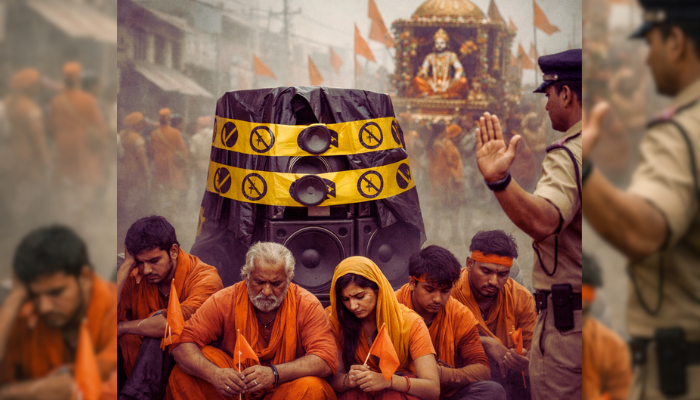
Case Summary
In the Jamui district of Bihar, a Hindu religious procession was unduly restricted by the local police administration. A ban on the use of DJ music and regulatory conditions were imposed ahead of Ram Navami in the Khaira block area. The directives were issued during a peace committee meeting held on Tuesday, 24 March 2026, within the premises of the Garhi police station. The meeting was convened to discuss arrangements for the upcoming Ram Navami and Chaiti Chhath festivals and was attended by police officials, local representatives, and members of the community. During the meeting, the administration made it mandatory for Hindu devotees to seek prior written permission before conducting any procession, religious gathering, or event. The authorities explicitly prohibited the use of DJs and any restricted sound systems during processions related to Ram Navami. Additionally, they warned that strict action would be taken against individuals engaging in disorderly conduct, including those found consuming alcohol and creating disturbances during the events. Further, the administration directed that all processions must conclude by 8 PM and that compliance with the prescribed conditions was compulsory. Station House Officer Vipin Chandra Palta stated that maintaining law and order in the area remained the primary responsibility of the police and emphasised the need for public cooperation. The meeting was attended by several local figures, including Mukhiya Anil Yadav and other community members, who were present during the discussions on the enforcement of these restrictions.
Why it is Hate Crime ?
This case is being added to the tracker under the primary category- Restriction/ban on Hindu practices. The subcategory selected is- Administration restricting religious practice. In several cases, it is seen that the administration/state disallows a religious practice owing to prejudicial orders and concerns, targeted specifically against the Hindu community. Such restriction/prohibition would be considered documented as a hate crime because the orders are often a result of pressure by groups that harbour animosity towards Hinduism and Hindus. Often, the restriction by the authorities is driven by bias, hostility, or prejudice against the specific community being stopped from holding a religious practice, by pressure groups that harbour animosity towards Hindus, intrinsic to their faith. Since practices are intrinsic to the faith of the Hindus, such prejudicial restriction is considered a curtailing of the fundamental rights of the Hindu community. In several cases, for example, the authorities ban a Hindu religious practice due to pressure from groups opposed to the religion. In other instances, the prohibition is selectively enforced against one religious group (Hindus) while others are allowed to proceed. There are still other cases where the authorities preemptively restrict a religious practice by Hindus because those who hold animosity towards Hindus may get “provoked”, leading to them being violent, thereby assuaging the sentiments of those who hold animosity towards Hindus by curtailing the religious rights of Hindus. Such acts and orders are prejudiced, indicating discriminatory motives owing to the capitulation to groups that harbour animosity towards Hindus and therefore, would be categorised as a religiously motivated hate crime since the original pressure leading to the order itself is a result of hatred/bias/prejudice/religious hate against Hindus. The other sub-category is- Restriction on the expression of Hindu identity. An example of the state-affected prejudicial and targeted orders against the Hindu community would be a government denying the right of a Hindu or a group of Hindus to hold a religious procession owing to the animosity of non-Hindu groups. Denial of the religious right of the Hindus to assuage the non-Hindu group, which harbours animosity to a point where it could lead to violence against Hindus, is not only a failure of law and order but is a prejudicial order against Hindus, denying them their fundamental rights to express their religious identity. An example of a hate crime against Hindus by a non-Hindu would be a non-Hindu institution forcing its Hindu employees to abandon religious symbols that a Hindu would wear as an expression of faith owing to inherent prejudice against the faith professed by the victim or a non-Hindu group of people restricting a Hindu group from constructing a place of worship simply because the demography of the area in which the temple is being built is dominated by non-Hindus. Such actions are driven by religious animosity and/or prejudice against Hindus and their faith and would therefore be categorised as a hate crime. This case constituted a clear instance of a religiously motivated hate crime because the restrictions were imposed specifically in the context of Ram Navami, a major Hindu festival, where the administration banned the use of DJ music and placed conditions on how processions could be conducted in Khaira, Jamui. The trigger was not a general administrative concern but the very occurrence of a Hindu religious celebration in the public space. What made this instance more revealing and deeply unsettling was that these restrictions were imposed in an area where Hindus themselves formed the local population, yet they were restrained from expressing their faith openly. This was not a case of regulation in an unfamiliar or sensitive zone alone; it arose within the natural social setting of the Hindu community. The timing of the directives, aligned precisely with the festival, made it evident that the action was directed at the religious event itself rather than any consistent or neutral law and order framework. Further, the restriction did not remain limited to procedural control but extended into the manner of celebration. The ban on DJs directly affected how Ram Navami processions were experienced, as devotional music, bhajans, and chants formed a core part of collective participation. By removing this element, the administration effectively diluted the scale and vibrancy of the celebration. It was not merely an adjustment of logistics; it was a reduction of religious expression, ensuring that the festival remained subdued and less visible in the public domain. Moreover, while maintaining law and order was a legitimate responsibility of the administration, the manner in which it was enforced in this case was clearly misplaced. The restrictions were imposed on the devotees themselves, even though there was no indication that they were the source of disruption or communal disharmony. Instead of identifying and addressing elements that could potentially disturb peace, the administration chose to curb the very group that sought to celebrate peacefully. This amounted to a superimposed restraint, where those exercising their rights were controlled, while the potential causes of disturbance remained unaddressed. This imbalance became even more striking when viewed in principle. If maintaining order justified altering the core nature of a religious practice, then the same logic would apply across communities. One would then have to ask whether a ritual like Tatbir, where participants engage in acts of self-flagellation, would ever be similarly modified under the pretext of maintaining peace. The answer, in practice, remained no. Such rituals were allowed to continue in their original form, which exposed the selective nature of intervention. In contrast, Hindu practices were readily altered, reduced, or restrained, revealing a clear double standard in enforcement. Additionally, the selective nature of such restrictions stood out clearly. Measures of this kind repeatedly surfaced during Hindu festivals, while comparable practices in other religious contexts were rarely subjected to the same level of control. This created a clear imbalance. By consistently intervening only when Hindus gathered to celebrate, the administration built a pattern where Hindu festivals were treated as potential law and order problems. Over time, this framed Hindus not as citizens exercising their rights, but as likely culprits who needed to be restrained in advance. It was also significant that the administration made prior permission mandatory and imposed strict timelines, turning what should have been a routine religious procession into a regulated and conditional activity. The requirement to seek approval for participation in one’s own religious celebration, combined with restrictions on expression, indicated that Hindu practices were not being treated as rights but as privileges subject to administrative discretion. This shift from protection to permission reflected a deeper institutional bias in handling Hindu religious events. In the broader context, such incidents were not isolated. Across several regions, there had been a recurring pattern where Hindu festivals faced restrictions, modifications, or heightened scrutiny under the pretext of maintaining order. In contrast, the underlying causes of tension were often left unaddressed. This selective enforcement created an environment where Hindu assertion in public spaces was routinely curtailed, normalising the idea that such expressions required control rather than protection. Further, it is important to mention here that every individual has the right to practice their religious faith, and restricting someone from doing that can also be considered a prejudicial order, denying the Hindu community its fundamental rights. Such arbitrary actions taken against Hindus are prejudicial to the rights of Hindus and stem from animosity and prejudice against Hindu beliefs. Taken together, the facts revealed a consistent pattern of differential treatment. Each time a Hindu festival approached, elements such as music, timing, or participation were restricted, subtly portraying Hindu celebrations as sources of potential disruption. This repeated framing not only diminished the legitimacy of Hindu religious expression but also reinforced a narrative where Hindus were seen as instigators by default. Such actions stemmed from prejudice and bias against Hindu practices, thereby meeting the criteria of a religiously motivated hate crime.


Case Status
Unknown


Perpetrators Details
Perpetrators
State and Establishment
Perpetrators Range
Unknown
Perpetrators Gender
unknown
 Sources




