Hindu festival targeted; DJ banned ahead of Ram Navami celebrations by West Bengal's State administration
 Howrah, West Bengal, India
  16 February, 2026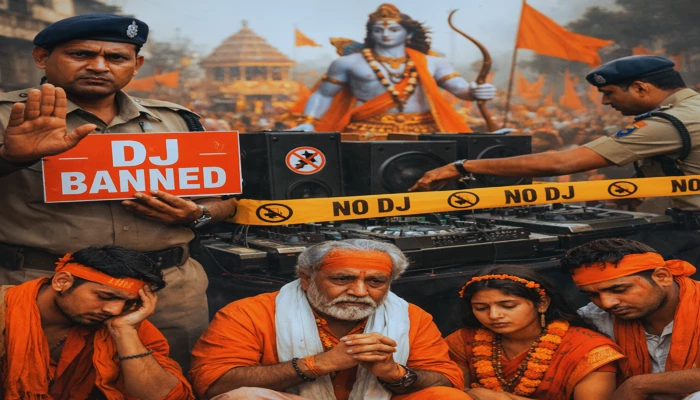
Case Summary
In Howrah, West Bengal, ahead of the Hindu festival, the State administration imposed restrictions on the Ram Navami Shobha yatra. The use of DJ systems during Ram Navami rallies was prohibited. A petition was filed before the Calcutta High Court seeking the removal of unreasonable restrictions imposed by the Police authorities. The petitioner, along with the Hindu organisation, the Vishwa Hindu Parishad, had stated that Police authorities had restricted the Ram Navami procession and changed the route of the Shobha yatra. In the petition, directions were sought for permission to hold the rally along the same route used in previous years, and to permit the Shobha Yatra, which the Police had restricted. Subsequently, the Calcutta High Court permitted the Ram Navami procession in Howrah to be carried out on March 26, 2026. It allowed the procession to proceed along its traditional route. The Court held that the authorities' reasons for altering the established route were insufficient, noting that the same route had been permitted in previous years, including under earlier judicial orders. It emphasised that administrative concerns could be addressed through adequate police deployment rather than curtailing the procession route. However, the Court imposed several conditions to regulate the procession. These included a cap of 500 participants, mandatory submission of participants' names and identity details, and the appointment of designated organisers responsible for maintaining order. The Court also directed that no provocative slogans be raised and that no weapons be carried, except for symbolic items. Additionally, the Court prohibited the use of DJ systems, allowed only limited sound arrangements, and restricted the number of vehicles in the procession to one for carrying the tableau and idol. It further directed that the rally must proceed without halting at intermediate points and empowered the police to take immediate action in case of any violation of the imposed conditions.
Why it is Hate Crime ?
This case is being added to the tracker under the primary category- Restriction/ban on Hindu practices. The subcategory selected is- Administration restricting religious practice. In several cases, it is seen that the administration/state disallows a religious practice owing to prejudicial orders and concerns, targeted specifically against the Hindu community. Such restriction/prohibition would be considered documented as a hate crime because the orders are often a result of pressure by groups that harbour animosity towards Hinduism and Hindus. Often, the restriction by the authorities is driven by bias, hostility, or prejudice against the specific community being stopped from holding a religious practice, by pressure groups that harbour animosity towards Hindus, intrinsic to their faith. Since practices are intrinsic to the faith of the Hindus, such prejudicial restriction is considered a curtailing of the fundamental rights of the Hindu community. In several cases, for example, the authorities ban a Hindu religious practice due to pressure from groups opposed to the religion. In other instances, the prohibition is selectively enforced against one religious group (Hindus) while others are allowed to proceed. There are still other cases where the authorities preemptively restrict a religious practice by Hindus because those who hold animosity towards Hindus may get “provoked”, leading to them being violent, thereby assuaging the sentiments of those who hold animosity towards Hindus by curtailing the religious rights of Hindus. Such acts and orders are prejudiced, indicating discriminatory motives owing to the capitulation to groups that harbour animosity towards Hindus and therefore, would be categorised as a religiously motivated hate crime since the original pressure leading to the order itself is a result of hatred/bias/prejudice/religious hate against Hindus. The other sub-category is- Restriction on the expression of Hindu identity. An example of the state-affected prejudicial and targeted orders against the Hindu community would be a government denying the right of a Hindu or a group of Hindus to hold a religious procession owing to the animosity of non-Hindu groups. Denial of the religious right of the Hindus to assuage the non-Hindu group, which harbours animosity to a point where it could lead to violence against Hindus, is not only a failure of law and order but is a prejudicial order against Hindus, denying them their fundamental rights to express their religious identity. An example of a hate crime against Hindus by a non-Hindu would be a non-Hindu institution forcing its Hindu employees to abandon religious symbols that a Hindu would wear as an expression of faith owing to inherent prejudice against the faith professed by the victim or a non-Hindu group of people restricting a Hindu group from constructing a place of worship simply because the demography of the area in which the temple is being built is dominated by non-Hindus. Such actions are driven by religious animosity and/or prejudice against Hindus and their faith and would therefore be categorised as a hate crime. This case was added to the tracker because the trigger in this case lay squarely in the religious nature of the occasion. The restriction was imposed specifically during Ram Navami, a Hindu festival defined by public processions, devotional music, and visible celebration of faith. What made this case even more revealing and deeply shocking was that this was not an order passed in a neighbouring Islamic country where Hindus are a minority. It arose in a State in India itself, where Hindus form the majority and have historically lived and practised their faith freely. Yet, in this very setting, they were denied the right to assert their religious presence in public. The restriction surfaced exactly at the time of their festival, making it clear that it was directed at a Hindu religious event rather than driven by any genuine or consistent law-and-order concern. Further, the restriction did not merely regulate arrangements; it directly cut into how the festival was practised. Devotional music played through sound systems had become an integral part of such processions, allowing collective participation and expression. By banning this, the authorities did not just manage the event; they diluted it. A vibrant religious celebration was deliberately toned down. This was not about control of excess; it was about curbing visibility, ensuring that Hindu expression remained limited and subdued. Moreover, the reasoning of maintaining order exposed a deeper imbalance. Instead of securing the procession or acting against those who might disrupt it, the administration chose to restrict the devotees themselves. This effectively shifted responsibility onto Hindus, as if their celebration was the source of potential disorder. In doing so, the state signalled that Hindu practices must be adjusted to accommodate the possibility of hostility from others. It was a clear case of controlling the victim rather than addressing the source of the threat. Additionally, the selective nature of such interventions could not be ignored. Restrictions of this kind repeatedly surfaced around Hindu festivals, while comparable practices in other religious settings were left largely untouched. This was not incidental; it reflected a pattern. By consistently stepping in only when Hindus gathered, the administration created a double standard. Hindu celebrations were treated as disturbances waiting to happen. Over time, this framed Hindus not as citizens exercising rights, but as potential culprits who needed pre-emptive restraint. It was also telling that the matter required judicial correction. The need for court intervention to allow a traditional procession route showed that the administrative stance had gone beyond reasonable regulation. What should have been a routine permission became a contested right. This pointed to a larger issue where Hindu practices were no longer protected as a matter of course, but had to be reclaimed through legal intervention. In the broader context, this incident fit into a disturbing pattern in West Bengal. Over the past several years, there have been repeated instances where violence, intimidation, and targeting of Hindus were downplayed or outright denied by the administration. At the same time, restrictions on Hindu practices were normalised and justified. This pattern created a one-sided framework where Hindu assertion was policed, while hostility against it was often overlooked. Under the leadership of Mamata Banerjee, this approach had drawn serious concern. The state machinery had often appeared more inclined to contain Hindu expression than to protect it. There had been consistent accusations of shielding elements responsible for disruption, while placing the burden of “peace” on Hindu communities themselves. For example, in South Kolkata, West Bengal, on 23rd January 2026, Hindu students were threatened for organising Saraswati Puja by All India Trinamool Congress (TMC) Muslim politician Daud Alam Molla. This occurred at the government-sponsored Jogesh Chandra Chaudhuri College. In another instance, on 19 June 2025, in Jalalpur town, West Bengal, permission for a 629-year-old Hindu village fair named Rath Mela was denied by the police. The administration cited 'law and order' concerns as an excuse to deny permission to Hindus to conduct their religious event. The bias of the state extends beyond inaction. There are increasing instances where the state actively suppresses Hindu religious expression. Hindus have been arrested simply for chanting “Jai Shri Ram”, a phrase vilified by sections of the administration and ruling party. Permission for Hindu processions—especially during festivals like Ram Navami or Hanuman Jayanti—is routinely denied on grounds of "law and order concerns", while Muslim religious gatherings face no such hurdles. Moreover, over the years, the Mamata-led government has issued numerous prejudicial directives, like orders restricting Durga Puja immersions, citing Muharram processions. Inaction on anti-Hindu mob violence in areas like Dhulian, Islampur, and Kaliachak. Public endorsements and appeasement of radical clerics and Islamist leaders, while dismissing concerns raised by Hindu groups as “communal provocation”. The systematic suppression of Hindu voices, the denial of communal violence, and the criminalisation of Hindu identity expressions such as “Jai Shri Ram” reflect not just administrative failure but a deeper ideological hostility toward the Hindu community. Taken together, the pattern was unmistakable. Each time a Hindu festival approached, some element, sound, route, or participation was restricted or altered. This was not a coincidence; it was a trend. Hindu celebrations were repeatedly modified under the assumption that they were the problem. In doing so, the administration steadily built a narrative where Hindus were seen as instigators by default, rather than as citizens exercising their legitimate religious rights. Disclaimer: The Hinduphobia Tracker records incident dates based on when the victim's ordeal began, rather than when the media reported it. In this case, the report does not mention when the Police order was passed but mentions the date when the petition was filed before the High Court, 17 February, 2026; therefore, it has been recorded as the indicative incident date for documentation purposes.


Case Status
Unknown


Perpetrators Details
Perpetrators
State and Establishment
Perpetrators Range
Unknown
Perpetrators Gender
unknown
 Sources




