Hindu festival faces restrictions in Begusarai, Bihar; administration bans DJs in Ram Navami processions
 Begusarai, Bihar, India
  22 March, 2026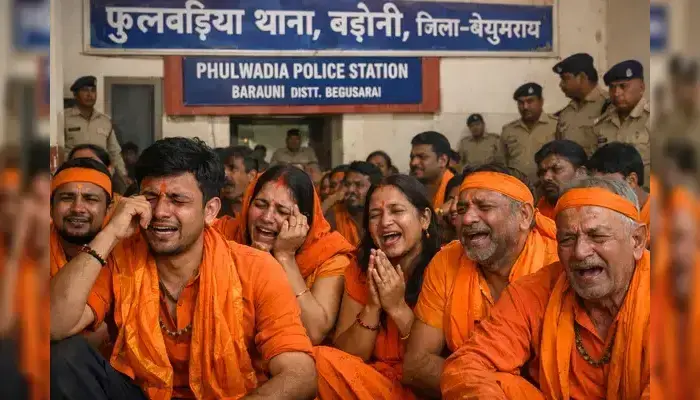
Case Summary
In Barauni, Begusarai, Bihar, Ram Navami celebrations were curtailed when the police administration imposed a ban on the use of DJs during the Ram Navami procession. This was announced during a peace committee meeting held on 23 March 2026. According to media reports, the meeting was held at the Phulwadia police station in Barauni regarding the Ram Navami festival. The Sub-Divisional Magistrate Rakesh Kumar chaired the meeting. The meeting specifically discussed the motorcycle procession proposed by Shri Maharana Pratap Parshuram Gymnasium and Bajrang Dal on 29 March 2026, and the foot procession held under the banner of Nav Yuvak Seva Sansthan and Shri Maharana Pratap Parshuram Gymnasium on 30 March 2026. The administration issued several guidelines for the procession and the parade. The police officials stated that DJ music was completely banned during the procession. Any rumours or anti-social activities were closely monitored. Drone surveillance was used to strengthen security. The Deputy Superintendent of Police Krishna Kumar, Phulwadia Police Station Head Vijay Sahni, Junior Engineer of Electricity Department Ranjeet Kumar, along with many public representatives, social workers and intellectuals were also present in the meeting. Sub-Divisional Magistrate Rakesh Kumar stated that it was everyone's responsibility to celebrate Ram Navami with peace and harmony. He appealed to organisers to follow the established guidelines and warned that the administration would not tolerate any negligence. Deputy Superintendent of Police Krishna Kumar stated that strict security arrangements had been made for the procession and the Shobha Yatra. Anti-social elements were closely monitored, and drone surveillance continued. He appealed to the public to avoid rumours and cooperate with the police administration in ensuring a peaceful celebration of the festival.
Why it is Hate Crime ?
This case is being added to the tracker under the primary category- Restriction/ban on Hindu practices. The subcategory selected is- Administration restricting religious practice. In several cases, it is seen that the administration/state disallows a religious practice owing to prejudicial orders and concerns, targeted specifically against the Hindu community. Such restriction/prohibition would be considered documented as a hate crime because the orders are often a result of pressure by groups that harbour animosity towards Hinduism and Hindus. Often, the restriction by the authorities is driven by bias, hostility, or prejudice against the specific community being stopped from holding a religious practice, by pressure groups that harbour animosity towards Hindus, intrinsic to their faith. Since practices are intrinsic to the faith of the Hindus, such prejudicial restriction is considered a curtailing of the fundamental rights of the Hindu community. In several cases, for example, the authorities ban a Hindu religious practice due to pressure from groups opposed to the religion. In other instances the prohibition is selectively enforced against one religious group (Hindus) while others are allowed to proceed. There are still other cases where the authorities preemptively restrict a religious practice by Hindus because those who hold animosity towards Hindus may get “provoked” leading to them being violent, thereby assuaging the sentiments of those who hold animosity towards Hindus by curtailing the religious rights of Hindus. Such acts and orders are prejudiced, indicating discriminatory motives owing to the capitulation to groups that harbour animosity towards Hindus and therefore, would be categorized as a religiously motivated hate crime since the original pressure leading to the order itself is a result of hatred/bias/prejudice/religious hate against Hindus. This case is a clear instance of a religiously motivated hate crime because the police administration in Barauni used its authority to ban DJs during Ram Navami processions, directly targeting a central expressive practice of a Hindu religious festival. The ban singles out a specific, sacred festival event, Ram Navami, and imposes a restriction that does not apply in the same way to other religious festivals celebrated in the area, demonstrating an institutional pattern of discrimination against Hindu religious expression. By focusing its administrative action selectively on Ram Navami, the administration sends a message that Hindu public worship and cultural display are less entitled to protection and space than other religious observances, which is the hallmark of religiously targeted hostility rather than neutral law and order management. The use of a DJ in Ram Navami processions is not merely entertainment; it is an integral part of how many Hindu communities experience the festival today. DJs amplify devotional bhajans, chants of Jai Shri Ram, and other religious songs traditionally sung along the procession route, allowing larger numbers of devotees to participate collectively in worship. Ram Navami processions are annual, highly symbolic events where Hindus publicly express their faith, devotion, and joy, often spanning long distances through towns and neighbourhoods. Restricting the means by which these bhajans and chants are shared, through a ban on DJ loudspeakers, effectively limits the visibility and public intensity of Hindu religious celebration. Hence, imposing such arbitrary restrictions on DJs during Ram Navami processions shows that the police administration is trying to suppress the outward expression of Hindu faith and identity, forcibly limiting the sacred playing of bhajans dedicated to Lord Ram and revealing institutionalised bias and discrimination against Hindu religious festivals. Playing music through a DJ is not an illegal act, nor is it inherently provocative or violent. When the music consists of religious bhajans and devotional songs connected to Ram Navami, it is a non-violent, peaceful expression of belief. The administration’s decision to ban DJs under the guise of general administrative or security considerations, while allowing other religious events to proceed without similar restrictions, exposes prejudice rather than genuine neutrality. The state singles out a minor, once-yearly expression of Hindu faith, a single day of public celebration where loudspeakers or DJs are used only for a short period, suggesting that the real target is not noise but the religious character of the event, which reveals deep-seated religious animosity towards Hindu public worship. The targeting of the DJ ban becomes even clearer when placed against the wider pattern of sound system use in the area. Ram Navami is a one-day Hindu festival, whereas loudspeakers and similar sound systems are used repeatedly throughout the year by other religious institutions. Mosques, for example, use loudspeakers daily for the azaan, yet such uses are very rarely subjected to the same kind of crackdown or restriction. It is only the one-day Hindu celebration, Ram Navami, where the playing of DJ bhajans is singled out for a ban, which reveals clear differential treatment towards Hindus. This selective targeting of Hindu religious expression, while everyday religious sound practices of other communities remain unaffected, showcases prejudice within the police administration and the broader state apparatus. When the state applies its restrictions so unevenly, it is not maintaining neutrality but actively privileging one religious practice over another, and such institutional bias against a Hindu festival fits squarely within the definition of a religiously motivated hate crime. It is also important to note that the police administration’s ban on DJs was imposed supposedly to maintain a better law and order situation, arguing that the playing of Ram Navami bhajans through DJ systems across India has triggered anti-Hindu radical elements to attack processions. They assert that chants of Jai Shri Ram and the use of Ram bhajans through loudspeakers have been used as pretexts for violence by radical groups, leading to clashes and unrest. However, in this case, instead of strengthening security, controlling these anti-social elements, or preventing attacks on Hindus, the administration responds by restricting the very religious expression targeted by those extremists. The state effectively shifts the burden away from protecting Hindu devotees and onto silencing them, appeasing radical groups rather than confronting them. By restricting the right of Hindus to play bhajans through DJs on Ram Navami, the administration reveals a biased stance that prioritises the comfort of potential attackers over the constitutional rights of Hindu worshippers, making the restriction a clear case of religiously motivated discrimination. Further, it is important to mention here that every individual or community has the right to practice their religious faith in the manner that is meaningful to them, within the bounds of the law; to single out a Hindu festival and impose arbitrary limitations on how devotees may express their beliefs, such as banning the use of DJ‑amplified bhajans, is to interfere with that fundamental right and can also be considered a prejudicial order denying the Hindu community its constitutional guarantees. Such arbitrary actions taken specifically against Hindu religious observances reflect animosity and prejudice towards Hindu beliefs and Hindu identity, and they go beyond routine administrative control into the realm of religious targeting, particularly when the state uses its authority not to protect Hindu worshippers but to curtail their religious expression, thereby undermining both the principle of equal treatment before the law and the rights of Hindus as equal citizens. Such actions stem from animosity and prejudice against Hindus and their beliefs, making it a religiously motivated offence. Overall, this case meets several key parameters of a hate crime, and it is being added to the Hate Crime database of the Hinduphobia Tracker. Disclaimer: In this case, the perpetrator count has been selected as "4", referring to the following individuals: Sub-Divisional Magistrate Rakesh Kumar, Deputy Superintendent of Police Krishna Kumar, Phulwadia police station head Vijay Sahni, and Junior Engineer of Electricity Department Ranjit Kumar. These people are counted as perpetrators because they held the peace committee meeting where the DJ ban was imposed on Ram Navami processions.


Case Status
Unknown


Perpetrators Details
Perpetrators
State and Establishment
Perpetrators Range
From 2 To 5
Perpetrators Gender
male
 Sources




