Navratri celebrations desecrated as singer performs Islamic songs during a jagran event in Ajmer
 Ajmer, Rajasthan, India
  20 March, 2026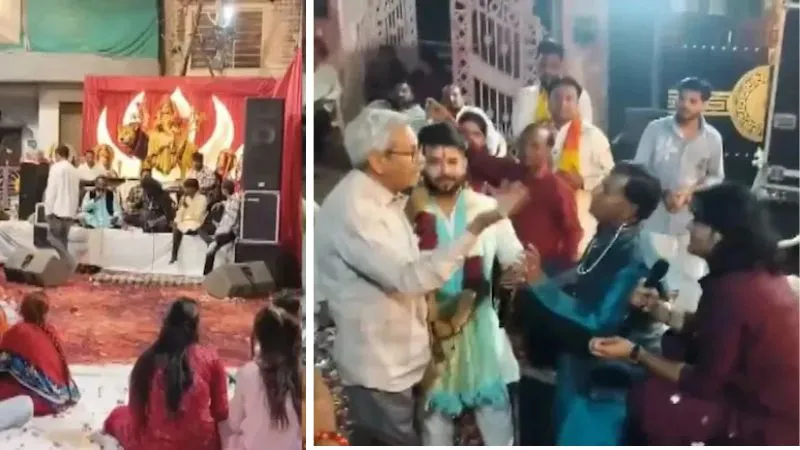
Case Summary
In Ajmer, Rajasthan, a Navratri celebration was desecrated as a singer named John Ajmeri sang Islamic songs during a jagran event named Chaitra Navratri Mata Jagran. This caused uproar and anger among Hindus, who called this an insult to their faith and festivals. A Jagran is an all‑night devotional vigil held in honour of a deity, usually involving singing of bhajans, chanting, prayers and sometimes dance. It commonly takes place during festivals, fasts or special religious occasions. In the context of Navratri, a Mata Jagran refers to a night‑long worship assembly focused on the goddess, where devotees stay awake, sing hymns and offer puja to seek blessings and express their faith. According to media reports, on Saturday, 21 March 2026, at a Mata Jagran held in the Nagra area of the Alwar Gate area, John Ajmeri, while singing sacred Hindu hymns (bhajans), began singing a qawwali (Islamic Sufi song) related to Khwaja Garib Nawaz, “Dulha Bana Hai Mera Khwaja Ajmer Ki Nagari.” Hindus present at the event objected, stating it was incompatible with Hindu traditions and the Navratri festival. As protests escalated, the situation was brought under control and the event was eventually moved forward. However, the incident sparked widespread public attention and became known to the Bajrang Dal and the Vishwa Hindu Parishad, two Hindu organisations. The next day, Sunday, 22 March 2026, there was another protest and Ajmeri had to leave the stage. When John Ajmeri arrived to perform at a bhajan event held at the Ganeshgarh Temple in Shastri Nagar, Bajrang Dal activists arrived and objected. The atmosphere became tense amidst the protests, and the singer was forced to leave the stage. The programme resumed after his departure. Kishan Gurjar, an official with the Vishwa Hindu Parishad, stated that such performances hurt religious sentiments and that the traditions of the event should be respected. He added that despite the previous incident, a similar performance was attempted again, which was unacceptable.
Why it is Hate Crime ?
This case is being added to the tracker under the primary category- Attack on Hindu religious representations. The subcategory selected is- Defiling religious customs. Sanatan Dharma is not a religion of one book, which is to say that while it has religious scriptures that form the central tenets of the faith, there are several traditions followed through thousands of years, mostly passed from generation to generation orally. There are several such customs and traditions that are followed by various Hindus and Hindu sects. Defiling of these traditions and customs is a breach of an individual or group’s religious practices. Such practices can range from dietary restrictions like not eating non-vegetarian food for a certain period of the year, not eating non-vegetarian food at all, not eating beef since the cow is considered holy in Hinduism, the sanctity of religious customs followed in the house (like many ISCKON devotees), etc. Any malicious action leading to the breach of such traditions or defilement of these traditions owing to animosity towards the faith or for the sake of activism stems not only from the lack of faith in the religion itself but also from disregard for the faith of the devotees who follow the customs/traditions and implicit bias against the faith, the tradition itself. Since these specific traditions are central to the faith of the devotees of that specific sect of Hindus, any non-compliance with these traditional rules would be considered a religiously motivated hate crime. The other subcategory selected is- Breaking rules of place of worship. Sanatan Dharma is not a religion of one book, which is to say that while it has religious scriptures that form the central tenets of the faith, there are several traditions followed through thousands of years, mostly passed from generation to generation orally. One of these oral traditions or written traditions is the rules of specific temples. Certain temples have rules which are traditional rules, dependent on the worship of the presiding deities. These rules and traditions have been followed for thousands of years whether they find scriptural mention or not. Such traditions are based on the nature and rules of worship of the presiding deity of that temple. Any non-compliance of these traditions owing to animosity towards the faith or for the sake of activism stems not only from the lack of faith in the presiding deity but also disregard for the faith of the devotees of that deity/temple and implicit bias against the faith, the tradition and the deity itself. Since these specific traditions are central to the faith of the devotees of that specific temple and presiding deity, any non-compliance with these traditional rules would be considered a religiously motivated hate crime. This case is a clear instance of a religiously motivated hate crime, not merely a lapse in protocol or a moment of poor judgment. The accused, singer John Ajmeri, desecrated Navratri celebrations by infiltrating a Hindu religious jagran where he was expected to sing Hindu bhajans and then abruptly shifting to Islamic songs rooted in Abrahamic tradition, during a sacred Hindu festival. By inserting alien religious content into a purely Hindu religious context, he transformed what was meant to be a devotional gathering into an act of religious provocation, directly targeting Hindu faith and its central practices. This intentional fusion of songs from a different faith into a Hindu religious event amounts to a deliberate insult to Hindu traditions and sentiments, and fits squarely within the definition of hate crime when hostility is directed at an entire religious community through the desecration of its most revered customs. Navratri is one of the most important Hindu festivals, dedicated to the worship of the divine Mother Goddess Durga. It is observed with fasting, prayer, chanting, and ritual gatherings, and for Hindus, it is a time of heightened spiritual discipline and collective devotion. Within this framework, a jagran is a night‑long religious vigil held in mandirs, pandals or temporary prayer halls, where devotees stay awake, sing bhajans and offer continuous worship to the deity. The atmosphere is highly ritualised, disciplined and emotionally charged, with strict norms about what is sung, how it is sung and how participants must behave. That the accused chose this specific context, a Navratri jagran, a sacred, structured Hindu religious event, shows that he was not merely singing songs in a neutral space but deliberately weaponising a religious moment against the Hindu community. The perpetrator’s act of singing Islamic songs, including a qawwali linked to a Sufi shrine, during this Hindu jagran amounts to an aggressive intrusion of an alien faith practice into a Hindu religious sphere. By replacing or overlaying Hindu devotional music with songs from a different theological tradition, he did not simply add a song; he asserted the presence and dominance of that faith in a space meant solely for Hindu worship. This is not syncretism or cultural exchange but the imposition of one tradition’s symbols onto another community’s most sacred events, establishing a boundary of domination rather than coexistence. It reveals a deep‑seated animosity towards Hindu religious autonomy and mocks Hindu traditions by implying that Hindu devotional space is not only open to outside religious expression but even “enhanced” by it, amounting to a form of religious humiliation for the Hindu community. In choosing to prioritise these songs at a Hindu festival, the perpetrator is effectively broadcasting religious dominance, suggesting that Islam’s music and imagery can rightfully intrude into and overlay Hindu celebrations. This is a deliberate act of supremacy that undermines the dignity of Hindu practices and the authority of Hindu devotees over their own religious space, demonstrating not mere disrespect but open hostility towards Hindu traditions and a desire to assert Islam’s presence over Hindu religious expression, which is the hallmark of a hate crime grounded in religious animosity. Jagran events are usually organised in pandals or other temporary religious enclosures, often as extensions of mandirs or temple premises, and are governed by strict unwritten as well as written decorum. Devotees, organisers and even artists are expected to adhere to specific religious protocols, such as singing only approved bhajans, avoiding secular or provocative content and maintaining a devotional tone throughout the night. The accused knowingly entered this environment as a hired singer, agreed to perform Hindu devotional music, and then violated the established religious discipline by beginning to sing Islamic songs. This was not a spontaneous or isolated slip; it was a conscious breach of the sacred rules of the jagran and the place of worship, which is normally treated as inviolable by participants. By deliberately overriding these norms, he undermined the sanctity of the Hindu religious space, showed brazen disrespect for Hindu protocol and signalled contempt for the community that had invited him to serve its devotional needs. Such a wilful, public violation of religious rules in a sacred setting further confirms the act as a religiously targeted hate crime rather than a misjudged performance. Navratri and jagran together constitute a layered religious custom in which the entire sequence of fasting, ritual, chanting and night‑long vigils is designed to create a continuous, immersive spiritual experience. When an outsider injects an alien religious practice into this meticulously structured custom, he does not just disrupt a single song; he defiles the integrity of the entire ritual. The jagran is not an entertainment programme but a form of collective worship, and any deviation from its prescribed devotional pattern is experienced as a rupture in the sacred narrative. The insertion of Islamic songs at the heart of this sequence breaks the continuity of Hindu devotional sound and imagery, scattering the spiritual focus of the participants and transforming the evening into a moment of religious confusion and indignity. To Hindus who observe Navratri with deep personal and communal devotion, such an act feels less like a creative choice and more like a deliberate assault on Hindu faith, aimed at polluting and degrading one of their most cherished religious customs. Given that this case meets multiple parameters of a hate crime, it is being added to the hate crime database of the Hinduphobia Tracker.


Case Status
Unknown


Perpetrators Details
Perpetrators
Others
Perpetrators Range
One Person
Perpetrators Gender
male
 Sources




