Minor Hindu girl lured into relationship, made to wear burqa and brainwashed into converting to Islam by Muslim man
 Dehradun, Uttarakhand, India
  20 March, 2026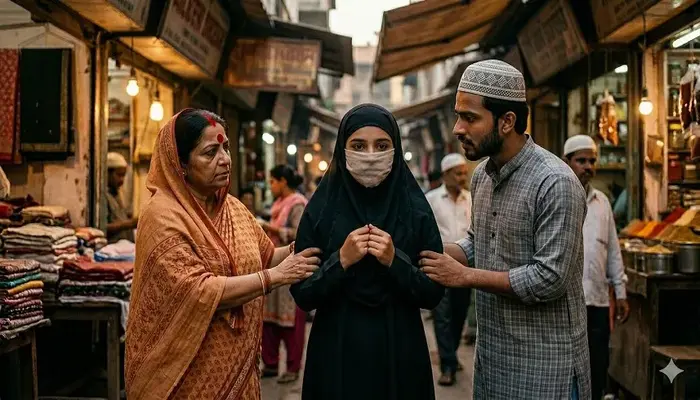
Case Summary
In the Doiwala area of Dehradun, Uttarakhand, a 15-year-old minor Hindu girl was lured into a relationship and brainwashed into converting to Islam by her Muslim neighbour named Rashid, along with others from the neighbourhood. According to reports, the minor Hindu girl lived with her mother and brother in a rented house. Rashid, who lived in the neighbourhood, maintained close relations with the victim’s family and had regular access to their home. Two Muslim men, identified as Gulistan and Sariq, from the same neighbourhood, were also known to the family. Taking advantage of this proximity, Rashid began visiting the minor victim in the absence of her mother and gradually trapped her in a romantic relationship. Over time, he gradually manipulated her to adopt Islamic practices, including changes in attire, language, and behaviour, leading to visible transformations such as wearing a burqa and using Islamic greetings. The continued interaction and influence resulted in the minor victim developing an inclination towards Islam. Furthermore, Gulistan and Sariq were also involved in the grooming and conversion process of the minor victim. Disturbed by these developments, the victim’s mother approached the Doiwala police station and filed a formal complaint seeking protection for her daughter and action against the accused. Based on the complaint, an FIR was registered on 21 March 2026 against the accused, Rashid, Gulistan, and Sariq, under Sections 3 and 5 of the Uttarakhand Freedom of Religion Act, 2018. The investigation was initiated, with Sub-Inspector Bhavana assigned to the case, and the police began examining all aspects while questioning those involved.
Why it is Hate Crime ?
This case has been added to the tracker under the primary category- Predatory Proselytisation. Within this, the subcategory selected is- Harassment, threats, coercion for conversion. Harassment covers a wide range of behaviours of an offensive nature. It is commonly understood as behaviour that demeans, humiliates, and intimidates a person, including threats and coercion. Harassment and threats, in this case, find their root on discriminatory grounds which has the effect of nullifying a person’s rights or infringing upon his freedom to exercise his right specifically owing to the victim’s religious identity. Verbal and physical threats and psychological or physical harassment are often used against Hindu victims because they choose to practice their professed religion. Religious harassment also includes forced and involuntary conversions by harassment, threats or coercion. Coercion includes intimidatory tactics like force-feeding a Hindu victim beef to convert to another religion, forceful circumcision etc. In several cases documented, non-Hindu perpetrators or those who harbour specific animosity towards Hinduism, harass victims simply based on their religious identity. Such cases often also include harassment to ensure the Hindu victim abandons his/her professed religion and adopts the religion of the perpetrator. Such cases where Hindu victims are harassed to convert to the perpetrator’s religion are rooted in animosity towards the victim’s religious identity and are therefore documented as religiously motivated hate crimes. Another subcategory selected is- Proselytisation by grooming, brainwashing, manipulation or subtle indoctrination. Within this, the tertiary category selected is- Conversion of Minor and Family claims grooming. Religious brainwashing essentially means the often subtle and forcible indoctrination to induce someone to give up their religious beliefs to accept contrasting regimented ideas. Religious grooming or brainwashing also involves propaganda and manipulation. It involves the systematic effort, driven by religious malice and indoctrination, to persuade “non-believers’ to accept allegiance, command, or doctrine to and of a contrasting faith. Cases of such grooming or brainwashing are far more nuanced than direct threats, coercion, inducement and violence. In such cases, it is often seen that there is repeated, subtle and continual manipulation of the victim to induce disaffection towards their own faith and acceptance of the contrasting faith of the perpetrator. While subtle indoctrination is widely acknowledged as predatory, an element which is often understated in such conversions or the attempts of such conversion is the role of loyalty and trust which might develop between the perpetrator and the victim. Fiduciary relationships are often abused to affect such religious conversion. For example, an educator transmitting religious doctrine of a competing faith to a Hindu student. The Hindu student is likely to accept what the teacher is transmitting owing to existence of the fiduciary relationship. The exploitation of the fiduciary relationship to religiously indoctrinate victims would also be included in this category. Since the underlying animosity towards the victim’s faith forms the basis of predatory proselytization, such cases are considered religiously motivated hate crimes. The other primary category selected here is - Crimes against women in relationships and other sexual crimes. Within it, the sub-category selected is - Brainwashed and/or grommed with the tertiary category being - Conversion of Minor and Family claims grooming. In our database, we have not added incidents where women have converted to another religion of their free will and no allegations of forced/involuntary conversion have been made. However, there are certain cases of conversion where the consent itself is a result of the brainwashing or grooming of a minor by the non-Hindu perpetrator trying to victimise a woman for her Hindu religious identity. The phenomenon of grooming points to non-Hindu perpetrators identifying their Hindu victims’ vulnerabilities and exploiting them over months and sometimes years, to extract the supposed ‘consent’ in order to convert their religion. In most cases of grooming, the victims are minors or the grooming started when the victim was a minor. In other cases of grooming, the non-Hindu perpetrator brainwashes and grooms a minor victim to extract their trust and then proceeds to rape them repeatedly with the intent of converting them to their faith. It is pertinent to understand here that when the victim is a minor, the ‘consent’ to convert or enter into a romantic relationship with an adult itself is redundant – addressed by POCSO. While every case of conversion of a minor and incidents of establishing a physical relationship with a minor by an adult is a crime, for the purpose of this database, a case would be considered a hate crime only if there is a distinct religious angle to the grooming. For example, in the UK, if a Hindu minor is targeted by Pakistani grooming gangs, it would be considered a hate crime because the victims are specifically targeted owing to their non-Muslim religious identity with the perpetrators being Muslim. In other cases, if a Hindu minor is brainwashed into entering a physical relationship with the non-Hindu adult perpetrator and the family alleges grooming/brainwashing of the minor to convert her religion, it would form a part of this database. If the victim is a Hindu adult, the case would form a part of this database only if the victim herself says that she was brainwashed/groomed to convert her religion. However, if the victim is deceased (murdered or otherwise), the case would form a part of this database if her family/friends provided testimony that the victim was brainwashed/groomed to convert her religion. Since these crimes have a distinct religious angle where the victim is being targeted owing to her Hindu religious identity, these cases are considered a hate crime. This case constituted a religiously motivated hate crime as a minor Hindu girl was deliberately targeted and influenced through sustained grooming and emotional manipulation, for religious conversion. The accused individuals, Rashid, Gulistan, and Sariq, used their familiarity and regular access to the household to initiate and sustain contact with the minor victim. The targeting was not incidental; the repeated visits in the absence of her mother and the gradual cultivation of a personal relationship demonstrated a calculated effort to exploit the vulnerability of a minor Hindu girl in an effort to convert her to Islam. Firstly, it is important to note here that the victim was a minor, which means the element of consent and genuine change of conscience was missing ab initio. Minors, due to their young age and lack of maturity, are particularly vulnerable to manipulation and coercion. They may not have the ability to fully understand the implications of converting to another religion or consenting to a relationship, and the Muslim perpetrator purposely targeted and exploited this vulnerability of the victim. Since this case exemplifies the use of coercion and manipulation to achieve religious conversion, it is a blatant act of religious hate, which is why it has been documented here in the hate tracker. Such acts are not merely criminal in nature; they are ideologically charged, revealing religious prejudice and a calculated intent to alter the religious identity of a minor without her volition. The use of grooming, where trust is built only to exploit, is an insidious method that exploits the child’s naivety and dependence. In this context, the testimony of the family, especially that of the victim's mother, holds considerable weight. Secondly, the accused brainwashed the minor Hindu girl to adopt Islamic practices, including changes in attire, language, and behaviour in an effort to convert her to Islam. Pressuring or brainwashing a minor Hindu girl to discard her religious faith and embrace another was a direct attack on her religious identity and dignity. It was not a matter of personal choice; it was coercion rooted in hostility towards the victim's Hindu identity. Such an attempt reflects religious animosity because the act was not simply about personal differences but about erasing the victim’s Hindu faith, making it a religiously motivated crime. Thirdly, under the influence of the accused, the victim began wearing a burqa, using Islamic greetings, and exhibiting a shift in her day-to-day conduct that aligned with Islamic customs. This transformation did not occur spontaneously; it was the result of continuous exposure and conditioning by the accused. By forcibly imposing Islamic rituals like wearing a burqa, the accused violated her religious autonomy and demonstrated deep-seated hatred towards Hinduism. Such actions were not mere persuasion but a systematic assault on her faith, aimed at breaking her spiritual ties and reprogramming her beliefs, constituting religiously motivated persecution. Such imposition of religious practices on a Hindu minor constituted a direct interference with her religious upbringing and identity, indicating an effort to detach her from her native faith and draw her towards another religious framework. Furthermore, the use of a romantic relationship as a means to influence the minor highlighted a pattern of emotional manipulation. By entrapping the minor in a relationship, the accused created a psychological dependency that made her more susceptible to adopting the practices and expectations imposed upon her. This method of influence exploited the emotional vulnerability of a minor and functioned as a tool to normalise religious changes that she may not have otherwise accepted. The actions of the accused went beyond personal interaction and were aimed at converting a minor Hindu girl to Islam. Such actions stem from inherent hostility towards the victim's professed faith since Abrahamic faiths believe that any non-adherent to the faith is subject to being dehumanised till they convert. Therefore, religious conversions, even of minors, are often seen as a badge of honour, totally disregarding the methods used to achieve it. Since such predatory actions stem from doctrinal animosity towards the Hindu faith and its adherents, this case is being documented as a religiously motivated hate crime. Overall, the case met the criteria of a religiously motivated hate crime as it involved the deliberate targeting of a Hindu minor, exploitation of her age and vulnerability and sustained grooming for religious conversion. Since the accused's actions were motivated by religious animosity, this case has been added to the tracker. Disclaimer: The Hinduphobia Tracker records incidents based on when an event occurred or when the victim's ordeal began. It is important to clarify that the report does not specify the exact date when the accused came into contact with the victim. Therefore, for documentation purposes, we have recorded the date based on when the FIR was filed, 21 March 2026.
Victim Details
Total Victim
1
Deceased
0
Gender
- Male 0
- Female 1
- Third Gender 0
- Unknown 0
Caste
- SC/ST 0
- OBC 0
- General 0
- Unknown 1
Age Group
- Minor 1
- Adult 0
- Senior Citizen 0
- Unknown 0


Case Status
Complaint registered


Perpetrators Details
Perpetrators
Muslim Extremists
Perpetrators Range
From 2 To 5
Perpetrators Gender
male
 Sources




