Hindu temple’s sanctity desecrated as miscreants dump cow remains near its premises during Navratri celebrations in Bhopal
 Bhopal, Madhya Pradesh, India
  21 March, 2026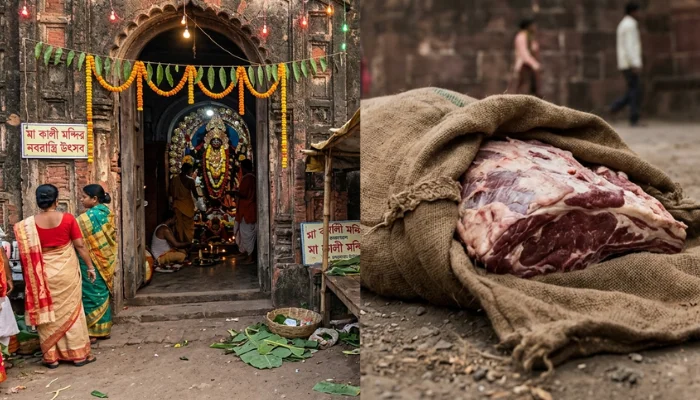
Case Summary
In Bhopal, Madhya Pradesh, a Hindu temple of Goddess Kali was desecrated after some miscreants dumped dead cow remains near its premises. This occurred on 22 March 2025, during Chaitra Navratri celebrations, causing religious tensions in the area. According to media reports, cow remains were discovered in a white sack in front of the Kali Temple in the Talaiya police station area of Bhopal. Upon receiving the information, activists from the Jai Maa Bhavani Hindu organisation arrived at the scene and blocked the highway, demanding action. The Hindu protesters sat on the road and raised slogans against the administration and stated that such incidents had been continuously happening in the area, but the administration had not taken any concrete action. Bhanu Hindu, head of the organisation, said, “The severed neck of the cow was found in the sack, indicating that the cow had been slaughtered. CCTV footage should be examined, and the accused should be identified and arrested. If no action is taken, the entire Hindu community will protest in the streets.” He called it an attempt to disrupt the social atmosphere. The protest lasted for about an hour and a half. Chandrashekhar Tiwari, president of the Hindu Utsav Samiti, also arrived at the scene. He described the incident as a conspiracy to disrupt the city’s atmosphere during Navratri and objected to shops operating late at night in the old city. The protesters demanded the immediate arrest of the culprits and strict action against them. Senior police officers and a large force arrived at the scene, and the Additional Deputy Commissioner of Police Shailendra Singh Chauhan assured appropriate action. According to the police, a sack containing the remains was found on the divider around 11 p.m. Based on a complaint filed by Bhanu Hindu, the police registered a first information report against unknown perpetrators and began an investigation based on CCTV footage. Traffic resumed after the protest ended, but tension remained in the area. The Hinduphobia Tracker team contacted Bhanu Hindu for more details on the case. He explained that a cow carcass was found on the fourth day of Navratri, roughly 100 to 200 metres from Bhopal's Kali temple, stuffed in a sack on the main road with a leg and meat pieces visible. Passers-by spotted it and rang his public number while he was travelling to an event; Bhanu hurried to the site, verified the remains, alerted the police, and filed the FIR as fellow organisation members arrived and crowds protested amidst the festivities. Bhanu voiced distrust in the police, referencing their poor handling of the 26.5-tonne beef case that he had previously exposed, where only a driver and a Muslim man named Aslam were arrested despite its magnitude. He also questioned how the sack evaded notice on a busy daytime road near the temple and police station, despite passers-by and officers. Noting it was also the second day of Eid, he suggested some anti-social elements sought to inflame Bhopal's atmosphere amidst surging cow slaughter incidents and nighttime stone-pelting. Bhanu urged the administration to round up cow slaughter offenders nationwide and act decisively, spotlighting attacks on cow protectors.
Why it is Hate Crime ?
This case has been added to the primary category- Attack on Hindu religious representations. The subcategory selected is- Desecration of Hindu religious symbol. Icons and symbols or a religious representation of a spiritual ideal are widely revered in Hinduism. Iconography is of vital significance in the Hindu milieu. It helps connect people’s spiritual beliefs with the real world. Iconography within the Hindu faith takes several shapes and forms. Murtis are of most significance to Hindus, to which daily rituals, prayers and offerings are done. Besides the murtis, there are several other symbols which have deep significance in the Hindu faith – the Om and Swastika for example. Since these Hindu religious symbols hold paramount importance in Hinduism, any desecration of symbols, icons, murtis, religious representations and manifestations, is driven by animosity towards the faith itself which manifests itself through these murtis, icons and symbols. Therefore, any desecration of these Hindu religious symbols and representations is considered religiously motivated hate crimes under this category. The other subcategory selected is- Attack on Temples. In Hinduism, a temple is the abode of the Deity. The Deity in the Temple is consecrated, thereby, making it a real, breathing entity. Hindus believe that not just the Deity but the temple premises itself are sacred to Hindus since Hindus hold the faith that the entire Temple space is an amalgamation of the divine energy of the deity. Given the central significance of Temples in Hindu Dharma, any attack against a Hindu Temple or its peripheral premises is an attack on the faith itself and is born out of animosity towards the faith, of which, the Temple is a central tenet. Any manner of attack against a Temple and/or its premises would therefore be considered a religiously motivated hate crime. The other subcategory selected is- Defiling religious customs. Sanatan Dharma is not a religion of one book, which is to say that while it has religious scriptures that form the central tenets of the faith, there are several traditions followed through thousands of years, mostly passed from generation to generation orally. There are several such customs and traditions that are followed by various Hindus and Hindu sects. Defiling of these traditions and customs is a breach of an individual or group’s religious practices. Such practices can range from dietary restrictions like not eating non-vegetarian food for a certain period of the year, not eating non-vegetarian food at all, not eating beef since the cow is considered holy in Hinduism, the sanctity of religious customs followed in the house (like many ISCKON devotees), etc. Any malicious action leading to the breach of such traditions or defilement of these traditions owing to animosity towards the faith or for the sake of activism stems not only from the lack of faith in the religion itself but also from disregard for the faith of the devotees who follow the customs/traditions and implicit bias against the faith, the tradition itself. Since these specific traditions are central to the faith of the devotees of that specific sect of Hindus, any non-compliance with these traditional rules would be considered a religiously motivated hate crime. This incident constitutes a hate crime, as it involved the deliberate dumping of dead cow remains near a Kali temple during Chaitra Navratri celebrations, a major Hindu festival. In Hinduism, temples are not merely architectural structures but sacred institutions in which devotees believe the deity resides, making them inviolable centres of worship and spiritual life. Any act of defilement, such as placing ritually offensive material like beef near the temple, strikes directly at this belief, treating the deity’s abode as a target of insult rather than reverence. Such behaviour reflects a calculated disregard for Hindu religious sentiments and signals hostility towards Hinduism itself, warranting classification as a crime motivated by hatred against Hindus and their faith. The cow also holds a deeply sacred status in Hinduism, symbolising purity, life, and non‑violence. Historically, cow slaughter or the public display of cow remains has been used by those hostile to Hindus as a deliberate tool of humiliation and intimidation. In many documented cases, the placement of cow carcasses or beef near temples, religious processions, or cremation grounds was meant to desecrate Hindu shrines, provoke outrage, and assert dominance over the community. Similarly, in this case, the dumping of cow remains in a white sack in front of the Kali Temple in Bhopal fits this pattern, transforming what might otherwise be treated as a routine law‑and‑order matter into a religiously charged act of desecration and defilement of Hindu sacred sites. The fact that this act occurred during Chaitra Navratri highlights its intention to disrupt and desecrate the festival itself. Navratri is a time of heightened devotion, fasting, and ritual preparation, when Hindus actively engage in worship and community celebrations of Goddess Durga. By choosing this period to place beef near the temple, the perpetrators targeted not only the physical premises but also the devotional atmosphere and religious observances of the faithful. This timing demonstrates that the act was not random vandalism but a premeditated effort to wound religious sentiments, defile a sacred Hindu festival, provoke tensions, and instil fear within the Hindu community, making it a religiously motivated crime. Overall, placing cow meat or cow remains outside the temple not only desecrates the temple, a sacred Hindu religious symbol, but also defiles the auspicious celebrations of Navratri and dishonours the cow itself, a deeply revered animal and a religious symbol of purity and sanctity in Hinduism, making this a religiously driven offence. In this case, although the perpetrators’ identities remain unknown, the act clearly stemmed from religious animosity towards Hinduism and resulted in the defilement of a sacred temple. The deliberate use of beef, the choice of a Hindu temple as the site, and the placement of severed cow remains outside its boundary all point to hostility directed specifically at Hindu religious symbols and practices. Therefore, this incident is being classified as a religiously motivated hate crime and is being included in the Hinduphobia Tracker's hate crime database.


Case Status
Complaint registered


Perpetrators Details
Perpetrators
Unknown
Perpetrators Range
Unknown
Perpetrators Gender
unknown
 Sources




