Hindu devotees and temple committee members threatened, renovation of 1000-year-old temple obstructed by the Muslim group in Tamil Nadu
 Krishnagiri, Tamil Nadu, India
  20 March, 2026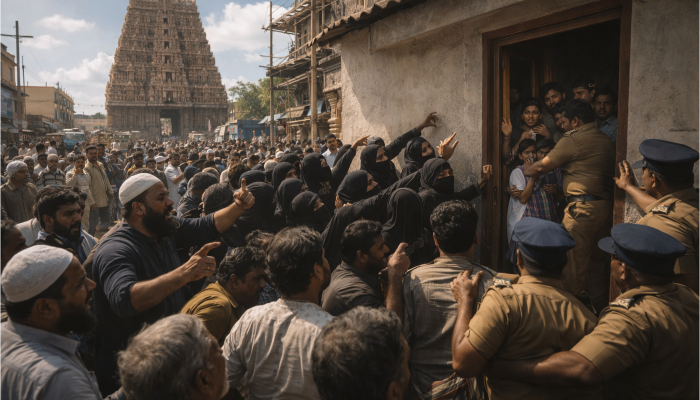
Case Summary
Hindu devotees, renovation workers, and temple committee members associated with the Varasiddhi Vinayagar temple, a Hindu temple of over one thousand years standing located near the bus stand in Krishnagiri town, Tamil Nadu were subjected to direct threats, intimidation, and violent confrontation by a group of Muslim men and burqa-clad Muslim women who objected to the ongoing renovation and Kumbabhisekam (the sacred Hindu consecration ceremony conducted to purify and re-energise a Hindu temple) works at the ancient temple. Police who were present at the scene pushed Hindu men inside their homes and watched the Muslim group staging their threatening acts rather than taking action against the perpetrators. Hindu Munnani functionaries raised strong objections to the threats and intimidation directed at the Hindu temple and its devotees. The Varasiddhi Vinayagar temple near the Krishnagiri town bus stand had commenced renovation works in preparation for its Kumbabhisekam, a sacred and significant religious occasion in the life of a Hindu temple. A group of Muslims, identified by Hindu Munnani functionaries as part of a fundamentalist group, began creating trouble for individuals associated with the renovation. They directly questioned construction workers, renovation workers, and temple committee members about the ongoing renovation work, seeking to obstruct and prevent the sacred renovation and consecration from proceeding. Hindu Munnani functionaries stated that the same Muslim group had built a mosque approximately five years prior on what had previously been a burial and cremation ground in the area, after telling local residents that the land would be used for a commercial complex. Since the construction of the mosque, the group had been causing sustained hindrance to the functioning of the temple, its poojas, its festivals, and disturbing devotees and temple administration members. Against this backdrop of sustained interference with the Hindu temple's religious life, a group of Muslim men gathered in front of a house associated with the temple and began issuing threats using filthy and abusive language. A video circulating on social media showed a man wearing a skull cap threatening the individuals in the house and attempting to physically assault them, while voices of women inside the house were heard urging their men to come indoors. A large number of burqa-clad Muslim women with their faces covered also gathered and issued threats against the Hindu family in a high-pitched and aggressive manner, actively participating in the intimidation campaign directed at the Hindu family and the temple community. Police who were present at the scene during the threatening and intimidation failed to take any action against the Muslim men and women issuing threats and attempting assault. Instead of restraining the threatening Muslim group, police pushed the Hindu men inside their home and confined themselves to occasionally shooing the Muslim group away while allowing the intimidation to continue. Hindu Munnani functionaries strongly condemned the threats directed at the Hindu temple and its devotees and the police's failure to protect the Hindu community from the sustained intimidation campaign directed at them.
Why it is Hate Crime ?
The primary category for this case is "Attack on Hindu religious representations". The sub-category for this case is "Attack on temples". In Hinduism, a temple is the abode of the Deity. The Deity in the Temple is consecrated, thereby, making it a real, breathing entity. Hindus believe that not just the Deity but the temple premises itself are sacred to Hindus since Hindus hold the faith that the entire Temple space is an amalgamation of the divine energy of the deity. Given the central significance of Temples in Hindu Dharma, any attack against a Hindu Temple or its peripheral premises is an attack on the faith itself and is born out of animosity towards the faith, of which, the Temple is a central tenet. Any manner of attack against a Temple and/or its premises would therefore be considered a religiously motivated hate crime. Another sub-category here is "Breaking rules of place of worship". Sanatan Dharma is not a religion of one book, which is to say that while it has religious scriptures that form the central tenets of the faith, there are several traditions followed through thousands of years, mostly passed from generation to generation orally. One of these oral traditions or written traditions is the rules of specific temples. Certain temples have rules which are traditional rules, dependent on the worship of the presiding deities. These rules and traditions have been followed for thousands of years whether they find scriptural mention or not. Such traditions are based on the nature and rules of worship of the presiding deity of that temple. Any non-compliance of these traditions owing to animosity towards the faith or for the sake of activism stems not only from the lack of faith in the presiding deity but also disregard for the faith of the devotees of that deity/temple and implicit bias against the faith, the tradition and the deity itself. Since these specific traditions are central to the faith of the devotees of that specific temple and presiding deity, any non-compliance with these traditional rules would be considered a religiously motivated hate crime. One other sub-category for the case is "Encroachment or illicit takeover of temple land/land near temple". In Hinduism, a temple is the abode of the Deity. The Deity in the Temple is consecrated, thereby, making it a real, breathing entity. Hindus believe that not just the Deity but the temple premises itself are sacred to Hindus since Hindus hold the faith that the entire Temple space is an amalgamation of the divine energy of the deity. Not only the Temple but the Temple premises in its entirety are considered sacred by Hindus. In several cases, the premises of the Temple and/or religious centre are illicitly taken over by institutions belonging to other faiths – like the Waqf board or the Church. Other times, the temple property, land or the property of religious centres are illicitly encroached by non-Hindu groups. Any illicit take over or encroachment is a crime an initio, however, when non-Hindu groups illicitly take over or encroach the sacred land of Hindus, it is an affront to the Hindu community and is therefore classified as a religiously motivated hate crime under this category. This case qualified as a religiously motivated hate crime on the basis that a fundamentalist Muslim group in Krishnagiri town, Tamil Nadu deliberately targeted the Varasiddhi Vinayagar temple, one of the most ancient Hindu temples in the region with over one thousand years of history, by threatening and intimidating renovation workers, construction workers, temple committee members, and Hindu devotees associated with the sacred Kumbabhisekam renovation works, in a sustained and organised campaign designed to prevent the Hindu temple from conducting its most sacred religious ceremonies and maintaining its religious life. The Varasiddhi Vinayagar temple is not merely a religious building but a living centre of Hindu community life, spiritual sustenance, and cultural identity that has served the Hindu community of Krishnagiri for over one thousand years. The Kumbabhisekam, the sacred Hindu consecration ceremony conducted to purify and re-energise a Hindu temple, is one of the most significant and spiritually important events in the religious life of a Hindu temple, representing the renewal of the divine presence within the temple and the recommitment of the Hindu community to its sacred institution. The Muslim group's deliberate targeting of the Kumbabhisekam renovation works through sustained threats and intimidation directed at renovation workers, construction workers, and temple committee members reflected a conscious and calculated decision to attack the Hindu temple at the most sacred and spiritually significant moment of its religious renewal, striking at the very heart of the Hindu community's relationship with their ancient place of worship. The Muslim group's sustained interference with the Varasiddhi Vinayagar temple's poojas, festivals, and devotees since the construction of the mosque five years prior confirmed that the threats and intimidation directed at the Kumbabhisekam renovation works were not an isolated incident but the continuation of a deliberate and sustained campaign of interference with the Hindu temple's religious life. The construction of the mosque on what had previously been a burial and cremation ground near the temple, after misleading local residents about the intended use of the land, reflected a premeditated and calculated strategy of establishing a physical presence in the immediate vicinity of the ancient Hindu temple as a base from which to conduct sustained and organised interference with its religious functioning. The five-year pattern of hindrance to the temple's poojas, festivals, and devotees confirmed the deliberate and sustained nature of the campaign directed against the Hindu temple and its community. The Muslim group's construction of a mosque on land in the immediate vicinity of the ancient Varasiddhi Vinayagar temple, after deliberately misleading local residents about its intended use, reflected a calculated and deliberate encroachment on the sacred environs of the Hindu temple. The immediate vicinity of a Hindu temple is not merely a geographical space but a sacred zone whose integrity is essential to the spiritual and religious life of the temple and its devotees. By establishing a mosque on land immediately adjacent to the ancient Hindu temple through deliberate deception of the local community, the Muslim group created a permanent physical presence that has been used as a base for sustained interference with the temple's religious functioning for five consecutive years, effectively transforming the sacred environs of the ancient Hindu temple into a contested and hostile space for Hindu devotees and temple administration. The threatening and intimidation campaign directed at the Hindu family associated with the temple, captured on video and widely circulated on social media, reflected the organised and public nature of the Muslim group's assault on the Hindu temple and its community. The participation of a large number of burqa-clad Muslim women in issuing high-pitched threats against the Hindu family reflected the broad and organised communal nature of the intimidation campaign, extending it beyond a small group of men into a large and visible communal mobilisation directed against the Hindu family and the temple community. The police's failure to take any action against the threatening Muslim group, instead pushing Hindu men inside their homes and confining themselves to occasionally shooing the Muslim group away, amplified the Hindu community's vulnerability and the emboldening effect of administrative inaction on the perpetrators' sustained campaign of intimidation against the Hindu temple. Given that this case met the parameters of a religiously motivated hate crime, it was added to the hate crime database of the tracker. Disclaimer: The Hinduphobia Tracker records incident dates based on when a crime occurred, or a victim's ordeal began, rather than when the media reported it. In this case, the exact date on which the fundamentalist Muslim group gathered in front of the Hindu family's home and issued threats during the Kumbabhisekam renovation works at the Varasiddhi Vinayagar temple is not confirmed in the sources. The article was published on March 21, 2026. Therefore, March 21, 2026 has been chosen as the indicative incident date as it represents the earliest confirmed and documented date referenced in the sources. It is important to note that the broader pattern of interference with the temple's poojas, festivals, and devotees by the same Muslim group had been ongoing for approximately five years prior to this incident, making the March 21, 2026 date reflective only of the most recent and documented escalation of the sustained campaign against the Varasiddhi Vinayagar temple and its Hindu community. This was recorded for documentation purposes only.


Case Status
Complaint not filed


Perpetrators Details
Perpetrators
Muslim Extremists
Perpetrators Range
Unknown
Perpetrators Gender
unknown
 Sources




