Hindu family attacked, their house looted and vandalised by Muslims under pretext of land dispute in Gopalganj, Bangladesh
 Gopalganj District, Bangladesh
  19 March, 2026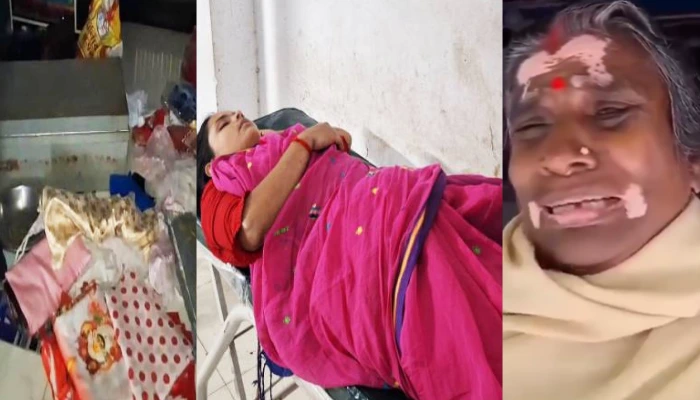
Case Summary
In Tarashi village in Kotalipara upazila of Gopalganj district in Bangladesh, a Hindu family was brutally attacked, their house was looted and vandalised by a group of Muslim men. This attack occurred under the pretext of a land dispute between the victim's family and the Muslim perpetrators. According to media reports, this occurred on 20 March 2026. The victims are identified as Bishnupada Das (45), his wife Mukta Das (30), daughter Sushmita Das (15), sister Liza Das (25), Parimal Das (65), and Renu Rani Das (60). The victim, Bishnupada Das, had a long-standing land dispute with two Muslim men, Mohammad Didar Islam Dariya and his nephew Suman Dariya of the same village, over land. As a result, Didar Dariya, his nephew and their associates attacked Bishnupada Das's house on the night of 20 March. During this, they vandalised and looted it and beat up Parimal Das and Renu Rani Das and injured them. The next day, 21 March 2026, in the afternoon, when Bishnupada Das and his family members reached Mahua intersection on their way to the police station, they were attacked again by the Muslim perpetrators. In this attack, Bishnupada Das, his wife, daughter, and sister were injured. Later, locals rescued the injured and took them to Kotalipara Upazila Health Complex. The seriously injured Mukta Das was admitted to the hospital. The others were given first aid. Injured Bishnupada Das stated that since he bought a piece of land, the perpetrators had been trying to seize that land and other lands. If he resisted, they would often attack and torture him. On the night of 20 March, they attacked his house and looted various items, including cash, gold ornaments and mobile phones. In this regard, Kotalipara Police Station Officer-in-Charge Mohammad Riyad Mahmud said, "I am not aware of the incident. Legal action will be taken if a complaint is received." A fresh wave of anti-Hindu violence followed the 13th National Parliamentary Election 2026 in Bangladesh, reinforcing a recurring pattern of post-poll violence targeting Hindu minorities. Within days of the announcement of results, Hindu families in districts such as Noakhali, Rangpur, Nilphamari, Sylhet, Thakurgaon, and Dinajpur reported coordinated attacks involving arson, looting, assault, and vandalism of temples and homes. In several instances, Hindu homes were selectively targeted, looted, and families were threatened with displacement. This escalation of violence against Hindus in Bangladesh unfolded in three distinct phases: first, following the ouster of Sheikh Hasina’s government in August 2024; second, after the death of Sharif Osman Bin Hadi in December 2025; and third, in the immediate aftermath of the 13th National Parliamentary Election 2026. This electoral violence unfolded against the broader backdrop of sustained anti-Hindu hostility that had persisted since the ouster of the Sheikh Hasina government in August 2024. During that period, multiple reports documented attacks on Hindu homes, temples, and religious institutions, alongside intimidation campaigns, arson, and mob assaults targeting minority neighbourhoods. The Hinduphobia tracker has recorded 336 such incidents against the Hindu minority, underscoring the scale and persistence of anti-Hindu violence during this period. A further escalation occurred following the death of Sharif Osman Bin Hadi, a Muslim political activist and student leader known for his anti-Hindu and anti-India rhetoric. Hadi had been involved in political unrest after the fall of the Hasina government and was killed in Dhaka on 18 December 2025 during clashes. In the aftermath of his death, Hindu communities were blamed and subsequently targeted in retaliatory violence. Hindu homes were selectively set ablaze in multiple localities, forcing families to flee and leaving many displaced. The attacks appeared patterned rather than sporadic, with Muslim mobs focusing on Hindu neighbourhoods, properties, and religious symbols. Among the victims was Dipu Chandra Das, who was lynched to death and his body was set ablaze by a Muslim mob over false blasphemy allegations. The Hinduphobia tracker documented 51 incidents of anti-Hindu violence in the period following Hadi’s death alone. Such incidents underscore the vulnerability of the Hindu minority amid rising communal hostility and the weaponisation of religious accusations. Reports further indicated that posters and written materials calling for the extermination of Hindus were displayed in public spaces, signalling an alarming normalisation of genocidal rhetoric. When combined with acts of arson, vandalism, assault, and targeted intimidation, these developments suggest a coordinated environment of hostility aimed at terrorising the Hindu community and reinforcing majoritarian dominance.
Why it is Hate Crime ?
This case is being added to the tracker under the primary category- Attack not resulting in death. The subcategory selected is- Attacked for Hindu identity. In several cases, Hindus are attacked merely for their Hindu identity without any perceived provocation. A classic example of this category of religiously motivated hate crime is a murder in 2016. 7 ISIS terrorists were convicted for shooting a school principal in Kanpur because they got ‘triggered’ seeing the Kalava on his wrist and tilak that he had put. In this, the Hindu victim had offered no provocation except for his Hindu religious identity. The motivation for the murder was purely religious, driven by religious supremacy. Such cases where Hindus are targeted merely for their religious identity would be documented as a hate crime under this category. In this case, a Hindu family faced brutal attacks on two consecutive days in Tarashi village, Kotalipara upazila of Gopalganj district, Bangladesh, where their home was looted and vandalised, and multiple members including Bishnupada Das (45), Mukta Das (30), Sushmita Das (15), Liza Das (25), Parimal Das (65), and Renu Rani Das (60) were severely beaten and injured by Muslim perpetrators under the pretext of a land dispute. The sustained violence left Mukta Das hospitalised and others requiring medical aid. In the prevailing environment of anti-Hindu hostility in Bangladesh, this incident aligns with the wider pattern of violence affecting Hindus. While some may argue that the case details do not explicitly state a religious motive, the broader context of anti-Hindu persecution in Bangladesh remains relevant for classification. During periods of sustained violence against Hindus based on religious identity, the Hinduphobia Tracker applies a contextual presumption that attacks on Hindu victims are likely faith-targeted, even when the immediate report does not record a specific religious marker. In such periods, the normalisation of religious hostility and the dehumanisation of minorities can contribute to crimes against them without perpetrators openly stating a motive. For the purpose of documenting the 2024 to 2026 ethnic cleansing of Hindus in Bangladesh, particularly the subsequent persecution after the political exile of Sheikh Hasina in August 2024, the death of Sharif Osman Hadi in December 2025, and the 13th National Parliamentary Election 2026, the Hinduphobia Tracker records such incidents as likely religiously motivated at the point of entry. If any case is later established through credible investigation or court findings to stem from motivations other than religious hostility, it will be revised or removed from the hate crime database. In this case, the extreme brutality of the repeated assaults, targeting an entire Hindu family, including women and elderly members, mirrors the severity observed in other reported attacks on Hindu victims during this period and therefore supports the contextual classification of likely religious hostility, absent contrary evidence. The case is documented as likely involving faith targeting, given the victims' identity and the surrounding pattern of persecution, while remaining open to revision if new facts emerge. This incident occurred following the 13th general parliamentary elections in Bangladesh, after which Hindus faced severe targeted violence, assaults, murders, and temple vandalism at the hands of perpetrators. The post-election period witnessed a sharp escalation in attacks on Hindu homes, families, and religious sites, with Muslim groups exploiting political upheaval to unleash physical brutality and property destruction against this minority community, particularly Hindus. Such systematic targeting of Hindus for repeated beatings, looting, and injury under flimsy pretexts like land disputes reveals clear religious animosity, transforming personal grievances into communal assaults designed to instil fear and displacement. When viewed alongside such incidents of communal violence against Hindus, the present case is recorded as part of a broader cycle of violence affecting Hindus, reinforcing the contextual presumption applied in this period. Henceforth, this case is being added to the hate crime database of the Hinduphobia Tracker. Disclaimer: The Hinduphobia Tracker has recorded the perpetrator count as "2", referring to Mohammad Didar Islam Dariya and his nephew Suman Dariya. Although multiple perpetrators were involved in this case, the total number of people was not specified, with references made only to these two individuals. Therefore, this perpetrator count serves as a conservative estimate recorded solely for documentation purposes.
Victim Details
Total Victim
6
Deceased
0
Gender
- Male 4
- Female 2
- Third Gender 0
- Unknown 0
Caste
- SC/ST 0
- OBC 0
- General 0
- Unknown 6
Age Group
- Minor 1
- Adult 5
- Senior Citizen 0
- Unknown 0


Case Status
Unknown


Perpetrators Details
Perpetrators
Muslim Extremists
Perpetrators Range
From 2 To 5
Perpetrators Gender
male
 Sources




