Navratri celebrations attacked in Nepal; Hindu devotees singing bhajans in a temple assaulted by Muslims observing Eid in nearby mosques
 Lumbini Zone, Nepal
  20 March, 2026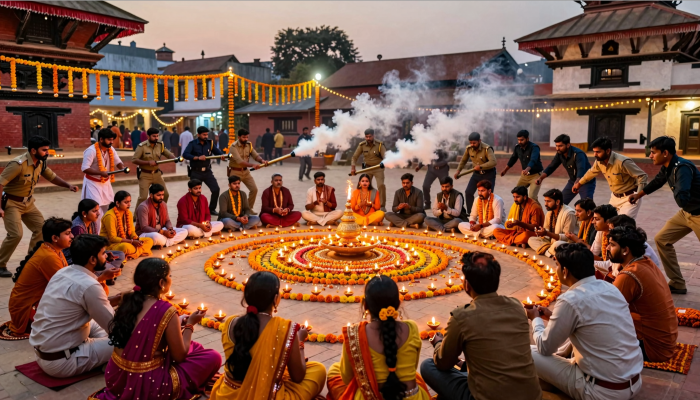
Case Summary
Hindu devotees celebrating Navratri in a Kali temple in Kapilvastu district, Nepal, were attacked by a group of Muslims celebrating Eid in nearby mosques. The devotees were singing bhajans on a microphone, and the Muslims objected to the volume of the bhajans being sung during the celebration. This minor dispute further escalated as the Muslim group began attacking Hindus and pelting stones at the temple. This triggered a violent clash in which six Hindu individuals were injured. According to media reports, this occurred on Saturday, 21 March 2026, when a group of Hindu devotees in the Bargadwa area of Maharajganj Municipality were celebrating Navratri by singing bhajans, the devotional songs that form a central and sacred part of Navratri celebrations across the Hindu community. A group of Muslims who were celebrating Eid in the same area objected to the Hindu devotees’ bhajan singing, stating that the music was too loud. The objection by the Muslim group to the Hindu devotees’ sacred Navratri bhajan singing triggered a direct confrontation between the two groups, which rapidly escalated into clashes as the Muslim group first launched violent attacks against Hindus. The Muslim community began pelting stones at the Hindu devotees who were present at the temple area, leading to protests by angry Hindus. Six Hindu individuals sustained injuries during the violence. The police arrived at the scene and used lathi charges and tear gas to disperse the crowd, and the local administration imposed indefinite prohibitory orders on parts of Maharajganj Municipality, banning all gatherings, demonstrations and rallies from 2 pm onwards until further notice. Following the violent clashes, the Kapilvastu District Administration Office imposed indefinite prohibitory orders on parts of Maharajganj Municipality, banning the gathering of people, demonstrations and rallies from 2 pm on Saturday until further notice. The prohibitory orders were imposed as an immediate measure to prevent the situation from deteriorating further in the aftermath of the communal violence.
Why it is Hate Crime ?
The primary category for this case is "Attack not resulting in death". The sub-category for this case is "Attack against Hindu devotees". Hindu devotees are a few of the easiest targets of religiously motivated hate crimes because during the festival/procession/puja etc, for non-Hindus it is easy to profile their victims on the basis of religion. Hindu devotees come under attack on several occasions by individual non-Hindus or mobs of non-Hindus owing to their animosity against Hinduism, its symbols and tradition/practices. There are several instances of Hindu devotees being attacked while they worship in temples or temporary religious structures, during religious processions, doing bhajan/kirtan/puja in their own homes, in the residential society etc. These attacks are perpetrated by non-Hindus primarily because of their animosity towards Hindus and their faith. In some cases, the trigger for the violence may be non-religious, however, there are two elements that make these hate crimes. First, the Hindus who come under attack are attacked violently while indulging in religious activity. Whether they are in a place of worship or not is immaterial to the crime. When individuals are attacked while indulging in religious practices, the attack in itself is a hindrance to their freedom to practice religion and therefore constitutes a hate crime. Secondly, religious supremacist doctrines and ideologies deem religious practices of Hindus to be offensive ab initio since they are considered “sinful” by these ideologies, worthy to be annihilated by force or coercion. Driven by these religious supremacist ideologies and doctrines, the attacks against Hindu devotees stem from intrinsic animosity towards Hinduism. In some cases, the trigger for the violence may be non-religious, however, it develops into a religiously motivated crime during the course of the violence. Since these attacks stem from animosity towards Hindus and Hinduism, they are considered religiously motivated hate crimes under this category. The other subcategory selected is- Communal Clash/Attack. Communal clash is a form of collective violence that involves clashes between groups belonging to different religious identities. For a communal clash between Hindus and non-Hindus to qualify as a religiously motivated hate crime, the trigger of the violence itself would have to be anti-Hindu in essence. For example, if there is a Hindu religious procession that comes under attack from a non-Hindu mob and after the initial attack, Hindus retaliate in self-defence, leading to a communal clash between the two religious communities. While at a later stage, both communities are involved in the clash/violence, the initial trigger of the violence was by the non-Hindu mob against the Hindus and therefore, it could safely be termed as an anti-Hindu violence. Further, the trigger would also have to be religiously motivated. In the cited example, the attack by the non-Hindu mob was against religious processions and therefore, can be concluded to be religiously motivated. In some cases, the trigger may be non-religious, however, it develops into religious violence against Hindus at a later stage. In such cases too, the foundational animosity towards Hindus becomes the motivating factor of the crime and therefore, it would be classified as a religiously motivated hate crime against Hindus under this category. The other subcategory selected is- Attacked for crossing 'Muslim area'. One of the reasons that Hindus get attacked unprovoked specifically by Islamists is for crossing ‘Muslim areas’. Essentially, Muslim mobs often attack Hindus crossing or present in certain areas which have a majority Muslim population. It has often been cited as one of the reasons to blame Hindus for attacks against themselves, signalling that Hindus displaying religious symbols, taking our religious processions or crossing any area which is dominated by Muslim residents is a provocation in and of itself. These areas are mostly ghettoized areas where mobs mobilize quickly to attack Hindus for a variety of reasons like playing music during a religious procession, crossing a mosque, wearing a tilak or any other religious symbol in a Muslim-dominated area, praying at a local temple in that area etc. There have been cases where the few local Hindus of that area have been attacked on their way to the Temple for prayers as well, simply because the area is considered a Muslim-dominated area. Several times, it is entirely possible that the immediate trigger for the violence against Hindus was non-religious in nature, however, the violence became religiously motivated in nature because the area was Muslim dominated and the residents on the whole harboured animosity towards Hindus, evidenced from the actions of the mob, the slogans, and the nature of the attack. Such crimes are motivated by the religious identity of the victims and are therefore classified as hate crimes under this category. The other subcategory selected is- Attacked for Hindu identity. In several cases, Hindus are attacked merely for their Hindu identity without any perceived provocation. A classic example of this category of religiously motivated hate crime is a murder in 2016. 7 ISIS terrorists were convicted for shooting a school principal in Kanpur because they got ‘triggered’ seeing the Kalava on his wrist and tilak that he had put. In this, the Hindu victim had offered no provocation except for his Hindu religious identity. The motivation for the murder was purely religious, driven by religious supremacy. Such cases where Hindus are targeted merely for their religious identity would be documented as a hate crime under this category. Another primary category selected is Attack on Hindu religious representations. The subcategory selected is- Attack on Temples. In Hinduism, a temple is the abode of the Deity. The Deity in the Temple is consecrated, thereby, making it a real, breathing entity. Hindus believe that not just the Deity but the temple premises itself are sacred to Hindus since Hindus hold the faith that the entire Temple space is an amalgamation of the divine energy of the deity. Given the central significance of Temples in Hindu Dharma, any attack against a Hindu Temple or its peripheral premises is an attack on the faith itself and is born out of animosity towards the faith, of which, the Temple is a central tenet. Any manner of attack against a Temple and/or its premises would therefore be considered a religiously motivated hate crime. The other subcategory selected is- Defiling religious customs. Sanatan Dharma is not a religion of one book, which is to say that while it has religious scriptures that form the central tenets of the faith, there are several traditions followed through thousands of years, mostly passed from generation to generation orally. There are several such customs and traditions that are followed by various Hindus and Hindu sects. Defiling of these traditions and customs is a breach of an individual or group’s religious practices. Such practices can range from dietary restrictions like not eating non-vegetarian food for a certain period of the year, not eating non-vegetarian food at all, not eating beef since the cow is considered holy in Hinduism, the sanctity of religious customs followed in the house (like many ISCKON devotees), etc. Any malicious action leading to the breach of such traditions or defilement of these traditions owing to animosity towards the faith or for the sake of activism stems not only from the lack of faith in the religion itself but also from disregard for the faith of the devotees who follow the customs/traditions and implicit bias against the faith, the tradition itself. Since these specific traditions are central to the faith of the devotees of that specific sect of Hindus, any non-compliance with these traditional rules would be considered a religiously motivated hate crime. This case is a clear example of a religiously motivated hate crime as the Muslim perpetrators attacked Hindu devotees who were celebrating Navratri and singing bhajans on a microphone while Muslims were observing Eid in nearby mosques. Using the complaint about loud noise as a cover, the Muslim group launched a violent assault and pelted stones at Hindu devotees inside the temple, directly targeting people who were engaged in peaceful worship. Instead of resolving the dispute through dialogue, the Muslim community chose physical violence and intimidation, attacking not their property or individuals in general but a Hindu religious gathering at a temple. The fact that this assault was carried out against Hindu worshipers during Navratri, under the flimsy pretext of a loudspeaker dispute, shows that the violence was driven by religious hostility and clearly marks it as a hate crime against Hindus. In this case, the victims were not engaging in any provocative act designed to harm or offend the Muslim community. They were simply celebrating Navratri, a sacred Hindu religious festival devoted to Goddess Durga, through the traditional practice of singing bhajans, which form the core devotional expression of the festival. The Hindu devotees were gathered in a temple, observing a nine‑day period of worship, fasting and community celebration, with no attempt to disrupt Eid prayers or Muslim religious activities. The Hindu victims did not commit any act of insult or desecration; they were merely exercising their religious freedom by celebrating their festival and singing devotional songs. The fact that this act of celebratory singing alone triggered a violent response from the Muslim community demonstrates that the real objection was not to volume but to the public expression of Hindu faith and identity. Such a reaction reflects deep‑seated animosity towards Hinduism and confirms that the crime was motivated by religious hostility rather than a concern over noise, making it a religiously driven hate crime. The attack on the Hindu devotees was not limited to the mere use of a loudspeaker, but was fundamentally rooted in the fact that Hindus were openly observing a Hindu religious festivity in close proximity to Muslim Eid celebrations. The violence erupted precisely when the Hindu community was celebrating Navratri inside a temple, a moment that should have been protected as a peaceful religious observance. The attackers targeted them at the height of their devotional practice, using stones and physical assault to intimidate and terrorise them. This shows that the crime was directed not at a specific behaviour but at the very act of Hindu religious celebration, reflecting a deliberate intent to demean and suppress public Hindu religious expression. Such attacks are designed to instil fear in the Hindu community, making them feel unsafe to practise their faith, sing bhajans or celebrate their festivals openly, and clearly classify this as a religiously motivated hate crime aimed at intimidating Hindus on account of their religion. Overall, the violence that the Hindu devotees were subjected to showcases this as a clear instance of communal violence against a religious community under the flimsy pretext of loudspeaker noise. The Hindus were attacked not because they committed any unlawful act or caused genuine harm, but simply because they were Hindus observing their religious festival in a temple. The fact that the assault was triggered by their religious identity and the peaceful celebration of Navratri highlights the deep‑seated religious animosity behind the crime. Attacks of this nature, targeting people for their faith or their participation in a religious festival, are rooted in prejudice and hostility towards that community, and must be understood as religiously motivated hate crimes. By singling out Hindus for violence during worship, the perpetrators exposed their intent to devalue and suppress Hindu religious life, which further confirms the hate‑driven character of this incident. It is also important to note that this incident occurred while the Muslim community was simultaneously celebrating Eid, yet the source of the conflict did not come from the Hindu side. The Hindus were not protesting Eid, disturbing prayers or engaging in any act to provoke Muslims. The dispute arose only when the Muslim group objected to the Hindu celebration of Navratri and the devotional singing of bhajans. The temple where the Hindu devotees were singing was located in the vicinity of mosques where Muslims were also worshipping, but the Hindu practices were not intrusive or unlawful. The Muslim community treated the area around the mosques as an exclusive zone meant solely for Muslim religious dominance, effectively declaring it a “Muslim area” and seeking to control who could worship there and how. This reveals a disturbing sense of Islamic supremacy, wherein public spaces are imagined as Muslim‑only domains and Hindus are implicitly or explicitly barred from freely expressing their faith. Such an attitude of religious domination and the attempt to dictate how Hindus may celebrate their festivals clearly transforms this attack into a case of religiously motivated violence rooted in Islamic supremacist ideology. During this attack, the Muslims also launched stone‑pelting assaults against the temple where the Hindu devotees were observing their Navratri celebrations. The fact that the violence targeted a functioning Hindu temple, a place where worshippers had gathered for religious observance, underscores that this was not a random street clash but a focused attack on a sacred Hindu religious space. Hindus consider temples not as mere buildings but as living abodes of deities, consecrated and sanctified through ritual and devotion. Any act of violent stone pelting against a temple during a religious festival constitutes a direct assault on the Hindu faith, its public expression and its adherents. The perpetrators showed no regard for the sanctity of the temple or the devotees inside, choosing instead to desecrate the space with stones thrown in anger over celebratory bhajans. This deliberate targeting of a temple confirms that the attackers viewed Hindu religious institutions as acceptable sites of attack, further reinforcing that this was a religiously motivated hate crime. It is also important to understand that this attack effectively desecrated the Navratri celebrations themselves. Navratri is a nine‑day Hindu festival dedicated to Goddess Durga, involving collective worship, fasting, devotional singing and community gatherings that hold deep spiritual and emotional significance for Hindus. Bhajan singing during Navratri is an integral religious practice, not background noise, and serves as a core mode of worship and cultural expression. When the Muslim community unleashed violence against Hindus merely for singing bhajans and celebrating Navratri, they were not responding to a technical issue of sound levels but to the religious content of the celebration. The assault disrupted the entire festive atmosphere, turning a period of devotion and joy into an occasion marked by fear and trauma. By attacking Hindus for observing Navratri and singing bhajans, the perpetrators desecrated the festival itself and the associated religious customs, marking this as a clear act of religiously motivated hatred against the Hindu faith and identity. Given that this case meets multiple parameters of a religiously motivated hate crime, it is being added to the hate crime database of the Hinduphobia Tracker.
Victim Details
Total Victim
6
Deceased
0
Gender
- Male 0
- Female 0
- Third Gender 0
- Unknown 6
Caste
- SC/ST 0
- OBC 0
- General 0
- Unknown 6
Age Group
- Minor 0
- Adult 0
- Senior Citizen 0
- Unknown 6


Case Status
Unknown


Perpetrators Details
Perpetrators
Muslim Extremists
Perpetrators Range
Unknown
Perpetrators Gender
unknown
 Sources




