Hindu temple gate vandalised, deities' images desecrated by Muslim children during Ramayana recital in Bokaro, Jharkhand
 Bokaro, Jharkhand, India
  22 March, 2026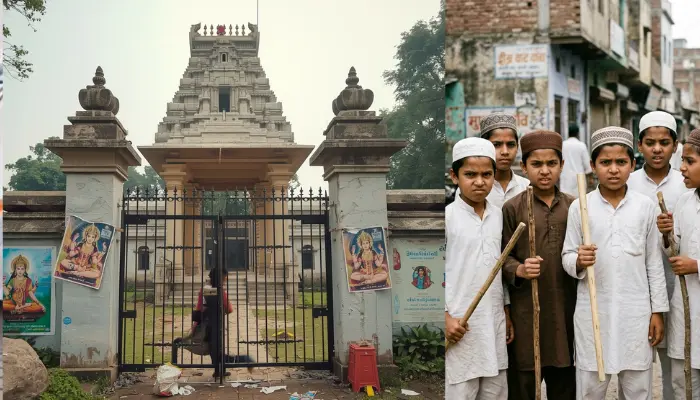
Case Summary
In Gomia, Bokaro, Jharkhand, a Hindu temple was targeted for vandalism by Muslim children. The accused vandalised the temple's gate and desecrated images of Hindu deities. This occurred during a Ramayana paath (recitation of the Ramayana) for the upcoming Ram Navami festival at the temple premises. This occurred at the Hosir Shiva Temple, under the Gomia police station in Bokaro district. This incident created a tense atmosphere in the area and caused widespread anger among the temple committee and Hindu villagers. Hindu organisations submitted a written application to the police demanding strict action against the accused. It was stated that while the Ramayana was recited inside the temple for Ram Navami, children from the Muslim community, walking along the road, desecrated the images of deities and vandalised the main gate of the temple. Following this incident, Hindu organisations were outraged. The temple committee and villagers apprehended one of the accused and handed him over to the Gomia police station. Police stated the matter was being investigated. Meanwhile, Vinay Kumar of the Vishwa Hindu Parishad (VHP) demanded strict action against the accused, urging the police not to undermine him by labelling him mentally ill or a child.
Why it is Hate Crime ?
This case has been added to the tracker under the primary category- Attack on Hindu religious representations. The subcategory selected is- Desecration of Hindu religious symbols. Icons and symbols or a religious representation of a spiritual ideal are widely revered in Hinduism. Iconography is of vital significance in the Hindu milieu. It helps connect people’s spiritual beliefs with the real world. Iconography within the Hindu faith takes several shapes and forms. Murtis are of most significance to Hindus, to which daily rituals, prayers and offerings are done. Besides the murtis, there are several other symbols which have deep significance in the Hindu faith – the Om and Swastika for example. Since these Hindu religious symbols hold paramount importance in Hinduism, any desecration of symbols, icons, murtis, religious representations and manifestations, is driven by animosity towards the faith itself which manifests itself through these murtis, icons and symbols. Therefore, any desecration of these Hindu religious symbols and representations is considered religiously motivated hate crimes under this category. The other subcategory selected is- Attack on Temples. In Hinduism, a temple is the abode of the Deity. The Deity in the Temple is consecrated, thereby, making it a real, breathing entity. Hindus believe that not just the Deity but the temple premises itself are sacred to Hindus since Hindus hold the faith that the entire Temple space is an amalgamation of the divine energy of the deity. Given the central significance of Temples in Hindu Dharma, any attack against a Hindu Temple or its peripheral premises is an attack on the faith itself and is born out of animosity towards the faith, of which, the Temple is a central tenet. Any manner of attack against a Temple and/or its premises would therefore be considered a religiously motivated hate crime. The other subcategory selected is- Defiling religious customs. Sanatan Dharma is not a religion of one book, which is to say that while it has religious scriptures that form the central tenets of the faith, there are several traditions followed through thousands of years, mostly passed from generation to generation orally. There are several such customs and traditions that are followed by various Hindus and Hindu sects. Defiling of these traditions and customs is a breach of an individual or group’s religious practices. Such practices can range from dietary restrictions like not eating non-vegetarian food for a certain period of the year, not eating non-vegetarian food at all, not eating beef since the cow is considered holy in Hinduism, the sanctity of religious customs followed in the house (like many ISCKON devotees), etc. Any malicious action leading to the breach of such traditions or defilement of these traditions owing to animosity towards the faith or for the sake of activism stems not only from the lack of faith in the religion itself but also from disregard for the faith of the devotees who follow the customs/traditions and implicit bias against the faith, the tradition itself. Since these specific traditions are central to the faith of the devotees of that specific sect of Hindus, any non-compliance with these traditional rules would be considered a religiously motivated hate crime. This case is a clear example of a religiously motivated hate crime as the Muslim perpetrators desecrated images of Hindu deities during a Ramayana recital event in the Shiva temple, specifically organised for the upcoming Ram Navami celebrations. In Hinduism, images of Hindu deities represent sacred manifestations of the divine, embodying profound spiritual power and serving as focal points for devotion, worship, and community connection to the eternal truths of the Hindu faith. The deliberate act of desecrating Hindu deities' images constitutes a direct assault on these revered symbols, revealing raw animosity towards Hindus and their beliefs. Such violations inflict deep emotional wounds on the Hindu community, shattering their sense of sanctity and security in worship, and unequivocally marking this as a religiously motivated hate crime. The perpetrators further vandalised the temple gates, deliberately targeting a core structural element of this sacred space. In Hinduism, temples stand as living embodiments of faith, cultural heritage, and intergenerational continuity, serving as the pulsating heart of religious life where devotees connect with the divine through worship, rituals, and communal gatherings, housing not just idols but the collective soul of the community’s devotion and history. Desecrating selective parts of a temple or assaulting its physical form equates to a vicious attack on the temple itself, demonstrating the religious animosity of the perpetrators. This act was committed during the Ramayana recital, a revered ritual involving the solemn, melodic recitation of the epic Ramayana over several hours or days, which instils timeless moral values like dharma, righteousness, devotion to Lord Rama as the ideal king and avatar of Vishnu, and a profound sense of unity among devotees who gather to immerse themselves in its teachings. This sacred paath fosters spiritual purification, strengthens familial and religious bonds, and heightens anticipation for festivals like Ram Navami by evoking Lord Rama’s divine birth and triumphs. The intrusion shattered the peaceful conduct of the event, desecrating the images, damaging the gates, and sowing chaos that disrupted every verse and prayer, effectively profaning the whole religious gathering and leaving devotees in stunned anguish. When such targeted desecrations strike during active worship, they expose the perpetrators' deep-seated religious animosity, aiming to instil pervasive fear in Hindus, desecrate their cherished customs like the Ramayana paath, and erode their right to practise faith undisturbed, cementing this as a clear case of religiously motivated hate crime. Another aspect to highlight is that this incident unfolded just days before Ram Navami, amidst the Ramayana paath explicitly held to prepare for the festival honouring Lord Rama's birth. The timing underscores a calculated effort to sow fear and chaos in the Hindu community right before a major Hindu celebration, amplifying the intent to intimidate and disrupt the festival. By striking at the temple during this heightened spiritual moment, the act sought to make Hindus feel vulnerable even in their places of worship, eroding their freedom to observe festivals without dread. Creating such pre-festival tension and disturbance transforms this into a textbook religiously motivated hate crime. The other disturbing aspect in this case is that all the accused were Muslim children. This sheds light on how, tragically, this animosity against the Hindus and their faith seems to be ingrained in them since childhood. The venomous seed of hatred has historically been sown by Muslim radicals, particularly targeting Hindus who have borne the brunt of this prejudice. They openly endorse the concept of Islamic supremacy and harbour animosity toward Hindus. Though it was Muslim children who desecrated the Hindu temple gate and images of deities, it highlights the Islamists' ingrained animosity against Hinduism, which catalyses these kinds of horrific acts. This instance has been added to the tracker, since disrespect for the Hindu religion is the primary purpose behind this incident. Given that this case meets all parameters of a religiously driven hate crime, it is being added to the hate crime database of the Hinduphobia Tracker. Disclaimer: The Hinduphobia Tracker records incident dates based on when the crime occurs, not when the media reports it. In this case, media reports have not specified the exact date of the incident. Hence, 22 March 2026, the date of media reporting, is selected as the indicative incident date for documentation purposes only. The Hinduphobia Tracker records the perpetrator count as "1". Media reports indicate multiple perpetrators were involved, but only one individual was specified without stating the total number. The perpetrator handed over to the police has thus been identified, and this count serves as a conservative estimate.


Case Status
Case sub-judice


Perpetrators Details
Perpetrators
Muslim Extremists
Perpetrators Range
One Person
Perpetrators Gender
male
 Sources




