Hindu religious sentiments insulted after Indian politician made remarks mocking Hindu deities
 Ranchi, Jharkhand, India
  17 March, 2026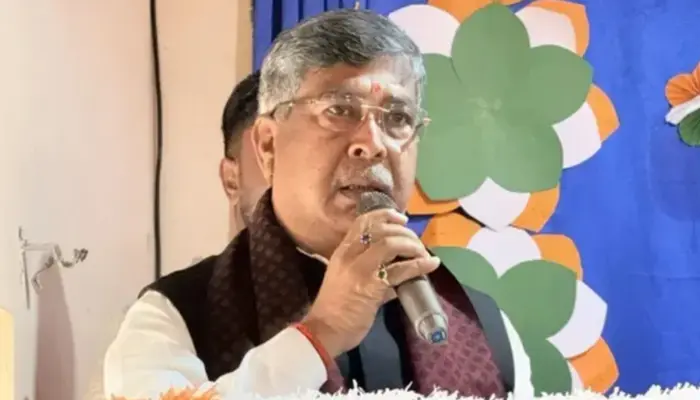
Case Summary
In Ranchi, Jharkhand, Hindu religious sentiments were insulted after Jharkhand Chief Minister Hemant Soren made remarks that mocked Hindu deities. The incident occurred on 18 March 2026 during the final day of the budget session of the Jharkhand state Assembly. While speaking in the Assembly, Soren mockingly said that despite the large-scale observance of Hindu religious practices such as Saraswati Puja, Lakshmi Puja, and Vishwakarma Puja, countries like Japan, the United States, and China excelled in education, wealth, and technical talent. He mockingly claimed, "We are among those who perform the most Saraswati Puja, yet the most brilliant children are born in Japan. We are among those who perform the most Lakshmi Puja, yet the richest people are born in America. Somewhere, something is wrong. We perform the most Vishwakarma Puja, even in our streets and neighbourhoods, but the talent is in China. There is something fishy somewhere." The remarks were widely circulated on social media, including by BJP (Bharatiya Janata Party) handles, which described the statement as an attack on Sanatan Dharma and an insult to Hindu faith and cultural practices. BJP leaders, including state president Aditya Sahu, condemned the statement, stating that it mocked Hindu deities and rituals and reflected an anti-Hindu mindset. Sahu further criticised the Chief Minister for what he described as hypocrisy, pointing out that Soren himself participated in Hindu rituals while simultaneously ridiculing them, and challenged him to make similar remarks about other religions. Union Minister Annapurna Devi also denounced the comments, stating that insulting Hindu gods and goddesses was unacceptable and amounted to disrespect towards longstanding traditions and beliefs. These statements triggered protests across multiple districts in Jharkhand, where demonstrators burned effigies of the Chief Minister and raised slogans against the remarks. Simultaneously, criticism was also directed at Soren’s participation in events such as Roza Iftar, with BJP leaders accusing him of selective respect towards religious communities.
Why it is Hate Crime ?
This case has been added to the tracker under the primary category- Hate Speech against Hindus. The subcategory selected is- Anti-Hindu slurs, mocking faith. Anti-Hindu slurs and the deliberate mocking of the Hindu faith owing to religious animosity involve the usage of derogatory terms, stereotypes, or offensive references to religious practices, symbols, or figures. One of the common anti-Hindu slurs used against Hindus is “cow-worshipper” and “cow piss drinker”. The intention of using this term is to demean and mock Hindus as a group and their religious beliefs since Hindus consider the cow holy. Additionally, some symbols and the slurs attached to them have a historical context that exacerbates the insult, hate, stereotyping, dehumanisation and oppression against Hindus. Cow worship has been used for centuries to denigrate Hindus, insult their faith and oppress Hindus specifically as a religious group. There has been overwhelming documentation about how cow slaughter has been used to persecute Hindus with cow meat being thrown in temples and places of worship. There has also been overwhelming documentation where cow meat (beef) has been force-fed to Hindus to either forcefully convert them to Islam or denigrate their faith. Apart from cow worship, the Swastika – which holds deep religious significance for the Hindus – has also been misinterpreted and distorted to use as a slur against Hindus. Similarly, the worship of the Shivling has been used by supremacist ideologies and religions to denigrate Hindus owing to religious animosity. Such slurs and denigration stem out of inherent animosity and hate towards Hindus and their faith, therefore, it is categorised as hate speech targeted at Hindus specifically owing to their religious identity. This case has been added to the tracker because derogatory remarks were made against Hindu religious practices and core elements of Hindu belief by Hemant Soren, the Chief Minister of Jharkhand, during a speech in the state Assembly. In his address, he drew a misleading comparison between the widespread observance of Hindu religious practices, such as Saraswati Puja, Lakshmi Puja, and Vishwakarma Puja, and the perceived success of countries like Japan, the United States, and China. By claiming that despite extensive participation in these religious observances, India lagged in intellectual, economic, and technical achievements, and by concluding that “something is wrong” and “something is fishy,” he implicitly portrayed Hindu religious practices as ineffective, irrational, and regressive. Such framing went beyond policy critique and instead cast aspersions on the value and legitimacy of deeply held religious traditions. In Hinduism, festivals and rituals such as Saraswati Puja, Lakshmi Puja, and Vishwakarma Puja hold profound spiritual and cultural importance. These observances are not merely ritualistic acts but represent the invocation of divine blessings for knowledge, prosperity, and skill, forming an integral part of the religious and social fabric of Hindu life. Millions of Hindus participate in these practices with deep devotion, viewing them as meaningful expressions of faith and continuity with sacred traditions. Publicly suggesting that such practices fail to yield any real-world benefit, and juxtaposing them unfavourably with other nations’ progress, trivialises their significance and undermines the spiritual beliefs associated with them. This reduces sacred traditions to objects of ridicule and invites broader societal dismissal of Hindu religious practices. By framing Hindu worship practices as indicative of societal failure, Soren effectively demeaned a core aspect of Hindu identity and belief. The remarks did not engage with religion in a neutral or analytical manner but instead employed a mocking tone where the societal backwards was blamed on Hindu customs. Such statements contribute to an environment where Hindu traditions can be belittled without consequence, eroding respect for the faith and its adherents. This is particularly significant given that the remarks targeted widely practised and publicly visible forms of worship, thereby amplifying their impact on the collective religious sentiment of the Hindu community. Furthermore, the statements were made by Hemant Soren, the Chief Minister of the Jharkhand. As a Chief Minister, his words carry institutional authority and have the potential to shape public discourse. When a constitutional office-holder publicly disparages the religious practices of a majority community, it risks legitimising similar expressions of contempt and normalising the denigration of that community’s beliefs. Such conduct from a position of power reinforces perceptions of bias and contributes to a broader climate of hostility towards Hindu traditions. Such actions are not isolated but align with a broader pattern wherein Hindu beliefs and practices are subjected to public ridicule under the guise of political commentary. By demeaning established religious traditions and presenting them as obstacles to development, Soren's remarks demonstrates an underlying prejudice against Hinduism and its adherents. This goes beyond legitimate discourse and enters the realm of hate speech, as it targets a religious community’s core beliefs in a manner that is dismissive, derogatory, and capable of inciting disrespect. Given that the accused’s statements openly trivialised and undermined widely practised Hindu religious traditions, and framed them as indicative of societal deficiency, the incident constitutes a clear instance of anti-Hindu hate speech. The remarks diminished the sanctity of Hindu worship practices, encouraged their ridicule, and contributed to a climate of disrespect towards the Hindu faith, thereby meeting the criteria for inclusion in the Hinduphobia Tracker’s hate crime database.


Case Status
Unknown


Perpetrators Details
Perpetrators
Others
Perpetrators Range
One Person
Perpetrators Gender
male
 Sources




