Hindu devotees on Navratri fast targeted by Muslim mob near Mallepalli mosque in Hyderabad; beaten severely
 Hyderabad, Telangana, India
  18 March, 2026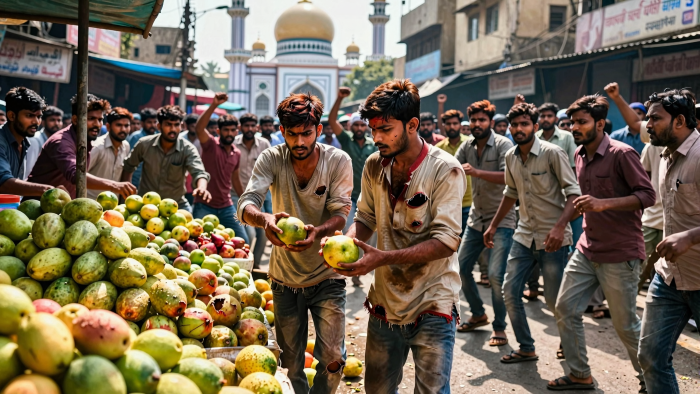
Case Summary
Two young Hindu men in the Mallepalli area of Hyderabad, Telangana, were brutally attacked by a mob of eight to ten Muslim youths near a large mosque on the first day of Chaitra Navratri. The Muslim mob beat the two young Hindu men so severely that their clothes were torn from their bodies, they were dragged along the ground, and one of them sustained fractures in his hands and legs, along with deep injury marks across his body. The incident was captured on video, which subsequently went viral. Police maintained a close watch on the area following the attack, given the tense atmosphere in the locality, with both Eid and Chaitra Navratri coinciding at the time of the incident. According to reports, on March 19, 2026 (Thursday), the first day of Chaitra Navratri, the two Hindu men went to a fruit stall in the Mallepalli area near a large mosque in Hyderabad to purchase fruit for their Navratri fast. Upon seeing them alone at the fruit stall, a mob of eight to ten Muslim youths who were present in the area targeted them and launched a violent attack. The mob beat the two young Hindu men with extreme brutality, tearing their clothes from their bodies and dragging them along the ground. The beating was so severe that the victims were unable to cry out. One of the Hindu young men sustained fractures in his hands and legs as a result of the assault, with deep injury marks visible across multiple parts of his body. Throughout the attack, the two young Hindu men were completely surrounded by a large Muslim crowd, leaving them entirely isolated and defenceless. The entire incident was captured on video and subsequently shared widely on social media. The viral video of the attack triggered significant tension in the Mallepalli area, with the atmosphere in the locality becoming charged given the coincidence of Eid and Chaitra Navratri at the time of the incident. Police deployed to the area and maintained a close watch on every corner of the locality to ensure that no inflammatory situation arose in the aftermath of the attack.
Why it is Hate Crime ?
The primary category for this case is "Attack not resulting in death". The sub-category for this case is "Attack against Hindu devotees". Hindu devotees are a few of the easiest targets of religiously motivated hate crimes because during the festival/procession/puja etc, for non-Hindus it is easy to profile their victims on the basis of religion. Hindu devotees come under attack on several occasions by individual non-Hindus or mobs of non-Hindus owing to their animosity against Hinduism, its symbols and tradition/practices. There are several instances of Hindu devotees being attacked while they worship in temples or temporary religious structures, during religious processions, doing bhajan/kirtan/puja in their own homes, in the residential society etc. These attacks are perpetrated by non-Hindus primarily because of their animosity towards Hindus and their faith. In some cases, the trigger for the violence may be non-religious, however, there are two elements that make these hate crimes. First, the Hindus who come under attack are attacked violently while indulging in religious activity. Whether they are in a place of worship or not is immaterial to the crime. When individuals are attacked while indulging in religious practices, the attack in itself is a hindrance to their freedom to practice religion and therefore constitutes a hate crime. Secondly, religious supremacist doctrines and ideologies deem religious practices of Hindus to be offensive ab initio since they are considered “sinful” by these ideologies, worthy to be annihilated by force or coercion. Driven by these religious supremacist ideologies and doctrines, the attacks against Hindu devotees stem from intrinsic animosity towards Hinduism. In some cases, the trigger for the violence may be non-religious, however, it develops into a religiously motivated crime during the course of the violence. Since these attacks stem from animosity towards Hindus and Hinduism, they are considered religiously motivated hate crimes under this category. Another sub-category for this case is "Attacked for Hindu identity". In several cases, Hindus are attacked merely for their Hindu identity without any perceived provocation. A classic example of this category of religiously motivated hate crime is a murder in 2016. 7 ISIS terrorists were convicted for shooting a school principal in Kanpur because they got ‘triggered’ seeing the Kalava on his wrist and tilak that he had put. In this, the Hindu victim had offered no provocation except for his Hindu religious identity. The motivation for the murder was purely religious, driven by religious supremacy. Such cases where Hindus are targeted merely for their religious identity would be documented as a hate crime under this category. One other sub-category that this case qualifies for is "Attacked for crossing 'Muslim area'" One of the reasons that Hindus get attacked unprovoked specifically by Islamists is for crossing ‘Muslim areas’. Essentially, Muslim mobs often attack Hindus crossing or present in certain areas which have a majority Muslim population. It has often been cited as one of the reasons to blame Hindus for attacks against themselves, signalling that Hindus displaying religious symbols, taking our religious processions or crossing any area which is dominated by Muslim residents is a provocation in and of itself. These areas are mostly ghettoized areas where mobs mobilize quickly to attack Hindus for a variety of reasons like playing music during a religious procession, crossing a mosque, wearing a tilak or any other religious symbol in a Muslim-dominated area, praying at a local temple in that area etc. There have been cases where the few local Hindus of that area have been attacked on their way to the Temple for prayers as well, simply because the area is considered a Muslim-dominated area. Several times, it is entirely possible that the immediate trigger for the violence against Hindus was non-religious in nature, however, the violence became religiously motivated in nature because the area was Muslim dominated and the residents on the whole harboured animosity towards Hindus, evidenced from the actions of the mob, the slogans, and the nature of the attack. Such crimes are motivated by the religious identity of the victims and are therefore classified as hate crimes under this category. Another sub-category for this case is "Communal clash/attack". Communal clash is a form of collective violence that involves clashes between groups belonging to different religious identities. For a communal clash between Hindus and non-Hindus to qualify as a religiously motivated hate crime, the trigger of the violence itself would have to be anti-Hindu in essence. For example, if there is a Hindu religious procession that comes under attack from a non-Hindu mob and after the initial attack, Hindus retaliate in self-defence, leading to a communal clash between the two religious communities. While at a later stage, both communities are involved in the clash/violence, the initial trigger of the violence was by the non-Hindu mob against the Hindus and therefore, it could safely be termed as an anti-Hindu violence. Further, the trigger would also have to be religiously motivated. In the cited example, the attack by the non-Hindu mob was against religious processions and therefore, can be concluded to be religiously motivated. In some cases, the trigger may be non-religious, however, it develops into religious violence against Hindus at a later stage. In such cases too, the foundational animosity towards Hindus becomes the motivating factor of the crime and therefore, it would be classified as a religiously motivated hate crime against Hindus under this category. This case bears clear indicators of a religiously motivated hate crime as two Hindu youths were violently attacked while engaged in a visible and ongoing religious act, namely purchasing fruit for their Navratri fast on the first day of Chaitra Navratri. The act of buying fruit specifically for vrat is not incidental but forms part of a recognised Hindu religious practice associated with fasting, purity, and devotion. Their identification in this context made their religious identity immediately apparent, indicating that the attack was triggered by their participation in a Hindu religious observance rather than by any personal dispute. The assault was entirely unprovoked. The victims had not engaged in any altercation prior to the incident and were simply carrying out a religious activity when they were surrounded and attacked by a group of Muslim youths. The absence of any prior conflict, combined with the timing and context of the attack, establishes that the violence was not spontaneous but directed at them because of their Hindu identity as expressed through their actions. The timing of the attack on the first day of Chaitra Navratri further reinforces its religiously targeted nature. Navratri is a period of heightened spiritual discipline during which devotees observe fasting and ritual purity. Targeting individuals at the very moment they are preparing to observe such a fast demonstrates not only awareness of the religious significance of the act but also a deliberate choice to strike at a point of heightened religious sensitivity. The location of the attack also carries significance. The assault took place near a mosque in an area where the attackers were present in numbers, enabling them to act collectively against two isolated individuals. This reflects a situation where Hindu individuals, even while engaged in ordinary or religious activities, become vulnerable in spaces where they are outnumbered. Such incidents contribute to an environment in which members of the Hindu community may feel intimidated or unsafe in accessing certain public spaces, particularly during religious observances. The nature of the violence further underscores its targeted character. The victims were surrounded by a mob, beaten severely, dragged, and left defenceless. Mob attacks of this kind go beyond individual aggression and function as collective acts that amplify fear and send a wider message of intimidation to the community. The brutality inflicted on the victims, combined with their isolation within a hostile crowd, reflects an intention not only to harm but also to instil fear. The incident therefore cannot be reduced to an isolated act of violence. It reflects a pattern in which Hindu individuals are targeted while visibly practising their faith, particularly during significant religious periods. When individuals are attacked in the course of performing a religious act, without provocation, and in a manner that creates fear within the broader community, the violence assumes a clearly religious dimension. Taken together, the targeting of individuals engaged in a Hindu religious practice, the absence of provocation, the timing during a sacred festival, the location that enabled group intimidation, and the collective nature of the assault establish that the victims were attacked because of their Hindu identity. Accordingly, the case displays clear markers of a religiously motivated hate crime and has been recorded in the Hinduphobia Tracker database.
Victim Details
Total Victim
2
Deceased
0
Gender
- Male 2
- Female 0
- Third Gender 0
- Unknown 0
Caste
- SC/ST 0
- OBC 0
- General 0
- Unknown 2
Age Group
- Minor 0
- Adult 0
- Senior Citizen 0
- Unknown 2


Case Status
Complaint not filed


Perpetrators Details
Perpetrators
Muslim Extremists
Perpetrators Range
From 5 to 10
Perpetrators Gender
male
 Sources




