Hindu residents lured to healing meeting, offered inducements for Christian conversion; perpetrators abused Hindu deities
 Gumia, Jharkhand, India
  21 March, 2026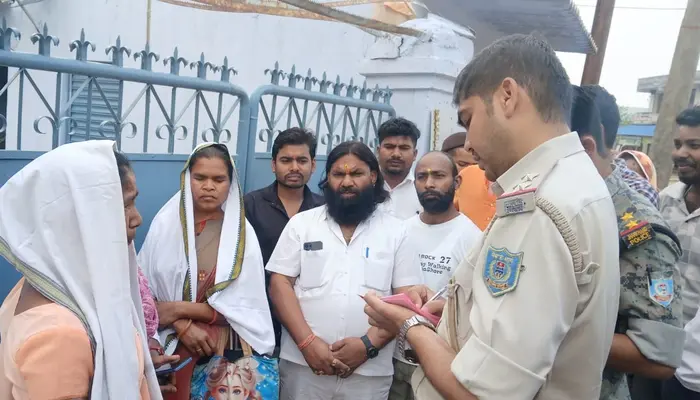
Case Summary
In Sisai town of Gumla district, Jharkhand, Hindu residents were lured to a healing meeting and offered inducements by Christian women. The perpetrators also abused Hindu deities in an effort to convert people. The incident occurred on 21 March 2026 in the Kumhar Mod area along Charda Road within the jurisdiction of Sisai police station, where five Christian women, identified as Romila Minj, Kiran Kujur, Shakira Tirkey, Sushila Devi, and Indu Devi, were moving door to door distributing pamphlets and encouraging residents to attend a healing meeting. During these interactions, they promoted the meeting as a means to attain relief from illness, promising good health and freedom from disease, while simultaneously urging Hindu residents to abandon their existing religious traditions. Furthermore, a local Hindu resident named Anand Sahu stated that the Christian women reached his house and repeatedly pressured him to renounce his faith and attend the healing meeting, while also making objectionable remarks about Hindu gods and goddesses. Following this, he informed members of Vishwa Hindu Parishad, Bajrang Dal, and Hindu Jagruti Manch, who subsequently reached the location in large numbers and staged a protest. The growing crowd created a tense atmosphere, prompting swift action from the local police, who arrived at the scene, brought the situation under control, and escorted the women safely to the police station to prevent any escalation. Subsequently, members of the Hindu organisation submitted a written application to the police stating that the Christian women were attempting to convert Hindu residents by luring them through inducements and by disparaging Hindu deities. The police detained the five women and initiated an inquiry into the matter, examining the pamphlets and the nature of the gathering being promoted. Several local figures and organisation members were present during the incident, including Sanjay Kumar Verma, VHP district functionary Manish Babu, Bajrang Dal members Saurav Tamrakar and Rohit Sharma, along with others such as Mukesh Srivastava David, Ashish Yadav, Bittu Gupta, and Vikram Kumar. Law enforcement officials maintained a visible presence in the area following the incident and appealed to residents to preserve peace while the investigation proceeded.
Why it is Hate Crime ?
This case has been added to the tracker under the primary category of - Predatory Proselytisation. Within it, the sub-category selected is- Proselytisation by grooming, brainwashing, manipulation or subtle indoctrination. Religious brainwashing essentially means the often subtle and forcible indoctrination to induce someone to give up their religious beliefs to accept contrasting regimented ideas. Religious grooming or brainwashing also involves propaganda and manipulation. It involves the systematic effort, driven by religious malice and indoctrination, to persuade “non-believers’ to accept allegiance, command, or doctrine to and of a contrasting faith. Cases of such grooming or brainwashing are far more nuanced than direct threats, coercion, inducement and violence. In such cases, it is often seen that there is repeated, subtle and continual manipulation of the victim to induce disaffection towards their own faith and acceptance of the contrasting faith of the perpetrator. While subtle indoctrination is widely acknowledged as predatory, an element which is often understated in such conversions or the attempts of such conversion is the role of loyalty and trust which might develop between the perpetrator and the victim. Fiduciary relationships are often abused to affect such religious conversion. For example, an educator transmitting religious doctrine of a competing faith to a Hindu student. The Hindu student is likely to accept what the teacher is transmitting owing to existence of the fiduciary relationship. The exploitation of the fiduciary relationship to religiously indoctrinate victims would also be included in this category. Since the underlying animosity towards the victim’s faith forms the basis of predatory proselytization, such cases are considered religiously motivated hate crimes. The other sub-category selected is - Conversion/ attempts to convert by inducement. Predatory Proselytisation is not just limited to threat, harassment, force and violence, but it also has contours of stealth. In several cases, the Hindu victim is exploited to convert, with non-Hindus taking advantage of their poverty. In such cases, the Hindu victim who is suffering financially is offered monetary benefits, including lucrative offers for jobs, health treatment, education, etc, to induce the victim into changing his/her religion. In such cases, the religious identity of the victim and the aim to disenfranchise him from his faith form the heart of the crime. Also, taking advantage of and exploiting an individual’s economic vulnerabilities is widely acknowledged as exploitation, forms of which are often penalised by law. Such cases, therefore, are considered religiously motivated hate crimes since the victim’s religious identity forms the very heart of the crime itself. The other sub-category selected here is - Harassment, threats, coercion for conversion. Harassment covers a wide range of behaviours of an offensive nature. It is commonly understood as behaviour that demeans, humiliates, and intimidates a person, including threats and coercion. Harassment and threats, in this case, find their root on discriminatory grounds which has the effect of nullifying a person’s rights or infringing upon his freedom to exercise his right specifically owing to the victim’s religious identity. Verbal and physical threats and psychological or physical harassment are often used against Hindu victims because they choose to practice their professed religion. Religious harassment also includes forced and involuntary conversions by harassment, threats or coercion. Coercion includes intimidatory tactics like force-feeding a Hindu victim beef to convert to another religion, forceful circumcision etc. In several cases documented, non-Hindu perpetrators or those who harbour specific animosity towards Hinduism, harass victims simply based on their religious identity. Such cases often also include harassment to ensure the Hindu victim abandons his/her professed religion and adopts the religion of the perpetrator. Such cases where Hindu victims are harassed to convert to the perpetrator’s religion are rooted in animosity towards the victim’s religious identity and are therefore documented as religiously motivated hate crimes. This case has been added to the tracker because Hindu residents in Sisai, Gumla district, Jharkhand, were specifically targeted for conversion under the guise of a “healing meeting” by Christian women. Firstly, the format of the event itself reflects a structured method of concealed proselytisation. The women involved were luring Hindu residents to a healing meeting, also known as Changai Sabha. The Changai Sabha format, often described publicly as a faith healing gathering, is a well-recognised tool in organised Christian proselytisation networks. These meetings usually employ songs, testimonies and emotionally charged prayer sessions to influence and induce vulnerable individuals without openly declaring the underlying objective. The absence of transparency is itself central to the method. People attend believing they are seeking comfort, healing or spiritual support, only to be gradually drawn into teachings that undermine their own religious identity and introduce them to the Christian framework presented as the only path to relief. Secondly, the perpetrators also offered inducements and promised relief from illness, good health and freedom from disease in an effort to convert Hindus. Offering incentives, especially when directed at vulnerable individuals in need, shows that these incentives are not acts of kindness or charity. Instead, they are calculated moves to exploit vulnerable Hindus because of their religion. By providing inducements in exchange for conversion, the accused were effectively blackmailing those who might have been desperate for assistance or hope. Such instances are seen in many cases where members of Christian missionary groups target socially and economically vulnerable Hindus to further their agenda of religious conversions. This form of coercion strips people of their agency and dignity and results in coerced conversions. These are not random or isolated incidents, but rather cases deeply rooted in religious animosity towards Hindu victims. Thirdly, the victim, Anand Sahu, also revealed that the perpetrators had made objectionable remarks about Hindu gods and goddesses. This goes beyond religious debate or proselytisation; it constitutes an act of incitement and insult directed at the core beliefs of the Hindu community. Such remarks are designed to demean and undermine the faith of Hindus and intend to create an inferiority complex in the minds of the victims against their own faith. This fosters an environment of hostility and disrespect towards the Hindu community and Hindu deities. These acts of insulting Hinduism stem from Christian theology, which harbours disdain and hatred for polytheistic faiths, and which categorises Hindus as ‘polytheists’, thereby fostering hatred against them. Such actions make the religiously motivated nature of the crime even more evident. Fourth, pressuring a Hindu individual to discard his religious faith and embrace another was a direct attack on his religious identity and dignity. It was not a matter of personal choice; it was coercion rooted in hostility towards the victim's Hindu identity. Such an attempt reflects religious animosity because the act was not simply about personal differences but about erasing the victim’s Hindu faith, making it a religiously motivated crime. The Christian faith, by its very theological foundations, places a strong emphasis on proselytisation. In pursuit of conversion objectives, Christian evangelists often employ unethical means, ranging from psychological pressure and misinformation to inducements such as money or jobs. This systematic attempt to erode the religious foundation of individuals and replace it with allegiance to another faith reflects deep religious malice and animus against the Hindu identity. Disclaimer: The Hinduphobia Tracker acknowledges that multiple Hindu residents in the area were approached and targeted for conversion. However, only one individual, Anand Sahu, was explicitly identified and documented in available reports. Accordingly, the victim count for this case has been conservatively recorded as one.
Victim Details
Total Victim
1
Deceased
0
Gender
- Male 1
- Female 0
- Third Gender 0
- Unknown 0
Caste
- SC/ST 0
- OBC 1
- General 0
- Unknown 0
Age Group
- Minor 0
- Adult 1
- Senior Citizen 0
- Unknown 0


Case Status
Arrested


Perpetrators Details
Perpetrators
Christian Extremists
Perpetrators Range
From 2 To 5
Perpetrators Gender
female
 Sources




