Hindu temple premises illegally encroached upon, temple property misused by Muslim man in Jalaun, Uttar Pradesh
 Jalaun, Uttar Pradesh, India
  18 March, 2026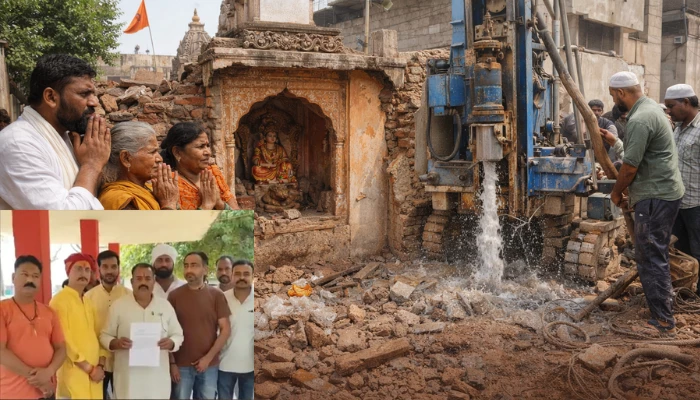
Case Summary
In Jalaun tehsil, the land of the well-known ancient Hindu Maa Singh Vahini Temple, located in the village Kuda, was illegally encroached upon by a Muslim man. Upon receiving information of the incident, a delegation from the Vishwa Hindu Parishad submitted a written complaint to Jyoti Singh, Sub-Divisional Magistrate of Konch, seeking immediate administrative intervention. The complaint stated that Muslims had been gradually encroaching upon the land surrounding the temple. Office bearers of the organisation alleged that a Muslim man named Afzal Qureshi ( The team at Hinduphobia contacted the district vice-president of VHP, Saket Shandilya and confirmed the identity of the accused), had attempted to encroach upon the temple land. They stated that such actions had hurt the religious sentiments of the Hindu community. The complaint further mentioned that a tube well installed within the temple premises had been fitted with a motor and was being used for private purposes. This, according to the complainants, amounted to misuse of temple property. The organisation stated that such activities could escalate into a larger dispute if not addressed promptly, and therefore urged the administration to take strict action at the earliest. They further warned that if no concrete action was taken within one week, they would be compelled to organise protests on a larger scale. The complainants also stated that in the event of any law-and-order situation arising due to inaction, the responsibility would lie entirely with the administration. No official statement had been issued by the administration at the time. However, Jyoti Singh confirmed receipt of the complaint and assured that the matter would be investigated and appropriate action would be taken. During the submission of the complaint, several members of the organisation were present, including district vice-president Saket Shandilya, city president Santosh Tiwari, Shishir Pratap, Mahendra Chanderiya, Sumit Agarwal, Satyendra Gurjar, Sachin Gurjar, Sumit Gurjar, Nirmal Goswami, Vivek Tiwari, Gopal Gupta, Shubhanshu Bundela, Dev Raja, and Anshul Thakur.
Why it is Hate Crime ?
This case is being added to the tracker under the primary category- Attack on Hindu religious representations. The selected subcategory is: Encroachment or illicit takeover of temple land or land near the temple. In Hinduism, a temple is the abode of the Deity. The Deity in the Temple is consecrated, thereby making it a real, breathing entity. Hindus believe that not just the Deity but the temple premises itself are sacred, since they hold that the entire Temple space is an amalgamation of the deity's divine energy. Not only the Temple, but the Temple premises in their entirety, are considered sacred by Hindus. In several cases, the premises of the Temple and/or religious centre are illegally taken over by institutions of other faiths, such as the Waqf board or the Church. Other times, the temple property, land or the property of religious centres are illicitly encroached upon by non-Hindu groups. Any illicit takeover or encroachment is a crime an initio; however, when non-Hindu groups illicitly take over or encroach on the sacred land of Hindus, it is an affront to the Hindu community and is therefore classified as a religiously motivated hate crime under this category. This incident was recorded under the Hinduphobia Tracker because the land surrounding the ancient Maa Singh Vahini Temple had been encroached upon, including the installation of a borewell for private use. Such actions threatened the integrity of the temple premises and interfered with the community’s access to a sacred religious space. In Hindu tradition, temples were not confined to the inner sanctum alone. The surrounding land formed an essential part of the religious ecosystem, allowing devotees to gather, perform rituals, and participate in daily worship. This was particularly significant in temples dedicated to forms of the Divine Mother, where devotees regularly visited for darshan, offerings, and community-based religious observances. When such land was encroached upon or repurposed for private use, it did not merely alter property boundaries; rather, it disrupted established patterns of worship and collective religious life that had continued for generations. This interference, though not framed as a direct prohibition, had effectively restricted the use and sanctity of the temple space. The installation of a borewell within the temple premises for non-religious purposes indicated a shift from sacred to utilitarian use, thereby undermining the religious character of the site. Consequently, devotees were faced with a diminished and disturbed environment for worship, where access and engagement were constrained in practice, even if not formally denied. Moreover, the Constitution of India, under Article 25, guaranteed every individual the freedom to profess and practise religion. Judicial interpretation had consistently affirmed that this right extended to the performance of essential and customary religious practices. Any act that obstructed access to a place of worship or altered its functional character struck at the core of this constitutional protection. Furthermore, India’s constitutional framework rested on the principle of secularism, which required the State to ensure that all communities could practise their faith without obstruction. This obligation included safeguarding religious spaces from encroachment and misuse. When temple land was subjected to unauthorised use and left vulnerable to encroachment, it reflected a failure to uphold this constitutional duty. Overall, the importance of temple land lay in its function as a living space of devotion. It sustained rituals, enabled gatherings, and preserved the continuity of faith. Encroachment upon such land disrupted this balance, created tension, and weakened the spiritual environment of the community. What emerged was not merely a land dispute but a gradual erosion of religious practice and cultural heritage. Therefore, this case was recorded under the tracker. Disclaimer: The Hinduphobia Tracker recorded incident dates based on when the crime occurred, rather than when it was reported in the media. In this case, the exact date of the incident was not specified in reports. Therefore, 19 March 2026, the date of the earliest available report, was taken as the indicative date for documentation purposes.


Case Status
Complaint filed


Perpetrators Details
Perpetrators
Muslim Extremists
Perpetrators Range
One Person
Perpetrators Gender
male
 Sources




