Hindu youths brutally attacked after being identified by their kalavas; Muslim perpetrators invoke 'Uttam Nagar incident', threaten to beat them more because they were Hindus
 Kanpur, Uttar Pradesh, India
  17 March, 2026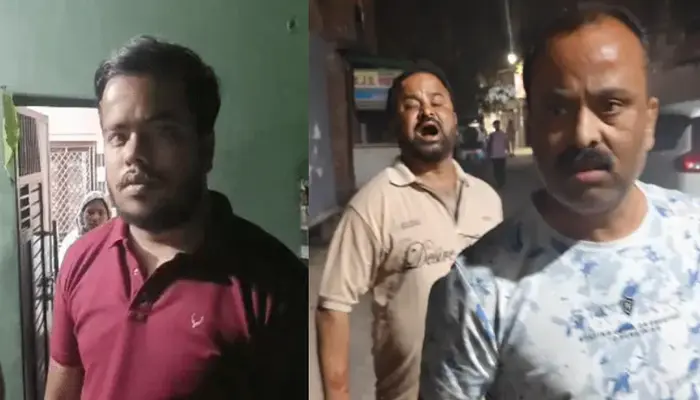
Case Summary
In the Kidwai Nagar area of Kanpur, two Hindu youths were brutally assaulted for their religious identity. What started over a minor vehicular collision escalated into a full-blown communal attack when the Muslim perpetrators identified the victims as Hindus through their kalavas (sacred thread) and kadas (bracelet). One of the Hindu victims, Rahul Kumar Sharma, a resident of Juhi Lal Colony, stated that he was travelling with his friend Akash Sachan when their scooter collided with a car on the night of 18 March 2026. Immediately after the collision, three Muslim men, identified as Shamshad, Naushad, and Sartaj, and a Muslim woman, exited the vehicle and began verbally abusing the victims. The situation escalated rapidly when the Muslim perpetrators noticed the sacred thread (kalava) and bracelets (Kada) on the victims’ hands, upon which they explicitly identified them as Hindus and declared that they would be beaten more for that reason. They said, "You're a Hindu, we'll beat you more… This isn't Delhi's Uttam Nagar." Uttering those words, the Muslim perpetrators then brutally assaulted the victim with kicks and punches. Furthermore, when the victim's friend, Akash Sachan, attempted to intervene, he was also assaulted. The Muslim attackers escalated the violence by attacking the victims with sticks, rods, and bricks, due to which Akash sustained severe injuries, including heavy bleeding from the eye and nose. During the course of the violence, the Muslim woman, who was present with the attackers, forcibly snatched a mobile phone from the victims. The Muslim attackers also resorted to pelting bricks and stones, creating panic in the surrounding area. The commotion led to the gathering of people from both sides, escalating communal tensions in the area, before police intervention brought the situation under control. Subsequently, a case was registered at the Kidwai Nagar police station against the named accused, and an investigation was initiated, including examination of CCTV footage from the vicinity. Station House Officer Dharmendra Kumar Ram confirmed that action was underway in response to the complaint and that efforts were ongoing to identify and apprehend all those involved.
Why it is Hate Crime ?
This case has been added to the tracker under the primary category of - Attack not resulting in death. Within it, the sub-category selected - Attacked for Hindu identity. In several cases, Hindus are attacked merely for their Hindu identity without any perceived provocation. A classic example of this category of religiously motivated hate crime is a murder in 2016. 7 ISIS terrorists were convicted for shooting a school principal in Kanpur because they got ‘triggered’ seeing the Kalava on his wrist and tilak that he had put. In this, the Hindu victim had offered no provocation except for his Hindu religious identity. The motivation for the murder was purely religious, driven by religious supremacy. Such cases where Hindus are targeted merely for their religious identity would be documented as a hate crime under this category. The other sub-category selected is - Attacked for opposing radicals or trying to save victim. In several cases, Hindus are attacked for opposing religiously motivated crimes being committed against a fellow Hindu or simply for voicing an opinion opposing radical elements, who either have in the past or continue to persecute Hindus. In such cases, the initial attack against the victim, against which the Hindu was trying to defend the victim, would also need to be classified as a religiously motivated hate crime. Since the initial crime itself was religiously motivated and the subsequent crime of attempting to save the victim or speaking against the radical elements ends up inviting a violent attack, it would also be classified as a religiously motivated hate crime under this category. The other category selected is- Hate speech against Hindus, and within this, the subcategory selected is- Violent threats. Violent threats, explicit, implicit or implied, is the most dangerous form of hate speech since it goes beyond discriminatory and prejudicial language to express the intent of causing harm to an individual or a group of people based on their religious identity and faith. There could be several different kinds of threats that are issued to Hindus based on religious animosity. An explicit threat would mean the direct threat of violence towards an individual Hindu, a group of Hindus or Hindus at large. Physical violence, death threats, threats of destruction of property belonging to Hindus and threats of genocide would mean explicit threats against Hindus for their religious identity. Implicit threats may not be a direct threat but implied through the use of symbols of actions – for example – in the Nupur Sharma case, other than explicit threats, there were also implicit threats when Islamists took to the streets to burn and beat her effigies. It implies that they want to do the same to Nupur Sharma – thereby is considered an implicit threat. Violent threats can be delivered in person, through letters, phone calls, graffiti, or increasingly through social media and other online platforms. It would be important to understand that a threat – explicit or implicit, online or offline – to an individual who happens to be a Hindu does not qualify as a religiously motivated threat. Such a threat, while vile and dangerous, could be owing to non-religious reasons and/or personal animosity. To qualify as a religiously motivated threat, it would need to exhibit an indication that the individual is being targeted for religious reasons and/or owing to his/her religious identity as a Hindu. This case constitutes a clear instance of a religiously motivated hate crime, as the Hindu victims were explicitly identified, targeted, and subjected to brutal violence by the Muslim perpetrators because of their Hindu identity. The Muslim perpetrators saw that the victims were wearing the sacred thread (kalava) and bracelets (kada) on their hands, after which they launched a violent assault on them. The incident, which initially arose from a minor vehicular collision, escalated into targeted brutality only after the perpetrators noticed these religious identifiers and verbally acknowledged the victims’ Hindu identity, stating, “You’re a Hindu, we’ll beat you more… This isn’t Delhi’s Uttam Nagar.” This direct verbal articulation establishes clear intent, demonstrating that the violence was not limited to a road rage incident but was aggravated and intensified due to religious bias against Hindus and their visible markers of faith. The kalava and kada are not mere ornaments but hold deep religious and cultural significance within Hinduism, symbolising faith, protection, and spiritual discipline. Their presence among the victims made their religious identity immediately recognisable, which the perpetrators used as a basis for the escalation of violence. The conscious decision to intensify the assault upon identifying these markers demonstrates entrenched hostility towards the Hindu faith and its public expression. By singling out the victims and launching a violent assault on them simply because they were Hindus, the perpetrators transformed a routine dispute into a targeted act of religious aggression. The nature and scale of the violence further reinforce the religious motivation behind the attack. The perpetrators did not confine themselves to verbal abuse or a limited physical altercation but escalated to brutal assault using sticks, rods, and bricks, causing severe injuries, including bleeding from the eye and nose of one of the victims. Such excessive and disproportionate violence over a minor collision indicates punitive intent, aimed at inflicting maximum harm as retribution for the victims’ religious identity. Furthermore, the attack on the victim's friend when he attempted to intervene underscores the extent and intensity of the perpetrators’ aggression and religious hatred. He was not part of the initial dispute, yet was deliberately targeted for attempting to assist a visibly Hindu victim, which indicates that the attackers were unwilling to relent and continued the violence simply because the victims were Hindus. This demonstrates a level of entrenched animosity towards the victim’s religious identity, where even acts of assistance were met with brutality. The attack on the friend also functioned as a broader message of intimidation, signalling that any Hindu who stepped forward to help or defend the victim would also be subjected to severe violence. Such conduct reinforces the coercive and terrorising nature of the assault, extending its impact beyond the immediate victims to the wider Hindu community. Additionally, the perpetrators’ reference to “this isn’t Delhi’s Uttam Nagar” is particularly significant, as it invokes an incident in Uttam Nagar, Delhi, where a Hindu man, Tarun Kumar Khatik, was beaten to death after a child accidentally spilt coloured water on a Muslim woman during Holi celebrations. By explicitly drawing this comparison during the assault, the attackers signalled an awareness of that incident and used it as a point of intimidation, implying that similar or even greater violence could be inflicted on the Hindu victim in the present context. This statement was not incidental but functioned as a death threat, reinforcing the communal nature of the attack and framing the victims’ Hindu identity as a basis for escalated brutality. The attackers used the Delhi incident involving fatal violence against a Hindu individual to legitimise their actions and threaten victims into submission, The progression of the incident, from a minor collision to identity-based verbal targeting, followed by violent assault, demonstrates a clear pattern of religious escalation. The explicit reference to the victims’ Hindu identity as justification for increased violence demonstrates religious hatred. This was not an incidental or ambiguous factor but a declared reason for the brutality inflicted, revealing deep-seated prejudice and hostility towards Hindus and their religious practices. Therefore, the attack was rooted in anti-Hindu animosity, where visible expressions of faith became the trigger for the escalation of violence. Such acts not only harm the immediate victims but also serve to instil fear within the broader Hindu community, discouraging the open display of religious identity in public spaces due to fear of violence. Since the violence inflicted on the victims was because of their Hindu identity, this case has been added to the tracker.
Victim Details
Total Victim
2
Deceased
0
Gender
- Male 2
- Female 0
- Third Gender 0
- Unknown 0
Caste
- SC/ST 0
- OBC 1
- General 1
- Unknown 0
Age Group
- Minor 0
- Adult 0
- Senior Citizen 0
- Unknown 2


Case Status
Complaint registered


Perpetrators Details
Perpetrators
Muslim Extremists
Perpetrators Range
From 2 To 5
Perpetrators Gender
female
 Sources




