Sacred Hindu language targeted: Harvard's grotesque mockery of sacred Sanskrit language exposes institutional Hinduphobia in USA
 Cambridge, Massachusetts, United States
  27 February, 2026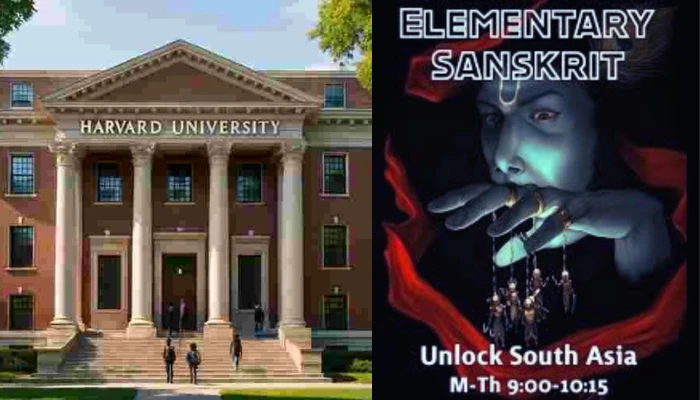
Case Summary
In Cambridge, USA, the Hindu religion was targeted and assaulted through sharing a post demonising the sacred Sanskrit language by the Department of South Asian Studies, Harvard University. The department shared a promotional post for its elementary Sanskrit course on social media. The post included an artwork to visually represent the course. The artwork shared in the course was titled “Master of Puppets”. It was created by Indian artist Anirudh Sainath under the brand Molee Art. It was claimed that the visual drew inspiration from Hindu epics such as the Mahabharata and themes associated with Krishna’s Ras Leela. Following the post, members of the Hindu community and organisations raised objections to the imagery. The Coalition of Hindus of North America(COHNA) stated that the artwork portrayed Sanskrit and Hindu traditions in a negative and distorted manner. The organisation described the depiction as “blatant Hinduphobia” and likened the visual to something resembling a “horror movie”. Social media users also criticised the portrayal, stating that sacred elements of Hindu tradition were presented in a dark, manipulative, and oppressive tone. Concerns were raised that Sanskrit, described as a sacred language tied to Hindu civilisation, was being misrepresented through such imagery. Amid the backlash, Harvard University issued a formal statement acknowledging the concerns. The Department of South Asian Studies stated that it “deeply regrets the posting of an insensitive image” in relation to its Sanskrit programme. The university subsequently removed the artwork from its promotional material. It also stated that it would review its internal social media processes to ensure that future content aligns with the department’s academic mission and cultural sensitivity. Harvard further clarified that the post was unrelated to the Lakshmi Mittal and Family South Asia Institute, describing it as a separate entity within the university. The incident sparked broader online discussion about the representation of Hindu traditions and Sanskrit in Western academic institutions and the need for greater cultural sensitivity in academic communication.
Why it is Hate Crime ?
This case is being added to the tracker under the primary category- Hate Speech against Hindus. Within this, the subcategory selected is- Anti-Hindu slurs, mocking faith. Anti-Hindu slurs and the deliberate mocking of the Hindu faith owing to religious animosity involve the usage of derogatory terms, stereotypes, or offensive references to religious practices, symbols, or figures. One of the common anti-Hindu slurs used against Hindus is “cow-worshipper” and “cow piss drinker”. The intention of using this term is to demean and mock Hindus as a group and their religious beliefs since Hindus consider the cow holy. Additionally, some symbols and the slurs attached to them have a historical context that exacerbates the insult, hate, stereotyping, dehumanisation and oppression against Hindus. Cow worship has been used for centuries to denigrate Hindus, insult their faith and oppress Hindus specifically as a religious group. There has been overwhelming documentation about how cow slaughter has been used to persecute Hindus, with cow meat being thrown in temples and places of worship. There has also been overwhelming documentation where cow meat (beef) has been force-fed to Hindus to either forcefully convert them to Islam or denigrate their faith. Apart from cow worship, the Swastika – which holds deep religious significance for the Hindus – has also been misinterpreted and distorted to use as a slur against Hindus. Similarly, the worship of the Shivling has been used by supremacist ideologies and religions to denigrate Hindus owing to religious animosity. Such slurs and denigration stem from inherent animosity and hate towards Hindus and their faith; therefore, it is categorised as hate speech targeted at Hindus specifically owing to their religious identity. The other subcategory selected is- Anti-Hindu subversion and prejudice. Hate speech is defined as any speech, gesture, conduct, writing, or display that is prejudicial against a specific individual and/or group of people, which leads to or may lead to violence, prejudicial action or hate against that individual and/or group. Media plays a specific and overarching role in perpetuating prejudicial attitudes towards a community owing to unfair, untrue coverage and/or misrepresentation/misinterpretation, selective coverage and/or omission of facts of/about issues affecting a specific religious group. This type of bias can dehumanise the victim group, making it easier for others to justify harmful actions against them, which aligns with the objectives of hate speech laws aimed at preventing such harm. It is often observed that the media takes a prejudicial stand against the Hindu community, driven by their need to shield the aggressor community, which happens to be a numeric minority; however, that is the one perpetrating violence against Hindus. For example, the media is often quick to contextualise religiously motivated crimes against Hindus, omit or misrepresent facts that point towards religiously motivated hate crimes, justify and/or downplay religiously motivated hate crimes, or simply present fake news to stereotype Hindus. Such media bias leads to the denial of persecution and is often used to dehumanise Hindus, leading to justification for violence against them. For example, the media covered several fake allegations of Hindus targeting Muslims and forcing them to chant Jai Shree Ram. Most of these cases were proved false and fabricated after police investigation. These fake news reports were subsequently never retracted or clarified. Such fake news led to the justification of violence and dehumanisation of Hindus based on the argument that since Hindus targeted Muslims and forced them to chant Jai Shree Ram, the dehumanisation of Hindus and violence against them was par for the course and merely a retaliation. Such media bias leads to prejudicial portrayals of Hindus and offers a justification for violence against them and, therefore, is considered hate speech under this category. This case was a clear instance of anti-Hindu prejudice and institutional insensitivity targeting Hindu religious identity and sacred traditions. Harvard University, one of the most influential academic institutions in the world, used imagery to promote a Sanskrit programme that distorted and misrepresented Hindu civilisational elements. At the outset, Sanskrit does not merely form part of an academic subject. Instead, it was a sacred language deeply intertwined with Hindu scriptures, rituals, and philosophical traditions. The use of imagery that portrayed these elements in a dark, manipulative, and grotesque manner was not an innocent artistic choice at all. Instead, it was intentionally used to undermine the sanctity of Hindu traditions and hurt the religious sentiments of Hindus. Though Harvard later apologised through a social media post. But what is pertinent to mention here is that Harvard University issued its apology only after objections were raised by the Coalition of Hindus of North America (CoHNA). This indicated that the response was not voluntary or reflective of prior sensitivity, but was instead prompted by external pressure. Therefore, it clarified further that the original intent behind the depiction had not been accidental but intentional. Furthermore, this was not an isolated lapse in judgment that could be dismissed as a one-time blunder committed by Harvard. On the contrary, it was a repeat offence and formed part of a broader, recurring pattern. The institution had repeatedly engaged with narratives that portrayed Hinduism and associated traditions in a negative light. For instance, the same pattern was visible in 2020, when Harvard University Press used the 1917 cartoon “Millstone of the Caste System”, depicting a grotesque Hindu priest crushing lower-caste individuals, to promote academic work. Consequently, that imagery reduced an entire civilisation to a caricature of oppression, thereby reinforcing colonial-era stereotypes about Hindu society. Moreover, Harvard’s involvement in the 2021 “Dismantling Global Hindutva” conference exposed the ideological framework within which such representations emerged. The conference openly advanced the position that Hindutva and Hinduism were inseparable, thereby implying that dismantling one required dismantling the other. This conflation was not an academic critique; rather, it was a deliberate attempt to delegitimise Hindu identity itself. By associating Hindu civilisational expressions with supremacism and violence, such platforms normalised hostility against Hindus while cloaking it in the language of scholarship and activism. Accordingly, the repeated use of such narratives revealed that what Harvard described as a “mistake” was not accidental but reflective of an entrenched bias. When sacred symbols, language, and traditions of one community were consistently portrayed through a lens of distortion, fear, or ridicule, it inevitably fostered an environment where that community was viewed with suspicion and contempt. This was especially concerning given Harvard’s global influence, as such portrayals shaped perceptions far beyond academic spaces. In addition, the backlash from Hindu organisations and individuals was not a reaction to mere criticism but to the systematic misrepresentation of their faith. Indeed, had there been genuine cultural sensitivity, such content would not have been approved in the first place. Furthermore, undoubtedly, every artist had the freedom to express ideas through their work, and that creative expression was an essential component of any intellectual and cultural space. However, such freedom can not be selectively invoked to justify the demonisation of a sacred language intrinsically linked to a living religious community. In the present case, the use of artistic expression to portray Sanskrit, directly associated with Hindu scriptures and spiritual traditions, darkly and grotesquely, did not amount to neutral or exploratory creativity. Rather, it indicated an intentional act that caused hurt to Hindu sentiments. Therefore, this was not a legitimate exercise of artistic freedom; instead, it was a misuse of that freedom to target and diminish the religious identity and cultural foundations of Hindus. Taken together, this incident demonstrated a pattern of normalising negative depictions of Hinduism under the guise of academic freedom or artistic expression. It reflected a deeper hostility wherein Hindu identity was repeatedly problematised, distorted, and diminished. Such actions contributed to the broader ecosystem of Hinduphobia by legitimising disrespect towards Hindu beliefs and making such portrayals appear acceptable in mainstream discourse. For these reasons, this case met the threshold of anti-Hindu hate and was therefore included in the Hinduphobia Tracker database.


Case Status
Unknown


Perpetrators Details
Perpetrators
Others
Perpetrators Range
Unknown
Perpetrators Gender
unknown
 Sources




