Revered Hindu temple site encroached, illegal construction carried out by Muslims
 Khargone, Madhya Pradesh, India
  12 March, 2026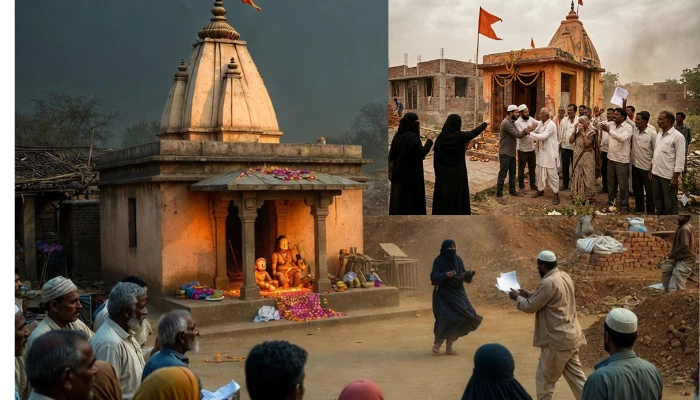
Case Summary
In an Adivasi-dominated village in Kasrawad area of Khargone district, Madhya Pradesh, a Hindu land reserved for religious purposes, including Holika Dahan, a Hanuman temple, Bhilat Dev, Kuldevi temple, etc., was illegally encroached upon by Muslim perpetrators. According to villagers and temple devotees, the land in question, recorded under Khasra number 191, belonged to the temple and had been used for religious purposes for a long time. The incident came to light when villagers reached at the land to clean and prepare it for temple-related construction. The accused Shabana, wife of Mushtaq and Mushtaq, son of Shakoor, residents of Balkwada, stopped them, claiming the land as their own. This led to an uproar within the village. Villagers further stated that Shabana and Mushtaq carried on illegal construction activities on the site. Following this, several villagers, including Sarpanch Gendli Bai, Patel Anar Singh, Himmat Singh, Bhawani Singh, Gulab Singh, and Gendalal, submitted a memorandum to the Sub-Divisional Magistrate (SDM). They demanded immediate intervention, removal of the encroachment, and a halt to the illegal construction. The villagers also issued a warning that if prompt action was not taken, they would launch an agitation against the illegal activities.
Why it is Hate Crime ?
This case is being added to the tracker under the primary category- Attack on Hindu religious representations. The selected subcategory is: Encroachment or illicit takeover of temple land or land near the temple. In Hinduism, a temple is the abode of the Deity. The Deity in the Temple is consecrated, thereby making it a real, breathing entity. Hindus believe that not just the Deity but the temple premises itself are sacred, since they hold that the entire Temple space is an amalgamation of the deity's divine energy. Not only the Temple but also the Temple premises in their entirety are considered sacred by Hindus. In several cases, the premises of the Temple and/or religious centre are illegally taken over by institutions of other faiths, such as the Waqf board or the Church. Other times, the temple property, land or the property of religious centres are illicitly encroached upon by non-Hindu groups. Any illicit takeover or encroachment is a crime an initio; however, when non-Hindu groups illicitly take over or encroach on the sacred land of Hindus, it is an affront to the Hindu community and is therefore classified as a religiously motivated hate crime under this category. This case bears clear indicators of a religiously motivated hate crime as it involves the encroachment and attempted appropriation of land that holds established religious significance for the Hindu community. The land in question was not ordinary property but a space historically and functionally associated with multiple Hindu religious practices, including Holika Dahan, and with temples dedicated to deities such as Hanuman, Bhilat Dev, and the Kuldevi. Such spaces form an integral part of the religious and cultural life of the community and are treated as sacred extensions of temple premises. A key religious marker in this case is the nature of the land itself. In Hindu tradition, land designated for religious use is not merely physical property but a consecrated space where rituals, festivals, and community worship take place. Sites used for ceremonies such as Holika Dahan hold collective religious significance, as they are tied to recurring sacred observances and shared faith practices. Encroachment upon such land, therefore, does not constitute a routine land dispute but interferes directly with the ability of the Hindu community to practice and sustain its religious traditions. The act of claiming ownership over this land and carrying out construction on it further demonstrates an attempt to alter the character and purpose of a space that is intrinsically linked to Hindu worship. By obstructing villagers from accessing and preparing the land for religious activities, the perpetrators effectively disrupted ongoing and future religious practices. This represents not only physical encroachment but also an intrusion into a sacred domain, undermining its religious identity and continuity. Such actions have broader implications beyond the immediate dispute. When land associated with temples and community rituals is encroached upon, it creates a sense of insecurity among devotees regarding the preservation of their religious spaces. These sites are often central to the spiritual and cultural cohesion of the community, and their appropriation can be perceived as an attempt to erode the visible and functional presence of Hindu religious life in the locality. The fact that the land was historically recognised and used for temple-related purposes further strengthens the religious dimension of the case. The attempt to assert ownership of such land and proceed with construction despite community objections indicates a disregard for its established religious character and the sentiments of the Hindu community attached to it. Taken together, the targeting of land used for Hindu religious rituals, the obstruction of access to a sacred space, and the attempt to alter its use through construction demonstrate that the incident was not a mere civil dispute but one that directly impacted Hindu religious practices and identity. Accordingly, the case displays clear markers of a religiously motivated hate crime and has been recorded in the Hinduphobia Tracker database. Disclaimer: The Hinduphobia Tracker records incident dates based on when crimes occur, rather than when they are reported in the media. In this case, the media reports have not specified the exact date of the incident. Therefore, 13 March 2026, the date when the first report was published, has been selected as the indicative incident date for documentation purposes.


Case Status
Complaint filed


Perpetrators Details
Perpetrators
Muslim Extremists
Perpetrators Range
From 2 To 5
Perpetrators Gender
both
 Sources




