Ancient Hindu temples attacked, temple premises illegally encroached upon in Bharatpur, Rajasthan
 Bharatpur, Rajasthan, India
  17 March, 2026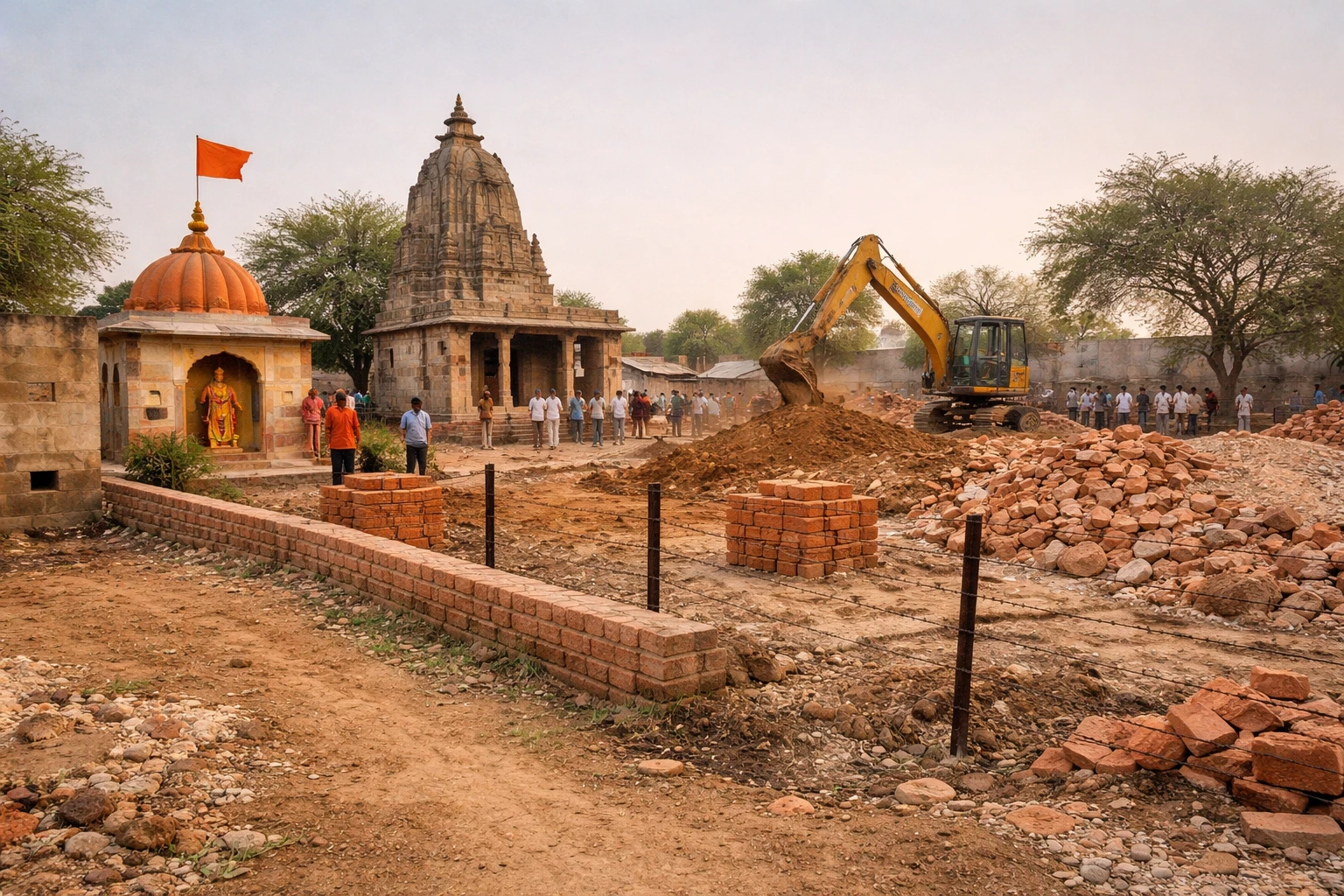
Case Summary
In Neemli village under Bhusawar tehsil of Bharatpur district, Rajasthan, the sacred Hindu Hanuman temple and the Thakur Ji temple land were illegally encroached upon by unknown assailants. According to residents, certain unknown individuals attempted to forcibly encroach upon the land associated with the ancient Thakut Ji temple and Hanuman temple. The land comprised Khasra numbers 398 (0.2000 hectares) and 399 (0.3700 hectares). Both of these temples were regarded as important centres of Hindu religious faith. The accused brought construction materials, including wood, stones, and other items, onto the land. They began efforts to establish permanent structures within the area. The residents expressed concern that such activities would damage the temple premises and alter the character of the land, which had been used for religious purposes for generations. Villagers further stated that when they objected to the encroachment, the accused behaved aggressively and engaged in confrontations. This led to rising tension in the village and concerns about a potential disturbance to public order. In response, the villagers submitted a memorandum to the local administration. They demanded immediate measurement of the land, removal of the encroachments, and legal action against those responsible, in order to protect both the religious sites and the public land.
Why it is Hate Crime ?
This case is being added to the tracker under the primary category- Attack on Hindu religious representations. The selected subcategory is: Encroachment or illicit takeover of temple land or land near the temple. In Hinduism, a temple is the abode of the Deity. The Deity in the Temple is consecrated, thereby making it a real, breathing entity. Hindus believe that not just the Deity but the temple premises itself are sacred, since they hold that the entire Temple space is an amalgamation of the deity's divine energy. Not only the Temple, but the Temple premises in their entirety, are considered sacred by Hindus. In several cases, the premises of the Temple and/or religious centre are illegally taken over by institutions of other faiths, such as the Waqf board or the Church. Other times, the temple property, land or the property of religious centres are illicitly encroached upon by non-Hindu groups. Any illicit takeover or encroachment is a crime an initio; however, when non-Hindu groups illicitly take over or encroach on the sacred land of Hindus, it is an affront to the Hindu community and is therefore classified as a religiously motivated hate crime under this category. This incident was recorded under the Hinduphobia Tracker because the land surrounding ancient Hindu temples, including a Hanuman temple and an ancient Thakur Ji temple, had been encroached upon. Such an act threatened the continuity of religious practices and restricted the community’s access to sacred space. In Hindu tradition, temples were not confined to the sanctum alone. The surrounding land formed an integral part of the religious ecosystem. It allowed devotees to gather, move freely, and participate in rituals and daily worship. This held particular significance for Hanuman temples. Lord Hanuman was worshipped as a protector and a source of strength and devotion. Devotees regularly visited such temples for prayers, offerings, and recitations like the Hanuman Chalisa. These practices depended on open and accessible temple space. When such land was encroached upon, it did not merely alter property boundaries; it interfered with the way worship had been practised for generations. This obstruction, though not presented as an outright ban, had effectively restricted access to and use of temple land. When devotees faced construction activities and shrinking space, their ability to freely approach and engage in worship was hindered. The right to worship had not been explicitly denied, but it had been rendered constrained in practice and reduced in effect. Therefore, it had directly hindered the practice of worshipping freely. The temple, instead of remaining a vibrant centre of devotion, had risked being reduced to a confined and obstructed structure. Moreover, the Constitution of India, under Article 25, guaranteed every individual the freedom to profess and practise religion. Judicial interpretation had consistently held that this right included the performance of essential and customary religious practices. Any act that disrupted access to a place of worship or interfered with its functioning struck at the heart of this constitutional protection. Furthermore, India’s constitutional framework rested on the principle of secularism. The State was expected to ensure that all communities could practise their faith without obstruction. This duty extended to protecting religious spaces from encroachment and unlawful occupation. When land attached to temples was encroached upon and left unprotected, it reflected a failure to uphold this constitutional obligation. Overall, the importance of temple land lay in its function. It sustained rituals, enabled gatherings, and preserved the continuity of faith. Encroaching on such land disrupted the community's spiritual rhythm. It created tension, invited conflict, and eroded the sense of security among devotees. What remained was not just a physical encroachment but a gradual weakening of religious life and heritage. Therefore, this case was recorded under the tracker. Disclaimer: The Hinduphobia Tracker records incident dates based on when crimes occur, rather than when they are reported in the media. In this case, the media reports have not specified the exact date of the incident. Therefore, 18 March 2026, the date when the first report was published, has been selected as the indicative incident date for documentation purposes.


Case Status
Complaint filed


Perpetrators Details
Perpetrators
Unknown
Perpetrators Range
Unknown
Perpetrators Gender
unknown
 Sources




