Hindu festival marred: Cow slaughtered deliberately on first day of Navratri by Muslims in Jalaun, Uttar Pradesh
 Jalaun, Uttar Pradesh, India
  29 March, 2025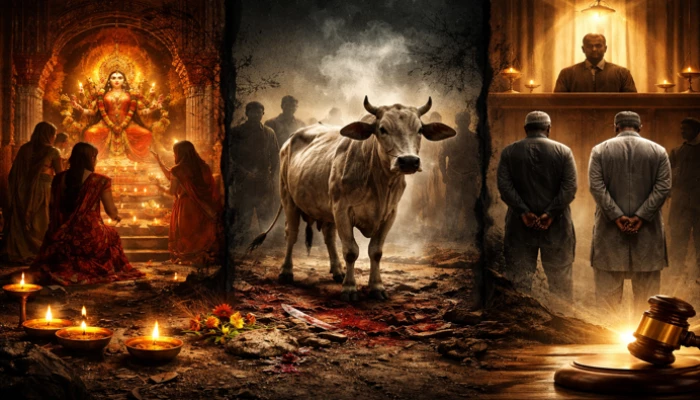
Case Summary
In Kalpi town of Jalaun district, Uttar Pradesh, a cow had been deliberately slaughtered on the pious occasion of the first day of Chaitra Navratri by three Muslim men. The incident took place on 30 March 2025, the start of a significant Hindu festival that coincided with Eid. A case had been filed, and the accused had been arrested. The Allahabad High Court on Thursday (26 February 2026) upheld the detention of three accused, Sikandar, Saiyyaj Ali, and Hasnen, under the National Security Act, 1980. According to the police, while patrolling the area, they had received information that seven to eight individuals were engaged in illegal cattle slaughter in fields and shrubs. Acting on the information, the police had conducted a raid and recovered two to three quintals of beef, along with knives and other materials used in the act. One accused had been apprehended at the scene, while others were subsequently identified and arrested. An FIR had been registered on 31 March 2025 at Police Station Kotwali Kalpi under Sections 3/5/8 of the Uttar Pradesh Prevention of Cow Slaughter Act, 1955, Section 11 of the Prevention of Cruelty to Animals Act, 1960, and Sections 4/25 of the Arms Act, 1959 against eight individuals, including Sikandar, Saiyyaj Ali, and Hasnen. The accused had been taken into judicial custody between 31 March and 11 April 2025. While two of the accused had been granted bail and another had a bail plea pending, the District Magistrate of Jalaun had invoked Section 3(2) of the National Security Act (NSA) on 25 and 28 April 2025, ordering their preventive detention. The detention orders had subsequently been approved by the State Government and referred to the Advisory Board. After hearing the detenues on 28 May 2025, the Board had found sufficient cause for continued detention. The State Government thereafter confirmed the detention for a period of twelve months. The accused had challenged their detention before the Allahabad High Court, claiming a violation of their constitutional rights and seeking its quashing. A bench of Justices Chandra Dhari Singh and Devendra Singh had heard the matter and, while dismissing the petitions, upheld the detention. The court had upheld that the procedural safeguards under the NSA had been duly followed. Pointing out the timing of the incident, the High Court held that the act had hurt the religious sentiments of Hindus. “The slaughter of bovine animals by the accused on the first day of Navratri, in circumstances where the cow is venerated as sacred by the Hindu community, was not merely a criminal act; it was an act that directly and foreseeably struck at the religious sentiments of a significant section of the community at a moment of heightened communal sensitivity,” the court had remarked while upholding the detention of the accused. “The timing of the incident thus elevated it qualitatively beyond the category of an ordinary criminal offence into territory where its impact upon community life and public order became manifest,” the court had added. The High Court had highlighted the grounds for the accused's detention to underscore the impact of their act on society. “The grounds of detention record with specificity that the incident caused fear and terror, ‘भय प्रवाह व आतंक,’ not merely among the parties to the incident but among the general public in Kalpi town, village Guloli and surrounding areas. This fear was not abstract or inferential; it manifested in concrete behavioural change: the general public in Kalpi town and the surrounding areas stopped leaving their cattle outside their homes and stopped tying them outside, out of fear,” the court had noted. The Court had also noted that communal tension had erupted in the area, and a report from the Local Intelligence Unit stated that public order had been shattered. “The grounds further record that the incident created a tense atmosphere between people of the Hindu and Muslim communities in Kalpi town and surrounding areas. The general public began viewing the incident as a conspiracy to cause riots and communal violence,” the court had stated. According to the High Court, the situation on the ground had been so bad that the local administration had had to take extraordinary action to maintain peace. “…police forces from other police station areas of the district had been deployed at sensitive locations in Kalpi town and village Guloli as picket and patrol parties; a riot control drill had been conducted in Kalpi town; the Superintendent of Police Jalaun, Inspector-in-Charge Kalpi, Sub-Divisional Magistrate Kalpi and Circle Officer Kalpi had personally conducted foot patrols; adequate police force had conducted foot patrolling at sensitive locations during both day and night; communication had been established with the general public to instil a sense of security; and a Peace Committee meeting had been organised and dialogue had been held with both communities,” the court had noted. Following the incident, an extensive administrative response had been initiated. Police forces from multiple stations had been deployed in sensitive areas, riot-control drills had been conducted, and continuous patrols had been carried out. Peace Committee meetings had been organised to restore normalcy, and efforts had been made to reassure the public. The Local Intelligence Unit had reported that the incident had disrupted the “even tempo of life” in the area, indicating a breakdown of public order beyond an isolated criminal act.
Why it is Hate Crime ?
This case has been added to the tracker under the primary category- Attack on Hindu religious representations. The selected subcategory is: Desecration of a Hindu religious symbol. Icons and symbols, or religious representations of spiritual ideals, are widely revered in Hinduism. Iconography is of vital significance in the Hindu milieu. It helps connect people’s spiritual beliefs with the real world. Iconography within the Hindu faith takes many forms. Murtis are of most significance to Hindus, to which daily rituals, prayers and offerings are done. Besides the murtis, there are several other symbols which have deep significance in the Hindu faith – the Om and Swastika, for example. Since these Hindu religious symbols hold paramount importance in Hinduism, any desecration of symbols, icons, murtis, religious representations, and manifestations is driven by animosity towards the faith itself, which manifests through these murtis, icons, and symbols. Therefore, any desecration of these Hindu religious symbols and representations is considered a religiously motivated hate crime under this category. This incident has been recorded under the Hinduphobia Tracker because the accused deliberately intended to hurt the sentiments of Hindus. They slaughtered a cow on the first day of Chaitra Navratri, a period of deep religious significance for Hindus. The timing was not incidental. It reflected a conscious choice to act during a sacred festival, demonstrating awareness of the occasion’s sanctity and the impact such an act would have on the Hindu community. This indicates that the act was deliberate and carried out with the knowledge that it would cause maximum religious offence, provoke distress, and disrupt communal harmony. The cow has long held profound religious significance in Hinduism. It is regarded as sacred, symbolising motherhood, purity, and sustenance, and is revered as gau mata. Harming or killing a cow is not viewed as a routine act of violence but as a desecration of a deeply sacred religious symbol. In this context, the deliberate slaughter of a cow on the first day of Navratri directly targeted this core belief and reflected disregard for Hindu religious values. Furthermore, Navratri is a period of purity, discipline, and devotion, during which many Hindus observe strict vegetarianism and heightened spiritual practices. The act of cow slaughter on such a day was not only a violation of religious sentiment but also disrupted the sanctity of the festival. The choice of timing amplified the impact of the act and functioned as a form of religious provocation directed at Hindus. The intent behind the act is further underscored by the perpetrators' choice of a moment of heightened religious sensitivity, indicating they were aware of the symbolic significance of both the cow and the festival. The act, therefore, cannot be viewed as accidental or incidental but as one carried out with the understanding that it would deeply offend Hindu beliefs. This reflects a deliberate act borne out of disregard for the Hindu faith and aimed at provoking and causing distress within the community. The impact was immediate and severe. Even the High Court noted that fear spread among the public, with Hindu residents refraining from leaving their cattle outside their homes. This behavioural change demonstrates that the act created a climate of fear and insecurity within the Hindu community and had the potential to trigger wider unrest. Taken together, the targeting of a sacred religious symbol, the deliberate timing during a major Hindu festival, the awareness of its religious significance, and the resulting fear among Hindus establish clear intent. This was not a routine offence but an act that struck at the religious beliefs of Hindus and created insecurity within the community. It therefore qualifies as a religiously motivated hate crime. Disclaimer: The Hinduphobia Tracker records incident dates based on when a crime occurred, or a victim's ordeal began, rather than when the media reported it. In this case, the cow was slaughtered on 30th March 2025, and the Court delivered judgment on 26 February 2026. Since the crime was committed on 30 March 2025, that date has been selected to record the case in the tracker.


Case Status
Perpetrator held guilty by court


Perpetrators Details
Perpetrators
Muslim Extremists
Perpetrators Range
From 2 To 5
Perpetrators Gender
male
 Sources




