Sacred Hindu temple illegally encroached by Government department employees; devotees staged protest in Alwar, Rajasthan
 Alwar, Rajasthan, India
  27 February, 2026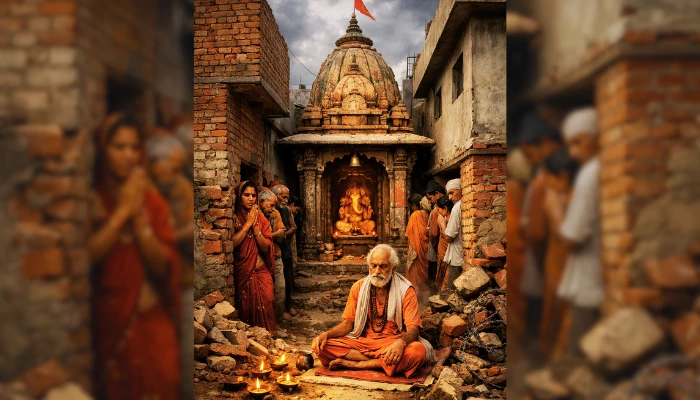
Case Summary
In Thanagazi, Alwar district of Rajasthan, a sacred Hindu temple had been illegally encroached upon by Government department employees who resided nearby. The encroachments had significantly reduced the open space around the Shri Ganesh temple, leaving devotees with no passage to carry out rituals, including parikrama (circumambulation). According to reports, Hindu devotees gathered, protested, and raised objections, stating that the temple’s traditional access routes had been obstructed. They stated that this obstruction had directly affected their ability to practise their religion as prescribed by their customs. Amid the ongoing dispute, the temple priest (pujari), Dinesh Kumar Sharma, had undertaken an indefinite hunger strike, demanding the removal of encroachments and the restoration of the temple land. Priest Dinesh Sharma, who had been serving the temple for the past 28 years, stated that 90% of the temple premises and 100% of the temple land had been encroached upon. The protest drew attention to the condition of the temple premises, with visuals showing the structure surrounded by construction and debris, reinforcing claims that the religious site had been effectively boxed in, restricting access for worshippers. According to the report, an employee of the Irrigation Department, a policeman, and a medical department employee had constructed permanent structures on the land. This encroachment had completely disrupted the temple's circumambulation path and the construction of the sanctum (garbhagriha). The matter was registered with the Devasthan Department, and the administration took cognisance of it. The priest explained that complaints had previously been filed with the District Collector and at public hearings, but no concrete action had been taken. Upon receiving information about the illegal encroachment, Pratapgarh Tehsildar Dataram Gurjar arrived at the scene. He assured the priest that the matter would be investigated and positive action would be taken within the next 15 days. The priest ended his indefinite hunger strike after the Tehsildar offered assurance. A large number of locals and prominent citizens had shown up in support of the priest during the protest. Dozens of villagers, including Dharamchand Jain, Upendra Mudgal, Ashok Saini, Radheshyam Lata, and Sanjay Maheshwari, had demanded that the administration restore the temple's dignity.
Why it is Hate Crime ?
This case is being added to the tracker under the primary category- Attack on Hindu religious representations. The selected subcategory is: encroachment or illicit takeover of temple land or land near the temple. In Hinduism, a temple is the abode of the Deity. The Deity in the Temple is consecrated, thereby making it a real, breathing entity. Hindus believe that not just the Deity but the temple premises itself are sacred, since they hold that the entire Temple space is an amalgamation of the deity's divine energy. Not only the Temple, but the Temple premises in their entirety, are considered sacred by Hindus. In several cases, the premises of the Temple and/or religious centre are illegally taken over by institutions of other faiths, such as the Waqf board or the Church. Other times, the temple property, land or the property of religious centres are illicitly encroached upon by non-Hindu groups. Any illicit takeover or encroachment is a crime an initio; however, when non-Hindu groups illicitly take over or encroach on the sacred land of Hindus, it is an affront to the Hindu community and is therefore classified as a religiously motivated hate crime under this category. This incident was recorded under the Hinduphobia Tracker because the land surrounding a functioning Shri Ganesh temple was encroached upon in a manner that effectively rendered the devotees incapable of performing an essential Hindu religious practice. In Hindu tradition, parikrama (circumambulation), the act of walking in a clockwise direction around a deity or temple, was regarded as an integral component of worship. It symbolised devotion, surrender, and the acknowledgement of the divine as the centre of existence. For devotees, worship remained incomplete without this ritual movement. By choking the pathways and leaving no space for circumambulation, the encroachments did not merely inconvenience devotees; they interfered with the very manner in which Hindu worship had been practised for centuries. This obstruction, though not framed as a prohibition, amounted to an infringement of the right to worship. When a devotee was denied the ability to complete essential rituals, the right was not directly banned but was rendered hollow in practice. Moreover, the Constitution of India, under Article 25, guaranteed to every individual the freedom to profess, practise, and propagate religion. Judicial interpretation has consistently held that this right includes the performance of essential religious practices. Furthermore, the Supreme Court had held, in various cases, that matters of religion included practices regarded by the community as integral to their faith, and that interference in such practices was impermissible. By preventing parikrama, the encroachment effectively struck at an essential aspect of Hindu worship, thereby undermining constitutionally protected religious freedom. India’s constitutional framework was built on the principle of secularism, under which the State was expected to maintain neutrality and ensure that every citizen could practise their religion freely and without obstruction. This protection was not ornamental; it imposed a duty to safeguard religious spaces and ensure that communities were not deprived of their modes of worship. When a temple was reduced to a confined structure with no access for essential rituals, it reflected a failure to uphold that constitutional promise. The importance of temple land and access lay not merely in ownership but in function. The space around a temple sustained rituals, enabled festivals, and allowed the faithful to engage with the divine in a complete and meaningful manner. Encroaching on such land and rendering it unusable for worship disrupted the community's spiritual rhythm. What remained was a hollowed structure, standing, yet unable to serve its sacred purpose. Such acts had consequences beyond property; they eroded religious continuity, diminished faith in institutional protection, and left devotees struggling to preserve traditions practised for generations. Therefore, this case was recorded under the tracker. Disclaimer: The Hinduphobia Tracker records incident dates based on when crimes occur, rather than when they are reported in the media. In this case, the media reports have not specified the exact date of the incident. Therefore, 28 February 2026, the date when the first report was published, has been selected as the indicative incident date for documentation purposes.


Case Status
Complaint filed


Perpetrators Details
Perpetrators
State and Establishment
Perpetrators Range
From 5 to 10
Perpetrators Gender
unknown
 Sources




