Hindu sentiments outraged as Indian politician burns Manusmriti and makes derogatory remarks against Brahmins
 Patna, Bihar, India
  16 March, 2026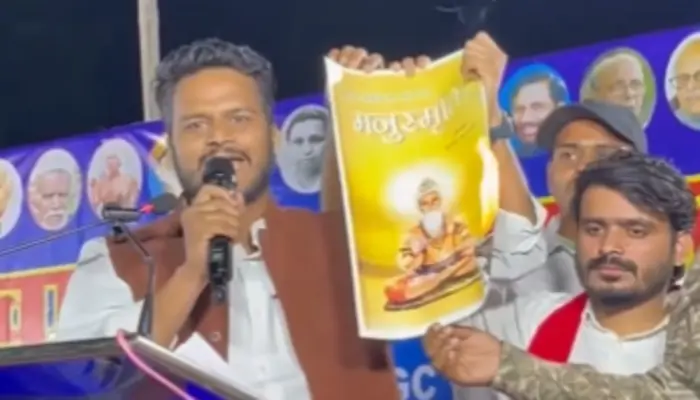
Case Summary
In Patna, Bihar, Hindu religious sentiments were outraged as Rashtriya Janata Dal (RJD) supporter Manish Yadav publicly burnt the Hindu holy book Manusmriti. Apart from this, the accused also made derogatory remarks against Brahmins. According to media reports, this occurred at the Patna University campus. The accused, Manish Yadav, stated that the country was historically run by Brahmins and presented a distorted narrative suggesting that they had monopolised resources and power, thereby inciting religious and social provocation. This was then followed by burning a picture of the Manusmriti while chanting anti‑Hindu slogans, “Manusmriti murdābād.” A video of this incident went viral on several social media platforms on March 17, 2026. This caused widespread outrage from the Hindu community. The Hindu community saw it as an attack on its religious sentiments.
Why it is Hate Crime ?
This case has been added to the tracker under the primary category of - Attack on Hindu religious representation, under this, the sub-category selected is- Desecration of Hindu religious symbol. Icons and symbols or a religious representation of a spiritual ideal are widely revered in Hinduism. Iconography is of vital significance in the Hindu milieu. It helps connect people’s spiritual beliefs with the real world. Iconography within the Hindu faith takes several shapes and forms. Murtis are of most significance to Hindus, to which daily rituals, prayers and offerings are done. Besides the murtis, there are several other symbols which have deep significance in the Hindu faith – the Om and Swastika for example. Since these Hindu religious symbols hold paramount importance in Hinduism, any desecration of symbols, icons, murtis, religious representations and manifestations, is driven by animosity towards the faith itself which manifests itself through these murtis, icons and symbols. Therefore, any desecration of these Hindu religious symbols and representations is considered a religiously motivated hate crimes under this category. The other primary category selected here is - Hate speech against Hindus. Within it, the sub-category selected here is - Anti-Hindu slurs, mocking faith. Anti-Hindu slurs and the deliberate mocking of the Hindu faith owing to religious animosity involve the usage of derogatory terms, stereotypes, or offensive references to religious practices, symbols, or figures. One of the common anti-Hindu slurs used against Hindus is “cow-worshipper” and “cow piss drinker”. The intention of using this term is to demean and mock Hindus as a group and their religious beliefs since Hindus consider the cow holy. Additionally, some symbols and the slurs attached to them have a historical context that exacerbates the insult, hate, stereotyping, dehumanisation and oppression against Hindus. Cow worship has been used for centuries to denigrate Hindus, insult their faith and oppress Hindus specifically as a religious group. There has been overwhelming documentation about how cow slaughter has been used to persecute Hindus with cow meat being thrown in temples and places of worship. There has also been overwhelming documentation where cow meat (beef) has been force-fed to Hindus to either forcefully convert them to Islam or denigrate their faith. Apart from cow worship, the Swastika – which holds deep religious significance for the Hindus – has also been misinterpreted and distorted to use as a slur against Hindus. Similarly, the worship of the Shivling has been used by supremacist ideologies and religions to denigrate Hindus owing to religious animosity. Such slurs and denigration stem out of inherent animosity and hate towards Hindus and their faith, therefore, it is categorised as hate speech targeted at Hindus specifically owing to their religious identity. This case has been added to the tracker because Rashtriya Janata Dal supporter Manish Yadav publicly burnt the Hindu holy book Manusmriti while making derogatory statements against Brahmins. The Manusmriti is a religious text within Hinduism, traditionally attributed to the sage Manu. It functions as a dharmashastra, guiding morality, law, social order and religious conduct, and represents an important symbol of Hindu religious and cultural heritage. The public burning of this sacred text constitutes a direct affront to Hinduism and its adherents. By publicly desecrating this text, Manish Yadav directly attacked Hindu religious sentiments, seeking to provoke animosity against Hindus and to incite hostility toward their faith. The incident was designed to outrage religious sentiments and deliberately provoke the Hindu community, thereby risking disruption of public peace and communal harmony. By targeting a Hindu religious symbol in a public setting, the act sought to inflame tensions and create conditions conducive to disorder. The act was carried out openly on a university campus, with statements portraying Hindu society as historically monopolised by Brahmins and falsely alleging their control over resources and power. This rhetoric was intended to denigrate Hindu social and religious identity and to provoke outrage. Such actions, the burning of Manusmriti and the raising of communal slogans, had clear motives to divide Hindu society along micro identities such as caste and region. His views aligned with those of several left-leaning and Islamist currents, which often weaponise identity politics to target Hindus and break the idea of Hindu unity. They seek to weaken Hinduism as a unifying religious identity that transcends caste distinctions and geographical boundaries by creating the impression that Brahmins have captured resources and that Dalits should therefore distance themselves from Hinduism. For them, micro identities of caste, region and language are secondary; their real target is Hinduism as a religious identity, and their goal is to fracture Hindu society through caste-centric, anti-Brahmin or anti-hierarchical narratives. It is also important to state that some anti-Hindu groups often weaponise the Manusmriti to portray Hinduism as regressive, casteist or anti-women, but this argument collapses under even basic scrutiny. Hinduism is not a religion centred around one book, one prophet or a single fixed law. The Manusmriti is not the Hindu equivalent of the Bible or the Qur'an; it is one among many Dharmashastras composed for specific times and social circumstances. Texts such as the Yājñavalkya Smriti, Nārada Smriti and Parāśara Smriti frequently contradict Manusmriti, demonstrating that Hindu thought has never been rigid or dogmatic but pluralistic, dialogic and adaptable. To hold Hindus collectively accountable for verses in the Manusmriti is deeply unfair and reflects a bias against Hinduism itself. No other major faith is judged by selectively quoting its ancient or context-bound texts, yet Hinduism alone is singled out in this manner. Expecting modern Hindus to answer for verses written thousands of years ago, in an entirely different era, is utterly irrational. Would Muslims feel comfortable if they were held responsible for obscure hadiths, or Christians if they were blamed for verses in the Old Testament? Furthermore, no modern Hindu derives their moral or spiritual life from the Manusmriti. Hindu rituals, festivals and everyday ethics are guided by the Bhagavad Gita, the Upanishads, the Ramayana and the living devotional and philosophical tradition texts that emphasise duty, inner discipline, equality and the divinity of all beings. In essence, in today's context, the Manusmriti is a historical text, not a religious scripture that defines or governs Hindu life. To use it as a weapon to vilify Hindus is intellectually dishonest and driven by prejudice rather than scholarship. It is a distortion that ignores both the pluralism of Hindu thought and the reality that Hindu society, including Hindu reformers and leaders, long ago moved beyond any literal or uncritical reading of such ancient legal codes. This deliberate desecration of a revered religious symbol, coupled with anti-Hindu statements meant to inflame religious tensions, firmly categorises the incident as a hate crime motivated by anti-Hindu animus. The case has therefore been documented in the Hinduphobia Tracker as a clear instance of religiously motivated hostility directed at Hinduism and its adherents. Disclaimer: The Hinduphobia Tracker records incidents based on when an event occurred or when the victim's ordeal began. It is important to clarify that none of the media sources covering this case has specified the exact date when the incident occurred. Therefore, for documentation purposes, the date has been recorded based on when the incident was reported in the media, 17 March 2026.


Case Status
Unknown


Perpetrators Details
Perpetrators
Others
Perpetrators Range
One Person
Perpetrators Gender
male
 Sources




