Hindu students made to participate in Iftar event at private college in Bhopal, Madhya Pradesh
 Bhopal, Madhya Pradesh, India
  10 March, 2026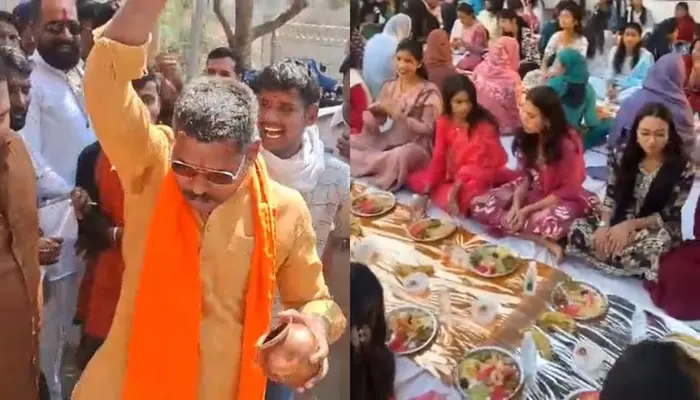
Case Summary
In the Neelbad area of Bhopal, Madhya Pradesh, a controversy erupted after Hindu students were made to participate in a Roza Iftar event at a private college. The Roza Iftar event occurred on 11 March 2026 at a private college in Bhopal, a video of which went viral on social media, triggering protests from Hindu organisations. The video showed Muslim students and some staff participating in the event, with a few Hindu female students also in attendance. Following the circulation of the video, members of Hindu organisations assembled outside the college premises, raising slogans and reciting the Hanuman Chalisa in protest. During the demonstration, some Hindu activists also sprinkled Ganga water at the site, describing it as an act of purification. The situation prompted a heightened police presence outside the college to maintain order. Representatives of Hindu organisations stated that the organisation of such a religious event within an educational institution reflected a pattern of Islamisation and opposed its continuation. Amid the unrest, the college administration claimed that it regularly observed festivals of multiple religions on campus and had recently celebrated Holi as well, describing the Iftar gathering as part of an effort to promote communal harmony among students and staff.
Why it is Hate Crime ?
This case has been placed in the ‘Undecided’ database of the Hinduphobia Tracker as it does not currently meet the threshold required to be categorised as a hate crime under the tracker’s evidence-based standards. The incident in Bhopal involved a Roza Iftar event organised on 11 March 2026 at a private college, which subsequently triggered protests by Hindu organisations after a video of the gathering went viral. Objections were raised regarding the organisation of a religious event on campus, with concerns about Islamisation and possible undue influence expressed during the protests. The college administration, however, claimed that it routinely celebrated festivals of multiple religions, including Hindu festivals such as Holi, as part of promoting communal harmony. Furthermore, there is no evidence to conclusively establish whether the Hindu girls present at the event were forced to participate or whether they attended of their own free will. This lack of clarity makes it difficult to determine the exact nature of their involvement. At the same time, even when individuals are adults, the possibility of proselytisation through grooming cannot be entirely ruled out in a broader context. In several such instances, participation in religious or cultural events can function as an initial point of contact, where Hindus are gradually exposed to Islamic religious practices and belief systems. Over time, such exposure leads to deeper influence or attempts at conversion. However, in the present case, there is no concrete or verifiable evidence to indicate that the event was used as a mechanism for grooming, coercion, or conversion, and therefore, these concerns remain speculative rather than established. At present, there is no verifiable evidence indicating that Hindu students were forced to participate in the Iftar event, nor is there any substantiated information suggesting forced religious conversion or deliberate targeting of Hindus within the institution. In the absence of clear indicators demonstrating that the incident was driven by hostility, prejudice, or targeted animosity towards Hinduism, the case does not satisfy the criteria for classification as a hate crime. Such concerns regarding differential treatment of religious practices in educational institutions are not without precedent and have been observed in other cases documented by the Hinduphobia Tracker, where the surrounding context and available evidence led to their classification as hate crimes. For instance, at Jadavpur University, the administration denied permission for the celebration of Ram Navami while Iftar observances had been allowed on campus days earlier, leading to widespread protests over discriminatory treatment towards Hindu students. Likewise, at Banaras Hindu University, an order was issued in February 2023 prohibiting students from celebrating Holi within the campus, despite the institution having hosted an Iftar gathering in the preceding period, prompting backlash and eventual withdrawal of the restriction. In those instances, the presence of administrative actions that appeared to differentially impact Hindu religious practices, along with supporting contextual indicators, contributed to their inclusion in the tracker as confirmed cases, unlike the present case, where such evidentiary thresholds have not been met. The Hinduphobia Tracker upholds rigorous, evidence-based parameters for designating any incident as a confirmed hate crime. With this case showing no definite proof of religious animosity at present, it has been added to the ‘Undecided’ database pending further clarity. If compelling new evidence emerges demonstrating hatred towards Hinduism as the underlying motivator behind the incident, the case will undergo swift reassessment and transfer to the verified hate crime database. Disclaimer: The Iftar event in this case was organised by the college administration rather than by Muslim individuals. As a result, the religion of the perpetrators has been recorded as unknown, since the available information does not attribute the organisation of the event to any particular religious group or individual actors.


Case Status
Unknown


Perpetrators Details
Perpetrators
Unknown
Perpetrators Range
Unknown
Perpetrators Gender
unknown
 Sources




