Hindu nationhood targeted as Muslim cleric advocates Islamic annexation of Hindustan
 Delhi, Delhi, India
  3 July, 2024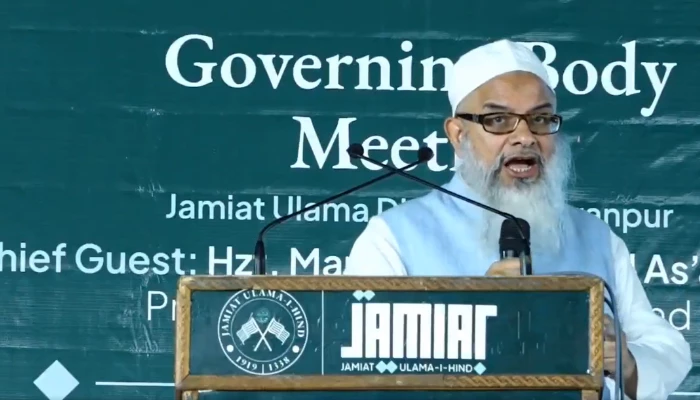
Case Summary
On 4th July 2024, hate speech against the Hindu nation, India, was delivered by Muslim cleric, Maulana Mahmood Madani, in the National Governing Body Meeting of Jamiat Ulama-i-Hind held at their Delhi headquarters in Delhi. The incident came to light on 16 March 2026, after a video dated 4 July 2024 was shared on social media by a user( previously on Twitter). The video showed a speech by a Muslim cleric associated with the organisation Jamiat Ulema-e-Hind. This clip created an uproar on social media. The clip was circulated in response to a post by Arfa Khanum Sherwani, in which she stated, “No one wants to turn India into a Muslim country. And India was never a Hindu nation and never will be.” In reaction to this, the video of the cleric was shared, where the cleric stated, “hum poore Hindustan lene ki baat kar rahe the” (we were talking about taking the whole of Hindustan). He further asserted that the partition of India was not a division of land but a division of Muslims, implying that the entire territory of India historically belonged to them. The remarks were delivered during a public gathering where the cleric addressed an audience and elaborated on these views. The video showed him speaking assertively while the audience listened, indicating that the statements were part of a broader ideological address rather than an isolated or casual remark. The clip was widely circulated online, where users highlighted that the statements directly contradicted the claim made in the original post and reflected an assertion over the entirety of India.
Why it is Hate Crime ?
The primary category selected in the case is 'Hate speech against Hindus'. The sub-category chosen is: 'Anti-Hindu subversion and prejudice' Hate speech is defined as any speech, gesture, conduct, writing, or display that is prejudicial against a specific individual and/or group of people, which leads to or may lead to violence, prejudicial action or hate against that individual and/or group. Media plays a specific and overarching role in perpetuating prejudicial attitudes towards a community owing to unfair, untrue coverage and/or misrepresentation/misinterpretation, selective coverage and/or omission of facts of/about issues affecting a specific religious group. This type of bias can dehumanise the victim group, making it easier for others to justify harmful actions against them, which aligns with the objectives of hate speech laws aimed at preventing such harm. It is often observed that the media takes a prejudicial stand against the Hindu community, driven by their need to shield the aggressor community, which happens to be a numeric minority; however, that is the one perpetrating violence against Hindus. For example, the media is often quick to contextualise religiously motivated crimes against Hindus, omit or misrepresent facts that point towards religiously motivated hate crimes, justify and/or downplay religiously motivated hate crimes, or simply present fake news to stereotype Hindus. Such media bias leads to the denial of persecution and is often used to dehumanise Hindus, leading to justification for violence against them. For example, the media covered several fake allegations of Hindus targeting Muslims and forcing them to chant Jai Shree Ram. Most of these cases were proved false and fabricated after police investigation. These fake news reports were subsequently never retracted or clarified. Such fake news led to the justification of violence and dehumanisation of Hindus based on the argument that since Hindus targeted Muslims and forced them to chant Jai Shree Ram, the dehumanisation of Hindus and violence against them was par for the course and merely a retaliation. Such media bias leads to prejudicial portrayal of Hindus and offers a justification for violence against them and therefore, is considered hate speech under this category. The other subcategory selected is- Violent threats. Violent threats, explicit, implicit or implied, is the most dangerous form of hate speech since it goes beyond discriminatory and prejudicial language to express the intent of causing harm to an individual or a group of people based on their religious identity and faith. There could be several different kinds of threats that are issued to Hindus based on religious animosity. An explicit threat would mean the direct threat of violence towards an individual Hindu, a group of Hindus or Hindus at large. Physical violence, death threats, threats of destruction of property belonging to Hindus and threats of genocide would mean explicit threats against Hindus for their religious identity. Implicit threats may not be a direct threat but implied through the use of symbols of actions – for example – in the Nupur Sharma case, other than explicit threats, there were also implicit threats when Islamists took to the streets to burn and beat her effigies. It implies that they want to do the same to Nupur Sharma – thereby is considered an implicit threat. Violent threats can be delivered in person, through letters, phone calls, graffiti, or increasingly through social media and other online platforms. It would be important to understand that a threat – explicit or implicit, online or offline – to an individual who happens to be a Hindu does not qualify as a religiously motivated threat. Such a threat, while vile and dangerous, could be owing to non-religious reasons and/or personal animosity. To qualify as a religiously motivated threat, it would need to exhibit an indication that the individual is being targeted for religious reasons and/or owing to his/her religious identity as a Hindu. This case was added to the tracker because the speech delivered by the Muslim cleric directly rejected India’s Hindu civilisational identity and advanced an expansionist narrative asserting Muslim claim over the entirety of Hindustan. The remarks were not framed as ordinary political commentary or historical discussion. They carried clear hostility towards Hindus, their historical belonging to India, and the Hindu character of the nation. The first major religious marker was the rejection of India’s Hindu identity. By asserting that India was never a Hindu nation, the cleric denied the civilisational continuity of Hindus and attempted to sever Hindu identity from the land historically shaped by Hindu civilisation. India’s cultural foundations, sacred geography, temples, epics, traditions, and social life have been deeply rooted in Sanatana Dharma for centuries. The statement therefore did not merely challenge a political idea. It directly attacked the historic and civilisational association between Hindus and India itself. The second important aspect was the distortion of Partition history. The Muslim League demanded Partition on the basis that Muslims constituted a separate political nation requiring a separate homeland. Pakistan emerged from that demand. However, the cleric reversed this historical reality by claiming that Partition was merely a “division of Muslims” and not of land. Through this framing, he implied that the whole of Hindustan still rightfully belonged to Muslims despite the creation of Pakistan. This was not an isolated historical opinion but a statement carrying clear ideological implications against the legitimacy of Hindu India. The statement “hum poore Hindustan lene ki baat kar rahe the” was especially significant because it openly spoke about taking over the entirety of India. Delivered publicly before an audience, the remark reflected a mindset that viewed India not as a shared nation but as territory historically owed to Muslims. Such rhetoric carries clear expansionist and supremacist undertones. It does not promote coexistence or constitutional citizenship. Instead, it frames Hindu majority India as something whose legitimacy can be challenged or overturned. It is also important to understand the ideological backdrop behind such statements. The demand for Partition itself emerged from the belief that Muslims constituted a separate political and civilisational nation that could not coexist within a Hindu majority national framework. In this context, assertions that the whole of Hindustan belonged to Muslims reflect more than historical revisionism. They stem from a worldview that sees India not as a Hindu civilisational homeland but as territory that Muslims retain a political or religious claim over despite Partition. Such rhetoric directly challenges the legitimacy of Hindu civilisational identity and reinforces hostility towards Hindus as the historic majority rooted in the land. By presenting Muslims as the rightful collective inheritors of the entire territory while dismissing India’s Hindu identity, the speech advanced an implicitly supremacist narrative that treated Hindu belonging as secondary or illegitimate within their own civilisation state. The speech also carried the potential to normalise radical and confrontational thinking among listeners. Publicly asserting that Muslims were discussing “taking the whole of Hindustan” transforms political rhetoric into ideological mobilisation. Statements of this nature deepen communal mistrust and reinforce fears among Hindus that their identity, historical continuity, and national belonging are being openly challenged by sections advancing Islamist supremacist narratives. Taken together, the rejection of India’s Hindu identity, the revisionist framing of Partition, the assertion of Muslim claim over the whole of Hindustan, and the expansionist rhetoric directed against Hindu India established the religiously aggravating nature of the speech. The remarks reflected hostility towards Hindus as a civilisational community and therefore qualify as religiously motivated hate speech.


Case Status
Unknown


Perpetrators Details
Perpetrators
Muslim Extremists
Perpetrators Range
One Person
Perpetrators Gender
male
 Sources




