Hindu man and his son forcibly converted to Islam by Muslim 'healer'; son dies by suicide after prolonged ordeal
 Farrukhabad, Uttar Pradesh, India
  4 September, 2025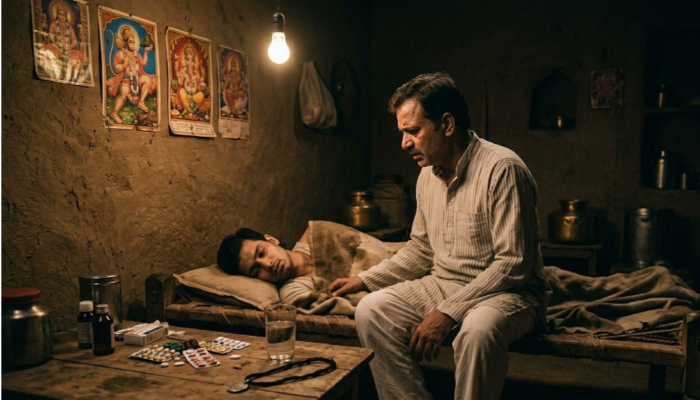
Case Summary
A Hindu man, Rajkumar, and his son, Shivam, in Farrukhabad, Uttar Pradesh, were forcibly converted to Islam by a Muslim man who claimed to be a ''healer". Both father and son fell victim to religious exploitation and coercion while seeking a cure for the son’s prolonged illness. Shivam had suffered from persistent headaches and dizziness for an extended period; despite seeking medical consultation, he found no relief. In his distress, the father, Rajkumar, approached a Muslim faith healer, Idrish, in search of a remedy. Instead of receiving genuine help, the father and son were drawn into a cycle of ritual practices and were forcibly converted to Islam under the false assurance that the illness would be cured. The incident unfolded in the Kamalganj area of Farrukhabad, where Rajkumar, a resident of Balipur village, contacted Idrish, a man from the Nagla Daud locality, for treatment. Idrish provided two taweez (Islamic amulets), instructing that one be worn around the neck and the other dissolved in water and consumed. The Hindu father and son were summoned regularly for weekly sessions of jhaad phoonk, a ritual involving spiritual healing through recitations and gestures. This continued for approximately six months, during which the youth’s condition showed no improvement. Throughout this period, Idrish extracted approximately forty-five thousand rupees from the family. When the illness did not subside, Idrish told Rajkumar that converting to Islam was the only way to cure the disease. Driven by desperation to save his son, both Rajkumar and Shivam converted to Islam, yet the illness persisted. After seeing no improvement, Rajkumar demanded the return of the money paid for the failed treatment. In response, Idrish and his son, Tamjeed, physically assaulted both the father and the son. The relentless illness, combined with the trauma of the failed treatment and the weight of coercion, placed an unbearable mental strain on Rajkumar's son. Tragically, Shivam later died by suicide, unable to cope with his ongoing suffering and the circumstances surrounding their ordeal. Following this, Rajkumar submitted a written complaint to the police on 5 September 2025 seeking action against the perpetrators, but no action followed. He then approached the Superintendent of Police on 13 September 2025 and recorded his statement on 15 September 2025; however, the authorities still failed to register a case. Following his son's death, Rajkumar again informed the authorities through a written complaint but received no response. He eventually sought legal intervention through the court. Acting on his petition, the Chief Judicial Magistrate ordered the registration of a case. Consequently, the police registered a First Information Report against Idrish and Tamjeed and initiated formal legal proceedings.
Why it is Hate Crime ?
The primary category for this case is "Predatory Proselytisation". The sub-category here is "Conversion/attempts to convert by inducement". Predatory Proselytisation is not just limited to threat, harassment, force and violence, but it also has contours of stealth. In several cases, the Hindu victim is exploited to convert, with non-Hindus taking advantage of their poverty. In such cases, the Hindu victim who is suffering financially is offered monetary benefits, including lucrative offers for jobs, health treatment, education, etc, to induce the victim into changing his/her religion. In such cases, the religious identity of the victim and the aim to disenfranchise him from his faith form the heart of the crime. Also, taking advantage of and exploiting an individual’s economic vulnerabilities is widely acknowledged as exploitation, forms of which are often penalised by law. Such cases therefore are considered religiously motivated hate crimes since the victim’s religious identity forms the very heart of the crime itself. Another sub-category for this case is- Proselytisation by grooming, brainwashing, manipulation or subtle indoctrination. The tertiary category selected is- Victim says was brainwashed/groomed. Religious brainwashing essentially means the often subtle and forcible indoctrination to induce someone to give up their religious beliefs to accept contrasting regimented ideas. Religious grooming or brainwashing also involves propaganda and manipulation. It involves the systematic effort, driven by religious malice and indoctrination, to persuade “non-believers’ to accept allegiance, command, or doctrine to and of a contrasting faith. Cases of such grooming or brainwashing are far more nuanced than direct threats, coercion, inducement and violence. In such cases, it is often seen that there is repeated, subtle and continual manipulation of the victim to induce disaffection towards their own faith and acceptance of the contrasting faith of the perpetrator. While subtle indoctrination is widely acknowledged as predatory, an element which is often understated in such conversions or the attempts of such conversion is the role of loyalty and trust which might develop between the perpetrator and the victim. Fiduciary relationships are often abused to affect such religious conversion. For example, an educator transmitting religious doctrine of a competing faith to a Hindu student. The Hindu student is likely to accept what the teacher is transmitting owing to existence of the fiduciary relationship. The exploitation of the fiduciary relationship to religiously indoctrinate victims would also be included in this category. Since the underlying animosity towards the victim’s faith forms the basis of predatory proselytization, such cases are considered religiously motivated hate crimes. The other subcategory selected is- Suicide after pressure to convert. When there is pressure, threat or coercion employed upon the Hindu victim to convert to a different religion, in several cases, owing to the humiliation or pressure/threat, the victim commits suicide. In such cases, the pressure/threat/intimidation/coercion/violence itself is driven by animosity towards the victim’s Hindu faith. The pressure/threat that is employed leads to the Hindu victim taking his own life. Since the victim’s faith is at the heart of the pressure to convert and the ensuing suicide by the victim, such cases are considered religiously motivated hate crimes. Another primary category selected is- Attack not resulting in death. The subcategory selected is- Attacked for opposing radicals or trying to save victim. In several cases, Hindus are attacked for opposing religiously motivated crimes being committed against a fellow Hindu or simply for voicing an opinion opposing radical elements, who either have in the past or continue to persecute Hindus. In such cases, the initial attack against the victim, against which the Hindu was trying to defend the victim, would also need to be classified as a religiously motivated hate crime. Since the initial crime itself was religiously motivated and the subsequent crime of attempting to save the victim or speaking against the radical elements ends up inviting a violent attack, it would also be classified as a religiously motivated hate crime under this category. This case exemplifies a religiously motivated hate crime, where Hindu father Rajkumar and son Shivam were targeted for their faith. The Muslim perpetrator, Idrish, exploited Shivam's prolonged illness by providing Islamic taweez (amulets), subjecting them to Islamic rituals like jhaad phoonk, and coercing their conversion to Islam under the pretence of a cure. Idrish's promise that conversion would relieve the illness acted as an inducement, preying on their desperation. When they demanded their money back after no improvement, Idrish and his son, Tamjeed, assaulted them violently. This pattern, targeting Hindus for conversion, rituals, and financial exploitation, reveals the perpetrators' deep-seated religious animosity, as they preyed on the victims' Hindu identity from the outset to dismantle their faith and assert religious dominance. Idrish's promise of healing through conversion served as a blatant act of offering inducements and manipulation, not genuine aid. He convinced Rajkumar that only embracing Islam would cure Shivam's persistent headaches and dizziness, despite six months of failed rituals yielding no relief. This false assurance exploited their vulnerability, pressuring them into religious change under duress. By linking faith abandonment to health recovery, Idrish weaponised their suffering to erode their Hindu beliefs, showcasing calculated coercion driven by deep-seated religious animosity towards Hinduism by the Muslim perpetrator. Such acts reveal a deliberate intent to target and dismantle the victim's Hindu faith through false promises, making this a textbook case of a religiously motivated hate crime. Prior to formal conversion, Idrish forced incremental steps to disintegrate their Hindu identity. He made them wear Islamic taweez, amulets inscribed with Quranic verses used in some Islamic practices for spiritual protection or healing. He also required them to participate in repeated jhaad phoonk sessions involving Islamic chants and gestures. These acts compelled the Hindu victims to adopt Muslim symbols and rituals, slowly alienating them from their faith under the guise of treatment. This manipulative prelude stripped their religious autonomy and amounted to psychological coercion aimed at conversion. Such tactics stem from deep-seated religious animosity towards Hinduism by the Muslim perpetrator, who systematically eroded the victims' Hindu identity to impose Islamic practices. With Shivam's health unchanged despite the ordeal, Rajkumar returned to demand the roughly forty-five thousand rupees extracted during the process. Idrish and his son Tamjeed responded with severe physical assault on both father and son. This violent retaliation targeted Hindu victims resisting the forced conversion and financial exploitation by Muslim perpetrators. The perpetrators used physical brutality to silence opposition and enforce submission, a hallmark of religiously motivated hate crime rooted in deep-seated religious animosity towards Hinduism. Such attacks punish Hindus for reclaiming their agency against coercive conversion, making it a hate crime. The unrelenting trauma from coercion, manipulation, rituals, conversion, financial loss, and assault proved so severe that Shivam took his own life. He could not endure the suffering inflicted specifically due to his Hindu identity, as the perpetrators weaponised his illness to dismantle his faith. The coerced conversion stripped his religious core, while financial exploitation drained family resources, and the final assault reinforced terror. This cascade created unbearable mental anguish: isolation from the Hindu community support, identity crisis from forced Islam, unhealed illness amplifying despair, and fear of further violence. Such religiously driven persecution targets faith as the vulnerability, escalating psychological harm to the point of suicide. It embodies a hate crime through biased motivation, where deep-seated religious animosity towards Hinduism by the Muslim perpetrators caused irreversible devastation, far beyond mere exploitation. Shivam's death underscores how forced conversion inflicts lethal trauma on Hindu victims. Such instances of forced conversions stem from inherent hostility towards the victims' professed faith since Abrahamic faiths believe that any non-adherent to their faith is subject to being dehumanised till they convert, making it a religiously motivated crime against Hindus. Therefore, this case is being added to the hate crime database of the Hinduphobia Tracker. Disclaimer: The Hinduphobia Tracker records incident dates based on when the victim's ordeal begins, rather than media reporting dates. In this case, media reports did not specify the exact start of the ordeal. Therefore, the earliest date mentioned, 5 September 2025, when Rajkumar first filed a written complaint, serves as the indicative incident date. This is recorded for documentation purposes only.
Victim Details
Total Victim
2
Deceased
1
Gender
- Male 2
- Female 0
- Third Gender 0
- Unknown 0
Caste
- SC/ST 0
- OBC 0
- General 0
- Unknown 2
Age Group
- Minor 0
- Adult 2
- Senior Citizen 0
- Unknown 0


Case Status
Complaint registered


Perpetrators Details
Perpetrators
Muslim Extremists
Perpetrators Range
From 2 To 5
Perpetrators Gender
male
 Sources




