Hindus targeted for forced Christian conversion under guise of attending prayer meeting in Janjgir-Champa, Chhattisgarh
 Janjgir-Champa, Chhattisgarh, India
  14 March, 2026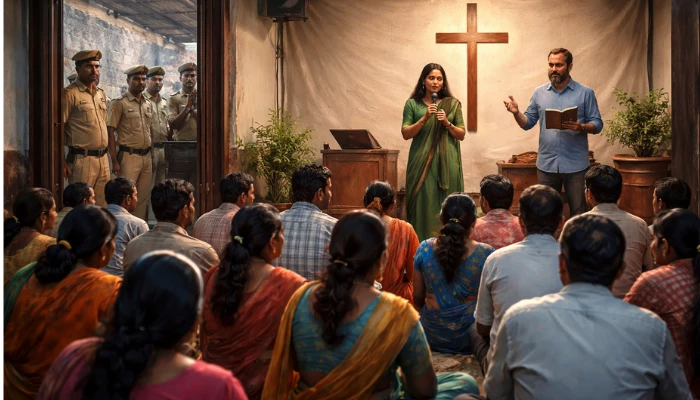
Case Summary
In the Janjgir-Champa district of Chhattisgarh, Hindus were targeted for forced religious conversion under the guise of attending a prayer meeting by Christian missionary members. The incident came to light when a dispute had erupted during an illegal prayer meeting at a church in Nagar Panchayat Kharoud, Shivrinarayan police station area, on Sunday morning (15th March, 2026). According to the police, a Christian man, Ramashankar Sahu, had been holding a prayer meeting without permission at his residence in Tiwaripara of Kharoud by gathering Hindus. In this meeting, he was manipulating and inciting Hindus to abandon the Hindu faith and convert to Christianity. When the Hindu residents of the locality came to know about this, they reached the church and protested. Meanwhile, people from some organisations had also reached the church. The Christian women and men present in the church started arguing and created a ruckus with the people of the locality and of the organisation. On receiving the information, the police team from Shivrinarayan police station reached the spot. The Christian missionaries misbehaved with the police and started shouting. Thereafter, the police caught the people involved in the dispute and brought them to the police station. Some items had also been confiscated by the police team. In this case, the police had arrested Yenivesh Sahu, Kishan Yadav, Ramshankar Sahu, a resident of Kharoud, and Motilal Ratre, a resident of Semriya, Thana Birra, along with two women, for organising a prayer meeting without permission and creating a situation of disturbance to public peace. Action had been taken against all of them under Sections 170, 126 and 135(3) of Bharatiya Nyaya Sanhita (BNS).
Why it is Hate Crime ?
This case has been added to the tracker under the primary category of Predatory Proselytisation. Within it, the sub-category selected is- Proselytisation by grooming, brainwashing, manipulation or subtle indoctrination. The tertiary category selected is - Pattern of targeting Hindus. Religious brainwashing essentially means the often subtle and forcible indoctrination to induce someone to give up their religious beliefs to accept contrasting, regimented ideas. Religious grooming or brainwashing also involves propaganda and manipulation. It involves the systematic effort, driven by religious malice and indoctrination, to persuade “non-believers’ to accept allegiance, command, or doctrine to and of a contrasting faith. Cases of such grooming or brainwashing are far more nuanced than direct threats, coercion, inducement and violence. In such cases, it is often seen that there is repeated, subtle and continual manipulation of the victim to induce disaffection towards their own faith and acceptance of the contrasting faith of the perpetrator. While subtle indoctrination is widely acknowledged as predatory, an element which is often understated in such conversions or the attempts of such conversion is the role of loyalty and trust which might develop between the perpetrator and the victim. Fiduciary relationships are often abused to affect such religious conversion. For example, an educator transmitting religious doctrine of a competing faith to a Hindu student. The Hindu student is likely to accept what the teacher is transmitting owing to the existence of the fiduciary relationship. The exploitation of the fiduciary relationship to religiously indoctrinate victims would also be included in this category. Since the underlying animosity towards the victim’s faith forms the basis of predatory proselytisation, such cases are considered religiously motivated hate crimes. This case has been added to the tracker because Hindus were targeted for forced conversion under the guise of attending a prayer meeting organised by Christian missionary members: Ramashankar Sahu, Yenivesh Sahu, Kishan Yadav, Motilal Ratre, and two Christian women. Firstly, the victims were gathered into what was presented as a simple prayer meeting at Ramashankar Sahu's residence in Tiwaripara, Kharoud, which in reality functioned as a highly manipulative front for Christian conversion activity. The perpetrators lured vulnerable Hindus by making the event seem harmless and benevolent. This gathering operated as a controlled environment where Hindus were gradually incited to abandon Hinduism and convert to Christianity. The session built false trust before escalating to manipulation through emotional pressure, all under the guise of worship. Organised without permission and specifically targeting Hindus, the meeting masked the true intent of forced religious conversion. This deceitful tactic eroded their faith identity and exemplified predatory coercion rooted in contempt for Hinduism. Secondly, the conduct of those present at the premises indicated a deliberate attempt to push this activity despite resistance from the local Hindu community. When residents objected and reached the spot, those inside did not disengage but instead started arguing and creating a ruckus. Even after police intervention, they continued shouting and causing disturbance. This persistence reflected that the activity was not an innocent or isolated prayer gathering but a determined proselytisation effort that continued despite objections, reinforcing the coercive and confrontational nature of the conversion attempt. Thirdly, the fact that the prayer meeting was conducted without permission and resulted in police action, including arrests under provisions related to disturbance of public peace, shows that the activity had crossed the threshold of lawful religious practice. The seizure of religious items from the premises further indicates that organised efforts were underway within the gathering. When religious activities are conducted covertly, without authorisation, and lead to law and order disruption, it points towards a structured attempt to carry out coerced conversions in a concealed and unlawful manner. Furthermore, the involvement of multiple accused individuals, including both men and women, demonstrates that this was not an individual act but a coordinated effort. Conversion activities carried out in groups reflect a systematic approach where roles are distributed to influence, persuade, and retain targets. Such organised efforts directed at Hindus as a group indicate that the intent was not merely to propagate a belief but to actively target and alter the religious identity of the Hindu community. The Christian faith, by its theological orientation, emphasises proselytisation, and such incidents often reflect that underlying objective. In pursuit of conversions, methods such as emotional persuasion, social pressure, and misrepresentation are frequently employed to weaken the faith of Hindus. When such actions are carried out in a structured and concealed manner, targeting Hindus specifically, they reveal a deeper religious hostility towards the Hindu identity and belief system. Moreover, this was not the first time that an illegal Christian conversion racket had been exposed in Chhattisgarh. There have been several such recurring instances recorded by the Hinduphobia Tracker. For example, on 17 November 2001, in Rajendra Nagar, Raipur, Chhattisgarh, a Hindu family had been forcibly converted to Christianity under the pretext of curing diseases. The victims’ mother had been ill, and on that pretext, twenty-two (22) members of the Hindu family had been forcibly converted to Christianity by local Christians. In another case on 11 January 2024, around ten to twelve Hindu minors had faced religious conversion by a Christian man, David Chako, in Dharampur village, Chhattisgarh. Minors from the Scheduled Caste and Scheduled Tribe communities had been brought to a private residential premises and kept under supervision. The property, originally intended for residential construction by Chako, had been converted into an improvised church. The complaint in this case had stated that the building had been operating for about two years and that children were being involved in religious activities at the premises without any legal permission. Similarly, the Hinduphobia Tracker has recorded numerous other cases where Christian missionaries targeted poor households, ailing families, and vulnerable Hindus under the pretext of healing or economic aid. They coerced conversions, showcasing their hatred and contempt for Hindus and their faith identity, amounting to religiously motivated hate crimes. Overall, this current case demonstrates organised, covert, and persistent attempts to convert Hindus under the guise of a prayer meeting. Here, the motivation and method both indicate hostility towards the victims' religion; thus, this case meets the threshold of a hate crime and has been categorised accordingly in the tracker.


Case Status
Arrested


Perpetrators Details
Perpetrators
Christian Extremists
Perpetrators Range
From 5 to 10
Perpetrators Gender
both
 Sources




