Hindus called 'dogs,' religion trashed by Pakistan Muslim journalist on Border Security Force Day in Pakistan
 Pakistan
  5 December, 2021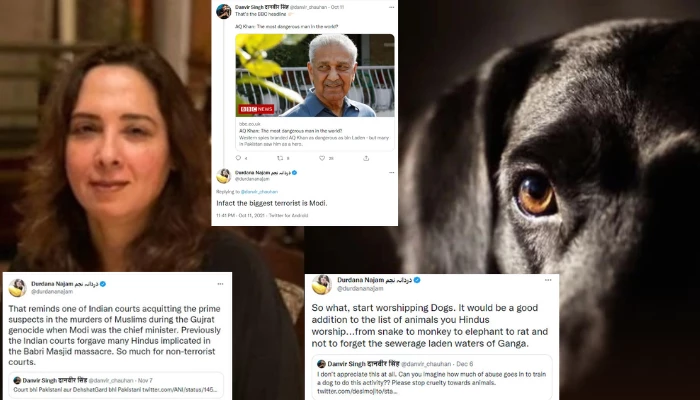
Case Summary
On 6 December 2021, the Hindu religion was mocked, demeaned and degraded by a Pakistani journalist through her social media post reacting to the BSF Raising Day parade held in Jaisalmer. As per the report, a Pakistani journalist named Durdana Najam, who wrote columns for Arab News Pakistan, The Express Tribune, and Roznama 92 News, posted a tweet on Twitter mocking Hindu religious practices. The tweet was made while reacting to a discussion surrounding the BSF Raising Day parade held in Jaisalmer, Rajasthan, where a K9 officer presented flowers to India’s Union Home Minister during the ceremony. Responding to the incident, Najam posted a tweet targeting Hindus and their religious traditions. In the tweet, she wrote: “So what, start worshipping Dogs. It would be a good addition to the list of animals you Hindus worship…from snake to monkey to elephant to rat and not to forget the sewerage-laden waters of Ganga.” The remark directly mocked Hindu beliefs and religious symbolism by ridiculing the reverence shown to animals and the sacred status of the river Ganga in Hindu tradition. The statement was posted publicly on social media and circulated widely online. Reports also noted that Najam had previously used derogatory language against India and Hindus in other tweets, including remarks targeting the Indian Prime Minister and claims portraying Hindus in a negative light. Most of the time, when Najam talked about Hindus or India, she used derogatory and offensive language. In a November 7 tweet, Najam alleged the courts in India acquitted the main suspects of the Gujarat riots and claimed it was genocide against Muslims. She conveniently forgot that 59 Kar Sewaks were burnt alive by a Muslim mob in Godhra, which had led to the riots. In another tweet from September 2021, she peddled lies against Hindus and defamed the Hindu organisation RSS as women molesters in Kashmir. In yet another tweet in October, she called the Indian Prime Minister Narendra Modi a terrorist.
Why it is Hate Crime ?
This case is added to the tracker under the primary category- Hate speech against Hindus. The sub-category selected under it is- Anti-Hindu slurs, mocking faith. Anti-Hindu slurs and the deliberate mocking of the Hindu faith owing to religious animosity involve the usage of derogatory terms, stereotypes, or offensive references to religious practices, symbols, or figures. One of the common anti-Hindu slurs used against Hindus is “cow-worshipper” and “cow piss drinker”. The intention of using this term is to demean and mock Hindus as a group and their religious beliefs since Hindus consider the cow holy. Additionally, some symbols and the slurs attached to them have a historical context that exacerbates the insult, hate, stereotyping, dehumanisation and oppression against Hindus. Cow worship has been used for centuries to denigrate Hindus, insult their faith and oppress Hindus specifically as a religious group. There has been overwhelming documentation about how cow slaughter has been used to persecute Hindus, with cow meat being thrown in temples and places of worship. There has also been overwhelming documentation where cow meat (beef) has been force-fed to Hindus to either forcefully convert them to Islam or denigrate their faith. Apart from cow worship, the Swastika – which holds deep religious significance for the Hindus – has also been misinterpreted and distorted to use as a slur against Hindus. Similarly, the worship of the Shivling has been used by supremacist ideologies and religions to denigrate Hindus owing to religious animosity. Such slurs and denigration stem from inherent animosity and hate towards Hindus and their faith; therefore, it is categorised as hate speech targeted at Hindus specifically owing to their religious identity. This incident was considered a case of anti‑Hindu hate speech because the remarks were directed not at a specific individual but at the religious beliefs and sacred symbols of the Hindu community as a whole. By ridiculing forms of worship associated with animals and mocking Hindu religious practices, the statement targeted core aspects of Hindu faith and practice. Rather than engaging in reasoned criticism or debate, the language used conveyed contempt and was perceived as belittling traditions that millions of people regarded as sacred. The comment not only targeted Hindus but also insulted the River Ganga, which was considered a sacred river in Hinduism. In the Hindu faith, the river was referred to as Ganga Maa, which translates to Mother Ganges, and the word Maa was a term of respect used when addressing a female deity. The Ganga, to the Hindus, was not just a river but a goddess and a river that was sacred river. Her waters were believed to purify the souls of the faithful and help them on the path to Moksha (liberation). Millions of devotees visited her banks every year to bathe in her waters, offer prayers, and perform the last rites of their loved ones. The name of the Ganga thus held a deeply religious significance. Interestingly, the timing of the tweet in relation to this event was ironic and thus further exemplified the apparent aggression in the post. The demeaning rant in relation to the Border Security Force Raising Day, a time when the force that protects our border was honoured and appreciated, was a wholly devious and deliberate insult. This inappropriate and amusement‑driven tweet had taken away all focus from the event that the presentation was celebrating and had turned it into an embarrassing spectacle of mocking a religion and a nation that the force was protecting. Instead of talking about the circumstances of the actual event, this comment was a sweeping generalisation of Hinduism and hence made a large section of the online population feel offended towards the religion. Moreover, such statements bring discrimination into everyday political talk. When people with big media reach mock religions and their symbols, their words have a huge impact on public views. These stories strengthen stereotypes and create a climate where bias against religious groups feels more normal. They systematically target Hindus to make them feel bad about their religion and faith. Notably, Hinduism views animals as carriers of deep symbolic and spiritual meanings. For instance, certain Hindu traditions link dogs to the sacred Dattatreya, often shown with four dogs symbolising the four Vedas, and to Bhairava, a fierce form of Lord Shiva, who rides a dog. Mocking religion and faith that Muslims do not practise has been a repetitive occurrence within the Muslim community. That shows insensitivity and intolerance towards the culture and faith of others. For these reasons, the incident qualified as a hate crime entry. The statement was an attack on the religion of Hindus as a whole, contained scornful language toward components of the Hindu religion, and sought to foster prejudice against the religious identity of Hindus in a public forum. Therefore, it constituted an attack on Hindus as a religious group and was thus an expression of anti‑Hindu bigotry.


Case Status
Unknown


Perpetrators Details
Perpetrators
Muslim Extremists
Perpetrators Range
One Person
Perpetrators Gender
female
 Sources




