Minor Dalit Hindu girl abducted, forcibly converted to Islam, and married to Muslim man in Sindh, Pakistan
 Mirpur Khas, Sindh, Pakistan
  12 March, 2026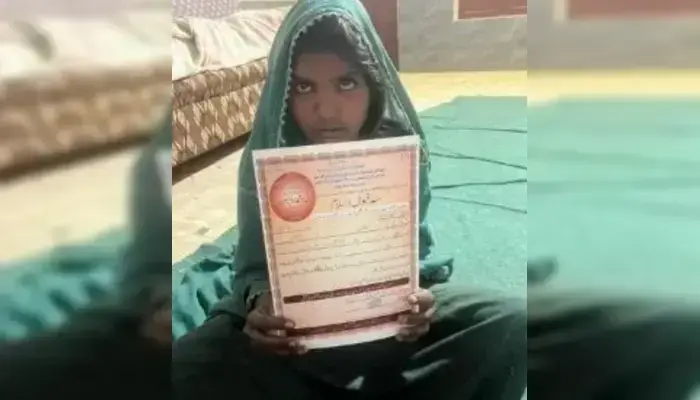
Case Summary
In Bukhari Farm, a village near Kot Ghulam Muhammad tehsil in Mirpurkhas district of Sindh province in Pakistan, a 12-year-old Dalit Hindu girl, Lakshmi Kolhi, daughter of Ramesh Kolhi, was kidnapped, converted to Islam, and married to a Muslim man named Parvez Marri. She was also given a new Islamic name after conversion. The victim's documents were forged to show her as an adult to avoid any legal trouble. According to reports, the Hindu victim was lured and abducted by Parvez Marri on 13 March 2026. She was taken to Samaro, where she was presented before Pir Omar Jan Sirhindi, a Sufi Islamic cleric. There, the girl was forcibly converted to Islam and later married to Parvez. Following the conversion, she was given a Muslim name, Shabana Sheikh. The girl’s actual age, 12 years, was recorded as 19 years on the conversion certificate. This forgery was done to escape the Sindh Child Marriage Restraint Act, which sets the minimum legal age of marriage at 18 years. Any marriage involving a minor is therefore considered illegal under provincial law. Human rights activists and social leaders from minority communities expressed deep concern over the growing number of cases involving the abduction, forced conversion, and forced marriage of minor girls from Hindu and other minority communities in Sindh. They stated that despite the existence of laws intended to prevent such incidents, weak enforcement allowed the problem to persist. Some activists stated that certain Muslim groups in the Samaro area continued to conduct conversions and marriages involving underage Hindu girls. They argued that such practices represent not only a violation of the law but also a serious injustice to vulnerable families from economically disadvantaged communities. This case highlights the persecution faced by the Hindu minorities in Pakistan, marked by systemic discrimination, violence, and forced conversions. Hindu women, particularly young girls, are often abducted, forcibly converted to Islam, and married off to Muslim men with little to no legal recourse. Temples are frequently vandalised or destroyed, and Hindu communities are subjected to social and economic marginalisation. Blasphemy laws are disproportionately used against Hindus, leading to false accusations and severe punishments. Many Hindu families are forced to flee their homes due to religious intolerance, living in constant fear of attacks. This sustained persecution highlights the dire conditions for Hindus in Pakistan, where their religious identity makes them targets of oppression.
Why it is Hate Crime ?
This case has been added to the tracker under the primary category- Predatory Proselytisation. Within this, the subcategory selected is- Harassment, threats, coercion for conversion. Harassment covers a wide range of behaviours of an offensive nature. It is commonly understood as behaviour that demeans, humiliates, and intimidates a person, including threats and coercion. Harassment and threats, in this case, find their root on discriminatory grounds which has the effect of nullifying a person’s rights or infringing upon his freedom to exercise his right specifically owing to the victim’s religious identity. Verbal and physical threats and psychological or physical harassment are often used against Hindu victims because they choose to practice their professed religion. Religious harassment also includes forced and involuntary conversions by harassment, threats or coercion. Coercion includes intimidatory tactics like force-feeding a Hindu victim beef to convert to another religion, forceful circumcision etc. In several cases documented, non-Hindu perpetrators or those who harbour specific animosity towards Hinduism, harass victims simply based on their religious identity. Such cases often also include harassment to ensure the Hindu victim abandons his/her professed religion and adopts the religion of the perpetrator. Such cases where Hindu victims are harassed to convert to the perpetrator’s religion are rooted in animosity towards the victim’s religious identity and are therefore documented as religiously motivated hate crimes. Another subcategory selected is- Proselytisation by grooming, brainwashing, manipulation or subtle indoctrination. Within this, the tertiary category selected is- Conversion of Minor. Religious brainwashing essentially means the often subtle and forcible indoctrination to induce someone to give up their religious beliefs to accept contrasting regimented ideas. Religious grooming or brainwashing also involves propaganda and manipulation. It involves the systematic effort, driven by religious malice and indoctrination, to persuade “non-believers’ to accept allegiance, command, or doctrine to and of a contrasting faith. Cases of such grooming or brainwashing are far more nuanced than direct threats, coercion, inducement and violence. In such cases, it is often seen that there is repeated, subtle and continual manipulation of the victim to induce disaffection towards their own faith and acceptance of the contrasting faith of the perpetrator. While subtle indoctrination is widely acknowledged as predatory, an element which is often understated in such conversions or the attempts of such conversion is the role of loyalty and trust which might develop between the perpetrator and the victim. Fiduciary relationships are often abused to affect such religious conversion. For example, an educator transmitting religious doctrine of a competing faith to a Hindu student. The Hindu student is likely to accept what the teacher is transmitting owing to existence of the fiduciary relationship. The exploitation of the fiduciary relationship to religiously indoctrinate victims would also be included in this category. Since the underlying animosity towards the victim’s faith forms the basis of predatory proselytization, such cases are considered religiously motivated hate crimes. This case has been added to the hate crime database as the abduction of a 12-year-old Dalit Hindu girl from Bukhari Farm near Kot Ghulam Muhammad tehsil in Mirpurkhas, Pakistan, her forced conversion to Islam under Pir Omar Jan Sirhindi in Samaro, and her marriage to Parvez Marri after forging her age from 12 to 19 years on documents starkly illustrate the exploitation of vulnerable Hindu minorities through coercion and force. Such incidents are not isolated; they form part of a persistent pattern in Pakistan, where Hindu minorities, particularly young girls from poor families, are frequently targeted for kidnappings, forced religious conversions, and marriages to Muslim men. This trend showcases systemic discrimination and violence faced by the Hindu community since Pakistan's inception, with Sindh province reporting hundreds of such cases annually, often involving local clerics and impunity for the Muslim perpetrators. Another key point is that the victim, Lakshmi Kolhi, is a minor aged 12. This negates any genuine element of consent or voluntary change of faith from the outset. Children at this age, due to their ongoing emotional, cognitive, and social development, are especially susceptible to manipulation, intimidation, and indoctrination, making them easy targets for those seeking to exploit religious or social vulnerabilities. When such acts target minors of a specific faith, in this case Hindus from marginalised Dalit communities, using abduction, document forgery to bypass the Sindh Child Marriage Restraint Act, and coercion by Sufi clerics, they constitute clear instances of hate crimes and gross violations of human rights, child protection norms, and provincial laws prohibiting underage marriages. The perpetrators in this case exploited the victim's age vulnerability to enforce Islam on her and get her married to the Muslim abductor, making it a hate crime. The act of forced conversion and subsequent marriage profoundly violated the victim's religious rights, autonomy, and freedom of faith. Perpetrators deliberately stripped her of her Hindu identity and beliefs, values, traditions, and community ties central to her life, renaming her with a Muslim name and imposing Islam through a fraudulent ceremony. This was not mere sharing of a different belief system but an aggressive attempt to undermine Hinduism itself, driven by external coercion rather than personal conviction. By specifically targeting her as a Hindu, the perpetrators showed utter contempt for her faith and its followers, exploiting vulnerabilities to erase her spiritual essence. This calculated assault transformed a personal violation into a religiously motivated hate crime, aimed at demographic alteration, cultural erasure, subjugation of a minority faith, and the humiliation of the entire Hindu community. The forging of the victim's documents exemplifies the extreme religious zeal and fanaticism of the perpetrators, who altered her recorded age from 12 to 19 to falsely portray her as an adult, thereby justifying the illegal conversion and marriage despite knowing it violated the Sindh Child Marriage Restraint Act. This deliberate criminal act, fully aware of its illegality under provincial law prohibiting underage unions, reveals an Islamic supremacist mindset prioritising religious dominance over legal and ethical boundaries. Their willingness to engage in such forgery underscores a profound hatred for the victim's Hindu identity, driving them to strip her of her faith, autonomy, and childhood at any cost, transforming the crime into a clear hate-driven assault on her religious identity and community. Given that this case meets the parameters of a religiously motivated crime, it is being added to the hate crime database of the Hinduphobia Tracker. Disclaimer: The perpetrator count is recorded as '2', referring to the abductor Parvez Marri and the Sufi cleric Pir Omar Jan Sirhindi, who conducted the forced conversion ceremony.
Victim Details
Total Victim
1
Deceased
0
Gender
- Male 0
- Female 1
- Third Gender 0
- Unknown 0
Caste
- SC/ST 1
- OBC 0
- General 0
- Unknown 0
Age Group
- Minor 1
- Adult 0
- Senior Citizen 0
- Unknown 0


Case Status
Unknown


Perpetrators Details
Perpetrators
Muslim Extremists
Perpetrators Range
From 2 To 5
Perpetrators Gender
male
 Sources




