Hindu students forced to remove sacred religious symbols by police during examination, defying government order
 Varanasi, Uttar Pradesh, India
  13 March, 2026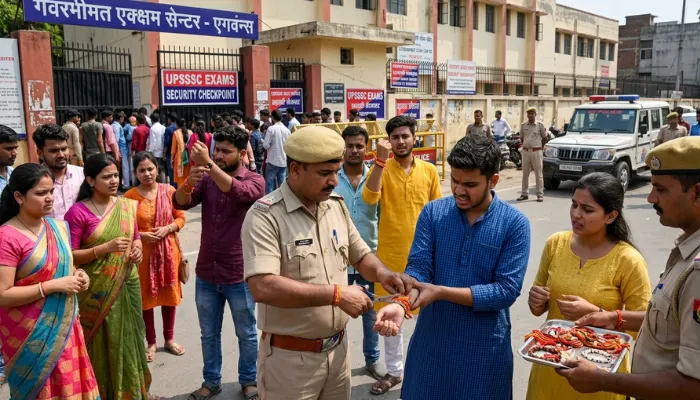
Case Summary
In Varanasi, Hindu students' sacred religious symbols like kalavas, rudrakshas, and neck threads were forcibly removed by the police. This occurred during the Uttar Pradesh Police Recruitment Examination on 14 March 2026. This government recruitment exam saw the violation despite clear state directives prohibiting the forced removal of religious symbols. According to media reports, the exams were conducted on 14 and 15 March 2026, when Hindu students' kalavas, rudrakshas, and sacred neck threads were forcibly removed by Uttar Pradesh police under the guise of maintaining security. During this period, Deputy Inspector General Shivhari Meena visited the exam centres and inspected the security arrangements as well as the checkpoints. During this, kalavas and watches were taken off the hands of male candidates. Apart from this, rudrakshas and the threads around the neck were also taken off. Belts of male candidates were also taken off. Similarly, kalavas, friendship bands, neck chains, anklets, ear studs and hair clips were also taken off from female candidates. Only after this were they given entry into the examination hall. During this, biometric checking was also done, and iris matching was performed. The Uttar Pradesh Police Recruitment Examination was held at 46 centres across the state, including Varanasi. Utmost caution was exercised regarding the examination. Intelligence agencies, as well as the Uttar Pradesh Special Task Force, were deployed to curb cheating. Following this, Uttar Pradesh Police Recruitment and Promotion Board, on their official X handle, stated that such curbs and forced removal of religious symbols violated the guidelines of conducting exams. They wrote: "Regarding the checking and frisking of candidates during examinations conducted by the Uttar Pradesh Police Recruitment and Promotion Board, policy guidelines were consistently issued that religious and cultural symbols, such as sacred thread, mangalsutra, etc., worn by any candidate would neither be removed nor attempted to be removed. Guidelines in this regard were already issued, and deployed police forces were instructed in this regard during every briefing. However, the occurrence of such incidents was unfortunate and objectionable. Disciplinary action would be ensured against the guilty personnel to ensure such incidents do not occur in the future."
Why it is Hate Crime ?
This case is being added to the tracker under the primary category- Restriction/ban on Hindu practices. The subcategory selected is- Restriction on expression of Hindu identity. An example of the state-affected prejudicial and targeted orders against the Hindu community would be a government denying the right of a Hindu or a group of Hindus to hold a religious procession owing to the animosity of non-Hindu groups. Denial of the religious right of the Hindus to assuage the non-Hindu group which harbours animosity to a point where it could lead to violence against Hindus is not only a failure of law and order but is a prejudicial order against Hindus, denying them their fundamental rights to express their religious identity. An example of a hate crime against Hindus by a non-Hindu would be a non-Hindu institution forcing its Hindu employees to abandon religious symbols that a Hindu would wear as an expression of faith owing to inherent prejudice against the faith professed by the victim or a non-Hindu group of people restricting a Hindu group from constructing a place of worship simply because the demography of the area in which the temple is being built is dominated by non-Hindus. Such actions are driven by religious animosity and/or prejudice against Hindus and their faith and would therefore be categorized as a hate crime. Another primary category selected is- Attack on Hindu religious representations. The subcategory selected is- Desecration of Hindu religious symbols. Icons and symbols or a religious representation of a spiritual ideal are widely revered in Hinduism. Iconography is of vital significance in the Hindu milieu. It helps connect people’s spiritual beliefs with the real world. Iconography within the Hindu faith takes several shapes and forms. Murtis are of most significance to Hindus, to which daily rituals, prayers and offerings are done. Besides the murtis, there are several other symbols which have deep significance in the Hindu faith – the Om and Swastika for example. Since these Hindu religious symbols hold paramount importance in Hinduism, any desecration of symbols, icons, murtis, religious representations and manifestations, is driven by animosity towards the faith itself which manifests itself through these murtis, icons and symbols. Therefore, any desecration of these Hindu religious symbols and representations is considered religiously motivated hate crimes under this category. This incident is a clear case of a religiously motivated hate crime as the Uttar Pradesh police imposed blatant restrictions on Hindu religious expression during a government examination, sending a clear message that Hindu symbols faced hostility in public institutions. Police forced the removal of Hindu symbols like Kalava, Rudraksh and sacred neck thread, alongside routine items like watches and belts, creating an atmosphere of fear, pressuring Hindu students to conceal their faith identity for equal participation while non-Hindu symbols escaped such scrutiny. Such tactics mirrored patterns of targeted erasure against Hindu practices, fostering coercion that eroded confidence in open religious expression and normalised suppression of Hinduism. The kalava (sacred thread worn on the wrist), rudraksha (holy beads of Lord Shiva), and sacred neck thread represent core Hindu religious symbols, tied during rituals for protection, spiritual focus, and divine blessings, deeply revered by all Hindus as emblems of faith worn daily with devotion. These items connect wearers to ancestral traditions and deities, embodying piety and warding off evil, making their forcible removal a profound desecration that wounds Hindu sentiments. Stripping them from Hindu students during exams humiliated their religious identity, amounting to a clear religiously motivated hate crime driven by animosity towards Hinduism, as it targeted sacred markers essential to Hindu spiritual life. These actions drove systematic suppression of Hindu symbols in exam centres, undermining students' religious confidence and enforcing conformity by deeming Hindu identity incompatible with neutral spaces. Selective enforcement of such restrictions humiliated Hindu students through institutional bias that treated their sacred symbols as threats, unlike secular accessories. This disdain for Hinduism and its adherents elevated the misconduct to religiously motivated hate, alienating Hindu students from their religious heritage. The Uttar Pradesh Police Recruitment and Promotion Board issued explicit guidelines stating that no religious symbols worn by candidates, such as sacred threads or mangalsutras, would be curbed, restricted, or forcibly removed during examinations. Police received these instructions at every briefing, yet personnel desecrated Hindu symbols by forcibly removing kalavas, rudrakshas, and sacred neck threads from students under security pretexts. This violation exposed targeted suppression of Hindu expression beyond legitimate protocol. Despite clear directives, the removals humiliated students and discarded faith emblems as threats, confirming religiously motivated hate crime masked as security. Disregard for their own rules proved institutional animosity, weaponising authority against Hindu identity and devotion in a statewide exam. Here, it is important to mention that in 2022, a massive controversy erupted in Karnataka, which took a national form, after Muslim women insisted that they should be allowed to wear burqas and hijabs in their schools and classrooms. At that time, the argument that was given by several politicians, social commentators, Hindu activists and even the judiciary was that schools have the right to enforce uniform rules, since wearing uniforms brings harmony and equality in the classroom, and therefore, schools not allowing girls to wear hijab in the classroom is not religious discrimination, but merely an enforcement of widely accepted uniform norms. Pseudo-seculars and leftist groups may argue that similar reasoning applies here. However, no standardised dress code was prescribed to students in this case. Even the Uttar Pradesh Police Recruitment and Promotion Board stated that guidelines were issued not to remove students' religious symbols during examinations, yet this occurred, revealing religious bias against Hindu symbols under the pretext of preventing cheating. Moreover, the religious symbols worn by victims remained entirely benign, causing no disruption or harm, which raises serious concerns about the true motivations behind such enforcement. When ostensibly secular police forces target Hindu religious symbols specifically during statewide exams, it exposes institutional prejudice against Hinduism. This suppression under security pretexts echoes patterns where Hindu practices face curbs to maintain neutrality, often appeasing other non-Hindu groups. The police actions constituted religious discrimination, fitting hate crime criteria, where Hindus suffered penalties solely for their faith. Since the enforcement stemmed from animosity towards Hindu victims and their religious symbols, this case entered the Hinduphobia Tracker's hate crime database.


Case Status
Unknown


Perpetrators Details
Perpetrators
State and Establishment
Perpetrators Range
Unknown
Perpetrators Gender
unknown
 Sources




