Sikh terrorist threatens to attack Hindu temples if Diwali is celebrated with firecrackers
 Canada
  31 October, 2024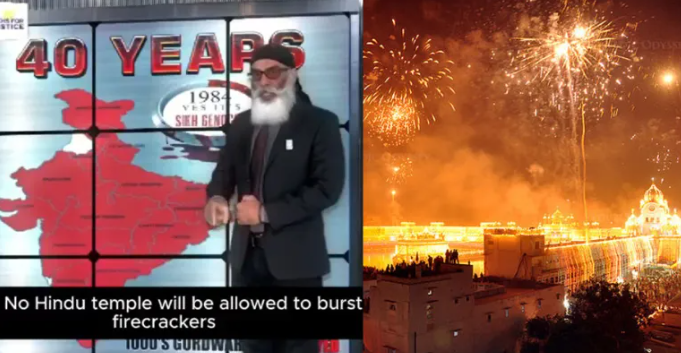
Case Summary
On November 2, Gurpatwant Singh Pannun, a designated Khalistani terrorist, issued a threatening message against Hindus celebrating Diwali. In a video, Pannun instructed Sikh youths in Punjab to prevent Hindus from bursting firecrackers during the festival. He urged them to first ask Hindus politely to refrain from using firecrackers, but if that failed, he suggested using traditional Khalsa methods, implying the use of force. Pannun claimed that no Hindu temple or household should engage in firework displays on Diwali. Declared a terrorist under the Unlawful Activities (Prevention) Act (UAPA) by the Indian Home Ministry, Pannun’s organization, Sikhs For Justice, was banned in 2019. He is known for issuing violent threats and announcing bounties for anti-India activities.
Why it is Hate Crime ?
This case has been classified as a religiously motivated hate crime under the prime category- Hate speech against Hindus, within which the sub-category selected is- Violent threats. Violent threats, explicit, implicit or implied, are the most dangerous form of hate speech since it goes beyond discriminatory and prejudicial language to express the intent of causing harm to an individual or a group of people based on their religious identity and faith. There could be several different kinds of threats that are issued to Hindus based on religious animosity. An explicit threat would mean the direct threat of violence towards an individual Hindu, a group of Hindus or Hindus at large. Physical violence, death threats, threats of destruction of property belonging to Hindus and threats of genocide would mean explicit threats against Hindus for their religious identity. Implicit threats may not be a direct threat but implied through the use of symbols of actions – for example – in the Nupur Sharma case, other than explicit threats, there were also implicit threats when Islamists took to the streets to burn and beat her effigies. It implies that they want to do the same to Nupur Sharma – thereby is considered an implicit threat. Violent threats can be delivered in person, through letters, phone calls, graffiti, or increasingly through social media and other online platforms. It would be important to understand that a threat – explicit or implicit, online or offline – to an individual who happens to be a Hindu does not qualify as a religiously motivated threat. Such a threat, while vile and dangerous, could be owing to non-religious reasons and/or personal animosity. To qualify as a religiously motivated threat, it would need to exhibit an indication that the individual is being targeted for religious reasons and/or owing to his/her religious identity as a Hindu. In his video message, Pannun not only urged Sikh youth to prevent Hindus from using firecrackers during the festival but also suggested using forceful "Khalsa methods" if they did not comply. This language goes beyond a simple expression of opposition and constitutes a form of intimidation, with an implied threat of violence specifically targeting Hindu religious celebrations. Pannun's instructions aim to instil fear among Hindu communities, restricting their ability to freely express their religious identity during Diwali, a major festival. The violent undertone in his message, compounded by his position as the leader of a banned terrorist organization, reflects deep-seated hostility towards Hindus. Such violent threats serve as a tool to coerce Hindus into abandoning their religious practices, underscoring the religious bias and antagonism motivating his statements. This makes the incident a clear example of a hate crime driven by religious intolerance.


Case Status
Unknown


Perpetrators Details
Perpetrators
Sikh Extremists
Perpetrators Range
One Person
Perpetrators Gender
male
 Sources




