Abrahamic chanting at Jamia University's Diwali event; Muslim students kick diyas, erase rangoli
 South Delhi, Delhi, India
  21 October, 2024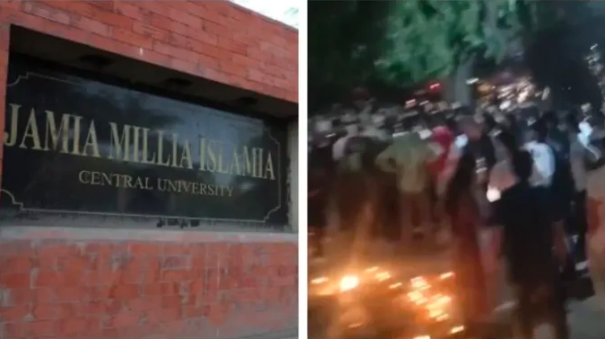
Case Summary
On October 22, 2024, a clash erupted at Jamia Millia Islamia University in Delhi during Diwali celebrations after a group of Muslim students kicked diyas and erased a Rangoli (by feet) made by other students for the festival. The incident, which took place during the pre-Diwali event "Jyotirmaya 2024" near Gate No. 7, was captured on video and circulated widely on social media. In the video, a large crowd is seen chanting slogans like “Allahu Akbar” and “Palestine Zindabad.” Reports indicate that the altercation began when some students, displeased with the Diwali decorations by ABVP-affiliated students, disrupted the setup, leading to a confrontation. Police were deployed to manage the situation, which was brought under control. Deputy Commissioner of Police Southeast Ravi Kumar said, “The incident occurred around 7:30-8 pm near gate 7. A group of students affiliated with the ABVP were putting up diyas and making rangolis for Diwali, which displeased another group of students. The other group wrecked the decorations, which led to a scuffle. Both sides engaged in sloganeering.”
Why it is Hate Crime ?
This case has been documented as a religious hate crime because the details clearly show that the offender had a bias against the Hindu faith and that the offence was performed in conjunction with that bias. Based on the case details, it has been added under the prime category- Attack on Hindu religious symbol. Further, based on the details, two sub-categories have been chosen within the aforementioned prime category. The first is- Desecration of Hindu religious symbol. Icons and symbols or a religious representation of a spiritual ideal are widely revered in Hinduism. Iconography is of vital significance in the Hindu milieu. It helps connect people’s spiritual beliefs with the real world. Iconography within the Hindu faith takes several shapes and forms. Murtis are of most significance to Hindus, to which daily rituals, prayers and offerings are done. Besides the murtis, there are several other symbols which have deep significance in the Hindu faith – the Om and Swastika for example. Since these Hindu religious symbols hold paramount importance in Hinduism, any desecration of symbols, icons, murtis, religious representations and manifestations, is driven by animosity towards the faith itself which manifests itself through these murtis, icons and symbols. Therefore, any desecration of these Hindu religious symbols and representations is considered religiously motivated hate crimes under this category. The second sub-category relevant here is- Abrahamic religious chanting outside Hindu religious places and/or during Hindu activities. In Hinduism, a temple is the abode of the Deity. The Deity in the Temple is consecrated, thereby, making it a real, breathing entity. Hindus believe that not just the Deity but the temple premises itself are sacred to Hindus since Hindus hold the faith that the entire Temple space is an amalgamation of the divine energy of the deity. Similarly, religious activities hold deep significance for Hindus, as they are intricately connected to their spiritual, cultural, and social lives. These practices encompass rituals, festivals, prayers, and pilgrimages that celebrate and honour various deities, fostering a sense of spiritual connection, community, and cultural continuity. Given the central significance of Temples and religious activities in Hindu Dharma, any aggressive Abrahamic chanting outside Temples or during religious activities negates the divinity of the religious space because the chanting itself negates the existence of any other God other than the God of the Abrahamic faith. Such chanting is specifically done to negate the faith of Hindus, establish religious supremacy, intimidate the devotees and mock the faith. Besides temples, Abrahamic chanting outside any Hindu place of worship or religious structure or during any religious activity has the same effect. Since such acts are rooted in an inherent religious supremacist mentality driven by religious animosity, such crimes would be considered religiously motivated hate crimes under this category. This incident at Jamia Millia Islamia University has been classified as a religiously motivated hate crime, reflecting a targeted display of disrespect for Hindu religious symbols. The act of kicking over diyas and erasing a Rangoli created for Diwali—a prominent Hindu festival symbolizing light, prosperity, and spiritual renewal—constitutes a desecration of Hindu religious symbols. Diyas and Rangolis hold significant spiritual meaning in Hinduism, representing reverence and traditional devotion. The deliberate destruction of these symbols reflects not only a disregard for their religious value but also an attempt to undermine Hindu expressions of faith in a public setting. Additionally, the loud chanting of “Allahu Akbar” and “Palestine Zindabad” during the Diwali observances is nothing but an intentional disruption and an act of intimidation against the Hindus celebrating Diwali. Together, these actions—desecrating religious symbols and chanting religious slogans—convey a lack of tolerance for the celebration of Hindu customs, highlighting tensions that often arise from conflicting expressions of religious identity and marking this as a case with underlying religious animosity.


Case Status
Unknown


Perpetrators Details
Perpetrators
Muslim Extremists
Perpetrators Range
Unknown
Perpetrators Gender
unknown
 Sources




