Christian evangelists coerce Hindu villagers to convert, force them to replace Hindu deities with Christian symbols
 Azamgarh, Uttar Pradesh, India
  19 October, 2024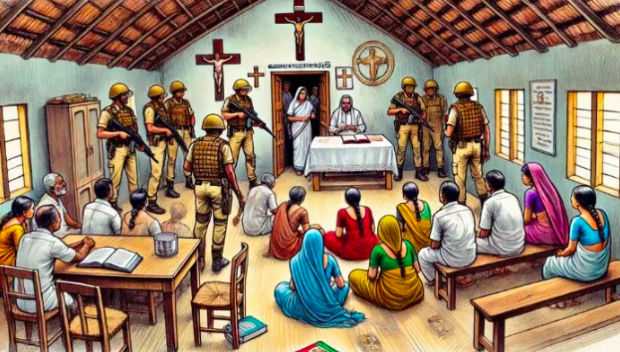
Case Summary
On October 20, Azamgarh Police in Uttar Pradesh disrupted a mass conversion event in Miria Redha village, Kandharapur, after receiving a complaint from BJP District Vice President Harivansh Mishra. The police, led by SHO Rudrbhan Pandey, raided the location and detained Rajaram Yadav, identified as the organiser of the event, for questioning. Authorities seized religious books and other materials from the scene. Mishra stated that Yadav coerced Hindu villagers into converting to Christianity, forcing them to replace Hindu deity images with Christian symbols. He described the event as a significant threat to Hindu beliefs and called for strict action. Superintendent of Police Shailendra Lal confirmed the seizure of "objectionable literature" and the legal proceedings against Yadav. Reports indicated that Christian prayer meetings targeting vulnerable villagers had been held every Sunday and Thursday in the area.
Why it is Hate Crime ?
This particular case has been classified as a religiously motivated hate crime under two subcategories of Predatory Proselytisation because of the various distinct components that demonstrate the perpetrator's bias against the Hindu faith and his deliberate attempt to alienate the victim from his Hindu identity. The first sub-category under 'Predatory Proselytisation' relevant in this case is- Attempting to convert/converting by denigrating Hinduism. In several cases, Hindus are converted or an attempt is made to convert Hindus by denigrating their faith, Hinduism. In such cases, the Hindus associate with the non-Hindu perpetrators often by choice and then, the attempt to convert them by insulting their faith, showing the faith down etc begins. An example of this would be a non-Hindu gathering where the Hindus are attending the gathering of their own free will. However, once they attend the gathering, there is an explicit attempt to convert them by abusing their faith and hailing the faith of the perpetrator. The denigration of the Hindu faith is often based on misrepresentation of the Hindu faith, its doctrine and scriptures and insult to espoused traditions if not blatant lies about Hindu beliefs and ways. Such conversions or attempts at conversions are driven by animosity towards the Hindu faith and are therefore documented as religiously motivated hate crimes. The second sub-category under Predatory Proselytisation relevant here is- Harassment, threats, coercion for conversion. Harassment covers a wide range of behaviours of an offensive nature. It is commonly understood as behaviour that demeans, humiliates, and intimidates a person, including threats and coercion. Harassment and threats, in this case, find their root on discriminatory grounds which has the effect of nullifying a person’s rights or infringing upon his freedom to exercise his right specifically owing to the victim’s religious identity. Verbal and physical threats and psychological or physical harassment are often used against Hindu victims because they choose to practice their professed religion. Religious harassment also includes forced and involuntary conversions by harassment, threats or coercion. Coercion includes intimidatory tactics like force-feeding a Hindu victim beef to convert to another religion, forceful circumcision etc. In several cases documented, non-Hindu perpetrators or those who harbour specific animosity towards Hinduism, harass victims simply based on their religious identity. Such cases often also include harassment to ensure the Hindu victim abandons his/her professed religion and adopts the religion of the perpetrator. In this subcategory, we would only include cases where the victim was harassed, threatened or coerced to convert. Cases where attempts were made to convert but the victim resisted would be documented in another sub-category. Such cases where Hindu victims are harassed to convert to the perpetrator’s religion are rooted in animosity towards the victim’s religious identity and are therefore documented as religiously motivated hate crimes. Here, the accused targeted Hindu villagers and sought to uproot their cultural and religious symbols, thereby diminishing their faith. Such efforts to denigrate or erase the Hindu identity reveal a bias intended to portray Hinduism as inferior or unworthy of respect compared to Christianity. Further, the forceful replacement of Hindu deities with Christian symbols suggests psychological and social pressure designed to isolate Hindu villagers from their community and faith. Denigrating someone else's faith for the purpose of conversion often stems from a deeper animosity or lack of respect for the victim's faith. This animosity can be driven by the belief that one's own faith is superior and can lead to a dismissive attitude towards other religions. This superiority complex can manifest as disrespect and hostility towards other beliefs. Insulting Hinduism in attempts to brainwash Hindus against their religion, itself stems from the animosity against the Hindu faith, which is why this case qualifies as a hate crime against Hindus and has been documented here.


Case Status
Arrested


Perpetrators Details
Perpetrators
Christian Extremists
Perpetrators Range
One Person
Perpetrators Gender
male
 Sources




