4 arrested in Barabanki, UP, for converting several to Christianity under guise of giving cancer treatment
 Bara Banki, Uttar Pradesh, India
  15 October, 2024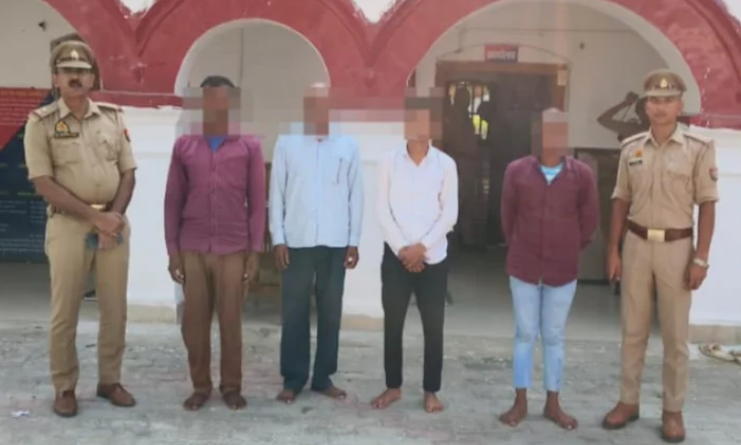
Case Summary
In Barabanki, UP, a religious conversion under the guise of cancer treatment was uncovered, where people were reportedly converted through exorcism and prayer meetings. A video of the gathering, circulating on social media, showed a prayer meeting aimed at healing through faith. Following a complaint, the police registered a case and arrested four individuals, also recovering Christian religious books from the location. The incident took place in Majara village, under Kothi police station's jurisdiction. Around three dozen villagers, including women and children, had gathered on a tarpaulin outside the house of Rajendra Prasad. According to witnesses, the group, identified as Christians, praised Lord Jesus and presented prayer-based treatments for cancer and other ailments. Jitendra Pratap Singh, the District Vice President of Vishwa Hindu Mahasangh, notified the police. Four people were subsequently detained: Shyamu from Palhari, Mehar Kashyap, Meghrani, and Badal Gautam from Nepalganj, Zaidpur, as well as Rajendra Kumar from Narottamou Ghat. The police confirmed the discovery of religious books at the site. Additional SP Dr. Akhilesh Narayan Singh stated that the arrested individuals were being sent to jail and their bank accounts and activities were under investigation.
Why it is Hate Crime ?
This case from Barabanki, Uttar Pradesh, where religious conversions were reportedly conducted under the pretext of offering faith-based healing for cancer, exemplifies a religiously motivated hate crime under the category of Predatory Proselytisation. The use of health crises, such as serious illnesses, to promote religious conversion exploits the vulnerabilities of individuals and their families during times of desperation, making it a clear instance of Conversion/attempts to convert by inducement. Predatory Proselytisation is not just limited to threat, harassment, force and violence, but it also has contours of stealth. In several cases, the Hindu victim is exploited to convert, with non-Hindus taking advantage of their poverty. In such cases, the Hindu victim who is suffering financially is offered monetary benefits, including lucrative offers for jobs, health treatment, education, etc, to induce the victim into changing his/her religion. In such cases, the religious identity of the victim and the aim to disenfranchise him from his faith form the heart of the crime. Also, taking advantage of and exploiting an individual’s economic vulnerabilities is widely acknowledged as exploitation, forms of which are often penalised by law. Such cases therefore are considered religiously motivated hate crimes since the victim’s religious identity forms the very heart of the crime itself. In this particular case, the Christian evangelists were overtly trying to convert villagers by glorifying their own faith, Christianity. In an effort to indoctrinate them against their religion—which itself is a product of hostility towards the victim's faith—they were extolling their faith by promoting Jesus as the true deity. Further, the accused were attempting to exploit a specific vulnerability of the victims who were in all likelihood also economically backward. The missionaries exploited the poor victims by promising them cures for their ailments like cancer - a cure that they either could not afford. Since exploiting vulnerabilities for the explicit purpose of conversion is purely based on animosity towards the victim's faith, this case has been categorised as a religiously motivated hate crime.


Case Status
Arrested


Perpetrators Details
Perpetrators
Christian Extremists
Perpetrators Range
From 2 To 5
Perpetrators Gender
both
 Sources




