Attack on Hindu faith: Play mocking Hindu deities performed at educational university in Maharashtra
 Pune, Maharashtra, India
  31 January, 2024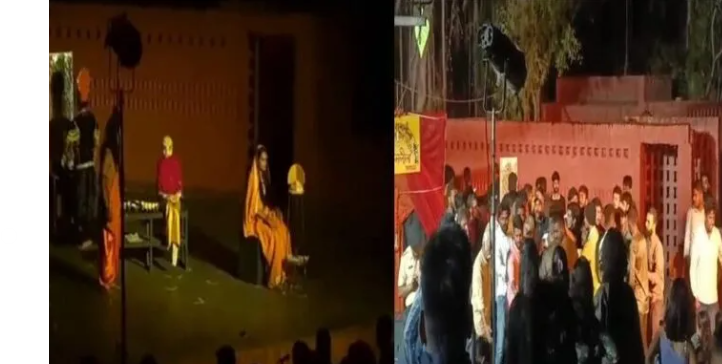
Case Summary
At Savitribai Phule Pune University (SPPU), Pune, a derogatory play mocking Lord Ram and Goddess Sita was staged. The play, titled "Jab We Met'', was performed as part of a competition at Lalit Kala Kendra, a department of the university. A video of the play circulated on social media, showing the student playing Mata Sita smoking a cigarette, while the character of Prabhu Shri Ram assisted her in lighting it. The depiction sparked outrage among the Akhil Bharatiya Vidyarthi Parishad (ABVP) activists, a Hindu students' group, who objected strongly to the insulting portrayal of Ramayana and Hindu deities. ABVP activists stopped the performance, and a heated argument broke out with the organisers, during which two students sustained injuries. The activists underlined that Ramayana was not mythology but a historical fact, and no derogatory references to Lord Ram and goddess Sita would be tolerated. On X, ABVP Pune shared a video of the offensive act, stating that “Prabhu Shri Ram and Mata Sita were portrayed as clowns in the dramas presented by the Department of Fine Arts, Savitribai Phule Pune University.” The organisation added that ABVP Pune Mahanagar activists had stopped the play and demanded strict action against those responsible for insulting Hindu sentiments. Responding to the controversy, Suresh Bhosale from the university’s security department said, “We were not given any prior intimation about the programme and came to know about it only after the incident.” Both ABVP members and the student performers lodged cross-complaints at Chatuhshrungi Police Station. Police confirmed that statements from both parties were being recorded. Following this, the police booked more than six perpetrators for the derogatory play. Some of the accused are identified: head of the Lalit Kala Kendra, Dr Pravin Dattatraya Bhole, writer of the play Bhavesh Patil, director Jay Pedhnekar and actors Prathamesh Savant, Hrushikesh Dalvi, Yash Chikhale and others. They were booked under sections 295 A (insulting religious beliefs), 294 (obscene acts and songs), 143 (unlawful assembly), 147 (rioting), 149, 323 (voluntarily causing hurt), 116, 117 (abetting commission of offence) of the Indian Penal Code and sections of the Cigarettes and other Tobacco Products Act (COTPA), 2003. Subsequently, the police arrested a few perpetrators.
Why it is Hate Crime ?
This case has been added to the tracker under the primary category- Hate Speech against Hindus. Within this, the subcategory selected is- Anti-Hindu slurs, mocking faith. Anti-Hindu slurs and the deliberate mocking of the Hindu faith owing to religious animosity involve the usage of derogatory terms, stereotypes, or offensive references to religious practices, symbols, or figures. One of the common anti-Hindu slurs used against Hindus is “cow-worshipper” and “cow piss drinker”. The intention of using this term is to demean and mock Hindus as a group and their religious beliefs since Hindus consider the cow holy. Additionally, some symbols and the slurs attached to them have a historical context that exacerbates the insult, hate, stereotyping, dehumanisation and oppression against Hindus. Cow worship has been used for centuries to denigrate Hindus, insult their faith and oppress Hindus specifically as a religious group. There has been overwhelming documentation about how cow slaughter has been used to persecute Hindus with cow meat being thrown in temples and places of worship. There has also been overwhelming documentation where cow meat (beef) has been force-fed to Hindus to either forcefully convert them to Islam or denigrate their faith. Apart from cow worship, the Swastika – which holds deep religious significance for the Hindus – has also been misinterpreted and distorted to use as a slur against Hindus. Similarly, the worship of the Shivling has been used by supremacist ideologies and religions to denigrate Hindus owing to religious animosity. Such slurs and denigration stem out of inherent animosity and hate towards Hindus and their faith, therefore, it is categorised as hate speech targeted at Hindus specifically owing to their religious identity. Another subcategory selected is- Attack on Hindu religious representations. The subcategory selected is- Iconoclastic representation of Hindu Gods/Goddesses. An icon is a symbol of someone or something that is revered, or a religious representation of a spiritual ideal. Iconography is of vital significance in the Hindu milieu. It helps connect people’s spiritual beliefs with the real world. Iconography within the Hindu faith takes several shapes and forms. Murtis are of most significance to Hindus, to which daily rituals, prayers and offerings are done. Besides the murtis, there are several other symbols which have deep significance in the Hindu faith – the Om and Swastika for example. Any iconoclastic representation of these symbols, images and murtis is an affront to the religious beliefs and faith of the Hindu community itself since the symbols and icons are deeply religious in nature. In this sub-category of crime, we would record hate crimes and iconoclastic representations, in words, art, or any other form of representations of symbols that hold religious significance for the Hindu community. Since these symbols, icons and murtis are central to the Hindu faith, any iconoclastic representation of these symbols is born out of animosity towards the faith itself, manifesting itself through these symbols and therefore, these representations would be considered religiously motivated hated crimes. In this incident, the denigration of Hindu deities is profoundly offensive to Hindus, because for practising Hindus, deities are living embodiments of divinity and not fictional characters. In Hinduism, the worship of deities forms an essential part of daily religious life, with Lord Ram revered as the epitome of virtue, justice, and dharma, and Mata Sita venerated as the embodiment of purity, strength, and sacrifice. To degrade such revered figures through vulgar mockery – such as showing Goddess Sita holding a cigarette and Lord Ram lighting it – is not a mere attempt at comedy or artistic expression. It is a calculated provocation that denigrates Hindu belief systems, insults sacred traditions, and wounds the sentiments of millions of Hindu believers. This is why it falls into the category of anti-Hindu hate speech, as it deliberately uses derogatory imagery to ridicule and attack the sacred foundations of the Hindu community. Beyond hate speech, such acts also take on the character of iconoclasm against the Hindu religion. In Hindu tradition, gods and goddesses are depicted in sanctified forms rooted in scriptural authority, with their iconography carrying deep metaphysical and cultural meaning. To distort those divine forms into vulgar and derogatory portrayals is not only a rejection of religious authenticity but an intentional act of desecration of Hindu beliefs. It symbolically “destroys” those icons in the public imagination, just as physical iconoclasts desecrate Hindu temples and idols. Thus, presenting Lord Ram and Mata Sita in a demeaning and obscene fashion represents both hate speech—by abusing and mocking a religious community—and hate crime—by targeting the community’s sacred heritage and attempting to normalise its humiliation in public space. Since this case meets the parameters of a religiously motivated crime, it is being added to the hate crime database.


Case Status
Case sub-judice


Perpetrators Details
Perpetrators
Others
Perpetrators Range
From 5 to 10
Perpetrators Gender
both
 Sources




