Hindu women’s suffering in Sandeshkhali denied and downplayed by Muslim politician in West Bengal
 North 24 Parganas district, West Bengal, India
  30 March, 2024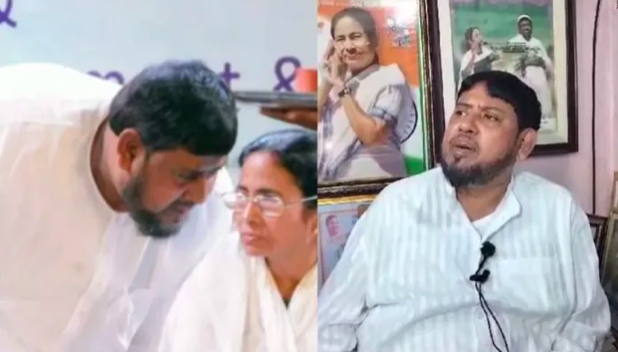
Case Summary
The sufferings of Hindu women who were victims of Sandeshkhali's mass rape atrocity by a Muslim politician, Sheikh Shahjahan Sheikh, were dismissed by Trinamool Congress (TMC) politician Haji Nurul Islam, who is Muslim by faith. He described the sufferings of Hindu women in Sandeshkhali as 'baseless allegations'. The Sandeshkhali rape scandal involved Hindu women from the region being selectively targeted and sexually exploited by Sheikh Shahjahan Sheikh, a Trinamool Congress leader, and his accomplices. The women were taken to the TMC office, where they were confined and repeatedly raped at gunpoint, with their families threatened or assaulted if they resisted. This systematic sexual violence and socio-economic domination reflected deep religious animosity, aiming to terrorise and suppress the Hindu community in West Bengal. The incident revealed the misuse of political power to perpetrate religiously motivated atrocities against vulnerable Hindu women. According to media reports, on 31st March 2024, Haji Nurul Islam, the Trinamool Congress candidate for the Basirhat Lok Sabha constituency, visited Sandeshkhali and promised to create a “new Sandeshkhali.” This village had witnessed protests against TMC leader Sheikh Shahjahan Sheikh and his aides over land grabbing and sexual harassment of Hindu women. At a street-corner meeting, Haji accused Bharatiya Janata Party (BJP) and Communist Party of India (Marxist) leaders of attempting to incite violence and reassured residents of development under TMC’s rule. While pledging to build a “new Sandeshkhali,” Haji denied the allegations against Sheikh and his aides, dismissing them as ‘baseless’. He defended the Trinamool Congress, claiming no women were sexually assaulted or tortured in Sandeshkhali and accused the BJP and central agencies of falsely implicating TMC leaders. Notably, Haji Nurul Islam, who served as a Member of Parliament representing Basirhat from 2009 to 2014, was implicated as a key figure in violence that took place over three days beginning on 6th September 2010 in the Deganga district, West Bengal. Reports stated that he led a mob of around 500 Muslims, resulting in the destruction of Hindu properties, desecration of temples, and arson, including police vehicles. Deganga, predominantly Hindu, experienced significant demographic changes during his tenure. The 2010 violence included road blockades and attacks on Hindu-owned establishments, causing widespread chaos and damage.
Why it is Hate Crime ?
This case has been added to the tracker under the primary category- Hate speech against Hindus. The subcategory selected is- Anti-Hindu subversion and prejudice. The tertiary category selected is- Anti-Hindu fake news or downplaying. Hate speech is defined as any speech, gesture, conduct, writing, or display that is prejudicial against a specific individual and/or group of people, which is leading to or may lead to violence, prejudicial action or hate against that individual and/or group. Media plays a specific and overarching reach in perpetuating prejudicial attitudes towards a community owing to unfair, untrue coverage and/or misrepresentation/misinterpretation, selective coverage and/or omission of facts of/pertaining to issues affecting a specific religious group. This type of bias can dehumanise the victim group, making it easier for others to justify harmful actions against them, which aligns with the objectives of hate speech laws aimed at preventing such harm. It is often observed that the media takes a prejudicial stand against the Hindu community driven by their need to shield the aggressor community which happens to be a numeric minority, however, is the one perpetrating violence against Hindus. For example, the media is often quick to contextualise religiously motivated crimes against Hindus, omit or misrepresent facts that point towards religiously motivated hate crimes, justify and/or downplay religiously motivated hate crimes or simply present fake news to stereotype Hindus. Such media bias leads to the denial of persecution and is often used to dehumanise Hindus, leading to justification for violence against them. For example, the media covered several fake allegations of Hindus targeting Muslims and forcing them to chant Jai Shree Ram. Most of these cases were proved false and fabricated after police investigation. These fake news reports were subsequently never retracted or clarified. Such fake news led to the justification of violence and dehumanisation of Hindus based on the argument that since Hindus targeted Muslims and forced them to chant Jai Shree Ram, the dehumanisation of Hindus and violence against them was par for the course and merely a retaliation. Such media bias leads to prejudicial portrayal of Hindus and offers a justification for violence against them and therefore, is considered hate speech under this category. This case is a clear instance of anti-Hindu hate speech, where the accused, a Muslim politician from the Trinamool Congress (TMC), denied the brutal ordeals suffered by Hindu women in Sandeshkhali. These women were selectively targeted solely because of their religious identity, making the crimes driven by religious animosity. By dismissing their suffering as baseless allegations and attributing the claims to political conspiracies by the Bharatiya Janata Party (BJP) or the Communist Party, the accused not only denied justice but also attempted to whitewash and diminish the gravity of the victims' trauma. This act of denial itself is a manifestation of religious hostility, seeking to silence and erase the suffering of the Hindu community. The targeted sexual exploitation and systemic violence against Hindu women illustrate a broader pattern of religiously motivated aggression. The fact that only Hindu women were victimised underlines the deliberate nature of this animosity. The accused's refusal to accept responsibility and his strategy to deflect blame onto political opponents point to an intention to protect the Muslim perpetrators and maintain a culture of impunity. This constitutes hate speech as it actively undermines the dignity and rights of the Hindu victims, perpetuating communal divisions and hostility. Furthermore, the accused's involvement in the 2010 riots in the Deganga district, West Bengal, where he led a mob of Muslims attacking Hindu properties, desecrating temples, committing arson, and targeting Hindu establishments, reinforces his long-standing pattern of religious hostility towards the Hindu community. His leadership in inciting communal violence and destruction highlights the continuity of his animus against the Hindu community. This historical context adds weight to the current actions of denying the Sandeshkhali atrocities, framing him as a figure who consistently acts against Hindu interests and the community as a whole. Overall, this case exemplifies a clear instance of anti-Hindu hate speech. Consequently, it is being recorded in the hate crime database of the Hinduphobia Tracker.


Case Status
Unknown


Perpetrators Details
Perpetrators
Muslim Extremists
Perpetrators Range
One Person
Perpetrators Gender
male
 Sources




