Hindu temple destroyed, temple idol desecrated and dumped in drain by state authorities in Madhya Pradesh
 Katni, Madhya Pradesh, India
  9 November, 2025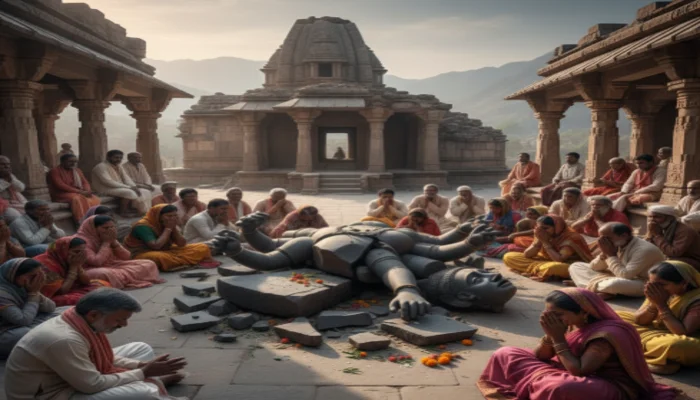
Case Summary
The ancient Hanuman temple in Katni’s Madan Mohan Choubey ward, located in Madhya Pradesh, was destroyed by railway authorities. Even the revered temple idol was desecrated and dumped in a drain. All of this occurred under the pretext of construction and development work. According to media reports, this incident occurred on 10th November 2025. Following this, on the next day, hundreds of Bajrang Dal and Vishwa Hindu Parishad activists protested near Mudwara railway station, raising slogans against the railway administration. A tense atmosphere prevailed in the area for about an hour. The situation was later brought under control after police and railway officials intervened. Bajrang Dal General Secretary Rahul Dubey stated that the Hanuman temple dates back to ancient times and is a centre of local faith. He said that railway employees destroyed the temple late at night and dumped the sacred idol in a drain. This happened without prior notice. Dubey emphasised that the temple is not merely a structure but a place deeply connected with the sentiments of thousands of devotees, and demolishing it was an attack on their faith. The Hindu community also stated that they had previously informed the railway authorities that if they wished to demolish the temple for development or any sort of construction, they should notify them in advance so that the temple idol could be respectfully relocated. Instead, the authorities acted disrespectfully, desecrating the temple without notice and desecrating the idol itself. Since the situation deteriorated, local police, administration, and railway officials arrived at the scene. They spoke with the protesters and attempted to calm them. Rahul Dubey said that the officials assured them the temple would be restored soon, after which the protest ended. Ending the protest, Bajrang Dal leaders announced that if the temple was not restored to the same location as promised, the organisation would launch an even larger movement. Rahul Dubey stated that, should this happen, the government and administration would be fully responsible.
Why it is Hate Crime ?
This case has been added to the tracker under the primary category- Attack on Hindu religious representations. The subcategory selected is- Attack on Temples. In Hinduism, a temple is the abode of the Deity. The Deity in the Temple is consecrated, thereby, making it a real, breathing entity. Hindus believe that not just the Deity but the temple premises itself are sacred to Hindus since Hindus hold the faith that the entire Temple space is an amalgamation of the divine energy of the deity. Given the central significance of Temples in Hindu Dharma, any attack against a Hindu Temple or its peripheral premises is an attack on the faith itself and is born out of animosity towards the faith, of which, the Temple is a central tenet. Any manner of attack against a Temple and/or its premises would therefore be considered a religiously motivated hate crime. The other subcategory selected is- Desecration of Hindu religious symbol. Icons and symbols or a religious representation of a spiritual ideal are widely revered in Hinduism. Iconography is of vital significance in the Hindu milieu. It helps connect people’s spiritual beliefs with the real world. Iconography within the Hindu faith takes several shapes and forms. Murtis are of most significance to Hindus, to which daily rituals, prayers and offerings are done. Besides the murtis, there are several other symbols which have deep significance in the Hindu faith – the Om and Swastika for example. Since these Hindu religious symbols hold paramount importance in Hinduism, any desecration of symbols, icons, murtis, religious representations and manifestations, is driven by animosity towards the faith itself which manifests itself through these murtis, icons and symbols. Therefore, any desecration of these Hindu religious symbols and representations is considered religiously motivated hate crimes under this category. This case is a clear instance of an anti-Hindu hate crime. The railway authority, under the pretext of development and construction work, completely destroyed the revered Hindu temple of Lord Hanuman. A Hindu temple is not merely a physical structure; it is a divine place believed to hold the presence of Hindu deities. Temples are the backbone of Hindu civilisation and society, and any attack on these revered institutions is a direct assault on the religious sentiments, faith, and identity of the Hindu community. Such an act constitutes a clear and explicit example of a religiously motivated hate crime. Moreover, not only was the temple demolished, but the temple idol was desecrated and dumped in a drain. Temple idols are sacred representations of deities and are deeply revered by devotees as physical embodiments of divine presence. The idol’s desecration is a profound insult, amounting to an attack on a central symbol of Hindu worship. Any disrespect or harm to temple idols is a blatant case of anti-Hindu hate crime, driven by religious animosity. Some might argue this was a routine developmental activity without any bias or intent to undermine Hinduism. However, that argument falters when considering that only the Hindu temple was targeted. The local Hindu community had clearly communicated with the authorities, requesting prior notice if demolition was inevitable, so they could relocate the idol respectfully. The railway authorities ignored this, desecrating the temple and idol without any advance warning, which goes beyond mere development—it exposes a deliberate disregard for Hindu religious sensibilities. If development had truly been the sole motive, proper protocol and respect would have been observed. Therefore, the act of destroying the temple and desecrating the sacred idol is a clear instance of a religiously motivated crime rooted in anti-Hindu hostility. Given these facts, the case meets the criteria of a hate crime and has been recorded in the hate crime database of the Hinduphobia tracker.


Case Status
Unknown


Perpetrators Details
Perpetrators
State and Establishment
Perpetrators Range
Unknown
Perpetrators Gender
unknown
 Sources




