Anti-Hindu prejudice: Western media outlet falsely vilifies revered Hindu organisation, calls it 'fascist' and threat to India's secularism
 United States
  25 December, 2025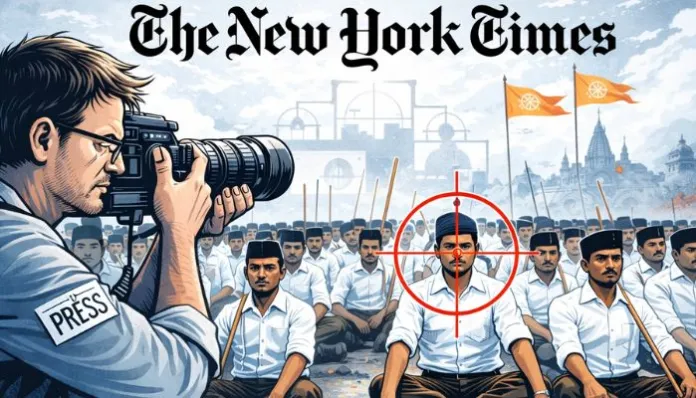
Case Summary
An anti-Hindu news report targeting the Rashtriya Swayamsevak Sangh (RSS) appeared in the New York Times (NYT), an anti-Hindu leftist Western news outlet. The NYT drew a malicious comparison of the RSS with fascism, the far right, and 'secret societies'. It also claimed that the RSS had infiltrated India's institutions and was quietly dismantling the secular fabric of the country. As per reports, on 26 December 2024, the New York Times published an article titled “From the Shadows to Power: How the Hindu Right Reshaped India”. This piece was authored by Mujib Mashal and Hari Kumar. The article was not just a critical piece on the Rashtriya Swayamsevak Sangh (RSS) but a downright attempt to vilify the largest Hindu organisation working tirelessly for the betterment of society. The article constructed a work of ideological fiction that portrayed the RSS as a shadowy, near-omnipotent “far-right” secret society, in other words, the “Illuminati” of India. It is important to state that in modern Western society the Illuminati is believed to be a shadowy elite cabal controlling world events, governments, finance, and celebrities, often symbolised by the "all-seeing eye" pyramid, engaging in satanic rituals, black magic, mind control, and plots for a New World Order; these theories had been amplified in pop culture since the 1790s. The article published by the NYT repeatedly branded the RSS as a “far-right Hindu nationalist group”. It is a term borrowed from Western political vocabulary and applied without contextual explanation. The concept of the far right differed completely in India and in Western countries. In India, the RSS is neither a political party nor a clandestine militia. It is a volunteer-based cultural organisation that has existed openly for a century. The “far right” served as a conclusion, not an analytical category. Once the Western concept of the far right is applied to an Indian organisation, it absolves the writer of the responsibility to engage with Indian social realities. Everything that followed, from mass mobilisation to ideological influence, was framed automatically as 'extremism'. The New York Times article did not explicitly use the word “Nazi”, nor did it directly equate the RSS with Hitler or the Third Reich. Instead, the article relied on implication and association, drawing repeatedly from fascist-era imagery to guide readers towards a particular conclusion. It stated that early RSS leaders openly drew inspiration from the nationalist formula of fascist parties in Europe during the 1930s and 1940s and referenced MS Golwalkar’s writings in connection with Hitler’s treatment of Jews. These historical references underwent no exploration as part of a balanced inquiry but anchored the present-day RSS to the moral weight of European fascism. The NYT report also referred to RSS using terms such as “shadowy cabal, “secret society”, “paramilitary discipline”, “supremacy”, and “infiltration of institutions”. This mirrored the standard vocabulary Western media uses when it describes authoritarian movements. This was done to portray a Hindu social organisation itself as something inherently dangerous. Contrary to NYT's claims of RSS being a 'secret society', RSS leaders, even when they ventured into politics, gave public speeches. They did not hide their association with the RSS. Those who led the RSS locally organised open conclaves and operated daily shakhas in neighbourhood parks. This was not a secret but a well-known aspect of the organisation. Anyone could attend these shakhas, irrespective of their association with the organisation itself. Despite this clarity, the NYT insisted on describing the organisation as “shadowy” and “secretive”. The authors never presented a contradictory view or attempted to look at the organisation through an unbiased lens. Prime Minister Narendra Modi never concealed his RSS background. He always called himself a “worker” of the organisation. Senior ministers, chief ministers, Members of Parliament (MPs), judges, civil servants, and professionals openly acknowledged their association with the RSS. The NYT also claimed that the RSS had “infiltrated” institutions in India such as the judiciary, police, media, and academia. This was a serious allegation. However, it underwent presentation without any evidence. No documentary proof, no command structure, no directives, and no financial trail demonstrated such capture. Instead, the authors presented ideological proximity and organisational overlap as evidence of subversion. By that logic, left-leaning academics who dominated Indian universities for decades also qualified as an “infiltration”. Pro-Naxal ideologues ruling academia for decades appeared as urban Naxals ruining the Indian education system from its roots. However, when such allegations, which held truth, were raised, left-liberal ideologues claimed it an attack on 'free speech'. The article revisited alleged fascist inspirations of early RSS thinkers and again invoked Mahatma Gandhi’s assassination. Notably, Indian courts exonerated the RSS as an organisation decades ago. However, outlets like the NYT carefully stopped short of that legal conclusion and ensured that the insinuation lingered in their narrative. Following this, the NYT painted Uttar Pradesh Chief Minister and Hindu religious leader Yogi Adityanath in a negative light by using the 'I Love Mohammad' poster controversy and Kanwar Yatra celebration. What the NYT deliberately omitted was that Muslims during the 'I Love Mohammad' poster controversy went on a violent rampage against Hindus and the authorities by openly giving "Sar Tan Se Juda" (beheading) threats, along with attacking Hindus and their temples. During the Kanwar Yatra, too, several instances of law and order issues occurred, for which tight security was maintained. However, the New York Times used Yogi Adityanath's strict maintenance of law and order and compared it with authoritarianism and maliciously painted him in a negative light. The New York Times further cited 'The Caravan', another anti-Hindu leftist outlet, to claim that schools, hostels, orphanages, old age homes, medical missions, yoga centres, and disaster relief initiatives associated with the RSS are “last-mile” instruments of ideological control. The New York Times article repeatedly claimed that while Indians voted, the RSS “really” ruled. Institutions functioned but underwent “co-opting”. Electoral victories underwent explanation away as organisational manipulation. By portraying the RSS as an ultra-powerful secret society and recycling Nazi analogies, the New York Times revealed its and its left-liberal ecosystem's Hinduphobia and hatred for any organisations that worked for the betterment of Hindus and India.
Why it is Hate Crime ?
The primary category selected in this case is- Hate Speech against Hindus. The subcategory selected is- Anti-Hindu subversion and prejudice. Hate speech is defined as any speech, gesture, conduct, writing, or display that is prejudicial against a specific individual and/or group of people, which is leading to or may lead to violence, prejudicial action or hate against that individual and/or group. Media plays a specific and overarching reach in perpetuating prejudicial attitudes towards a community owing to unfair, untrue coverage and/or misrepresentation/misinterpretation, selective coverage and/or omission of facts of/pertaining to issues affecting a specific religious group. This type of bias can dehumanise the victim group, making it easier for others to justify harmful actions against them, which aligns with the objectives of hate speech laws aimed at preventing such harm. It is often observed that the media takes a prejudicial stand against the Hindu community driven by their need to shield the aggressor community which happens to be a numeric minority, however, is the one perpetrating violence against Hindus. For example, the media is often quick to contextualise religiously motivated crimes against Hindus, omit or misrepresent facts that point towards religiously motivated hate crimes, justify and/or downplay religiously motivated hate crimes or simply present fake news to stereotype Hindus. Such media bias leads to the denial of persecution and is often used to dehumanise Hindus, leading to justification for violence against them. For example, the media covered several fake allegations of Hindus targeting Muslims and forcing them to chant Jai Shree Ram. Most of these cases were proved false and fabricated after police investigation. These fake news reports were subsequently never retracted or clarified. Such fake news led to the justification of violence and dehumanisation of Hindus based on the argument that since Hindus targeted Muslims and forced them to chant Jai Shree Ram, the dehumanisation of Hindus and violence against them was par for the course and merely a retaliation. Such media bias leads to prejudicial portrayal of Hindus and offers a justification for violence against them and therefore, is considered hate speech under this category. This case stands as a clear instance of anti-Hindu hate speech from the New York Times, a Western anti-Hindu leftist news outlet that falsely vilified the Rashtriya Swayamsevak Sangh (RSS), a revered Hindu organisation operating openly in India. The article vilified the RSS by labelling it a far-right Hindu nationalist group. Firstly, it is important to state that these were all political concepts associated with the Western political system. The New York Times used them mindlessly in the Indian political context and vilified a revered Hindu organisation that worked for social causes as well as for Hindu rights in the country, along with India's development as a whole. The act of falsely maligning the RSS by calling it a far-right nationalist group showcased deep-seated religious animosity that the New York Times held towards Hindus and Hindu organisations that worked for the community and the welfare of the nation, making it a clear instance of anti-Hindu bias and prejudice. Secondly, the New York Times associated the RSS and its earlier leaders with Western fascist leaders like Hitler. Comparing today's RSS with that showcased deep-seated religious animosity and prejudice that the NYT holds towards Hindus and any organisations working for the Hindu community. The New York Times article also falsely claimed that the RSS operated as a shadowy cabal and secret society with paramilitary discipline. However, it was important to state that the RSS stood far from being a secret society. Those associated with the RSS openly declared their association with the organisation. Even political leaders who emerged from the RSS acknowledged their connection with the RSS and never hid it. Secret societies in the West, like the Illuminati, functioned as a shadowy elite cabal controlling world events, governance, finance, and celebrities through satanic rituals like black magic, mind control, and plots for a New World Order. To equate the RSS with something like this showcased deep-seated religious animosity and prejudice against Hindus and Hindu organisations that the New York Times held. Furthermore, the New York Times claimed that the RSS infiltrated the judiciary, police, media, and academia and slowly tried to kill and demolish the secular fabric of the country. This stood far from true, with no evidence provided. The New York Times used its own left-wing anti-Hindu logic to push this narrative, showcasing deep-seated religious animosity towards Hindus and Hindu organisations. The New York Times also tried to equate the RSS with involvement in the assassination of Mahatma Gandhi. Indian courts exonerated the RSS from this allegation decades ago. Despite this, the New York Times ran this false propaganda to malign the RSS, making it a clear instance of religiously motivated hate speech. It also portrayed Uttar Pradesh Chief Minister Yogi Adityanath as authoritarian when he merely controlled the law and order situation in Uttar Pradesh amidst violent Muslim mobs rampaging against Hindus and authorities by issuing "Sar Tan Se Juda" beheading threats and attacking Hindus and their temples during the 'I Love Mohammad' poster controversy. Even during the Kanwar Yatra, several instances of law and order issues occurred, necessitating tight security maintenance. The New York Times portrayed this as malicious and painted it in a negative light, showcasing its deep-seated religious hatred towards the Hindu community, Hindu organisations, and Hindu leaders. The New York Times also claimed that schools, hostels, orphanages, old-age homes, medical missions, yoga centres, and disaster relief initiatives associated with the RSS served as "last-mile instruments of ideological control". All this showcased fear-mongering and hatred for the RSS, a Hindu organisation. The New York Times also stated that even though Indians voted, the RSS really ruled, implying that institutions that functioned were co-opted by the RSS. All this showcased fear-mongering among Indians and Hindus in general to portray Hindu organisations in a negative light, making it a clear instance of religiously motivated hate speech against the Hindu community and its leaders. Since this case met the parameters of religiously motivated hate speech, it was added to the Hate Crime Database of the Hinduphobia Tracker.


Case Status
Unknown


Perpetrators Details
Perpetrators
Others
Perpetrators Range
Unknown
Perpetrators Gender
unknown
 Sources




