Sanatana Dharma mocked and attacked by Muslim man under guise of film review
 Tamil Nadu, India
  24 December, 2025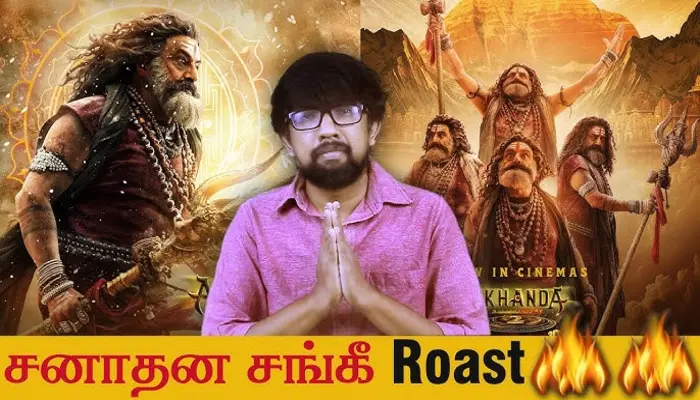
Case Summary
Sanatana Dharma was mocked and attacked by a Tamil film reviewer, a Muslim man named Kalilur Rahman, while reviewing the Telugu film Akhanda 2: Thaandavam. Rahman publicly used a film review as a platform to attack Sanatana Dharma. Rahman released his film review under the title “Sanatana Sanghi Roast” and framed the review around a sustained mocking of Hindu religious symbolism, portraying the film as a vehicle for Hindutva messaging rather than cinematic expression. He stated that the film was structured to appeal to North Indian audiences through repeated incorporation of Hindu religious imagery, repeatedly referencing cows, Sanatana Dharma and national political symbolism throughout the narrative. He drew attention to scenes depicting cows prominently, including visuals of the Prime Minister caressing a cow and sequences in the protagonist’s household where a cow was treated with reverence as a family member, claiming that these depictions were ideological insertions rather than storytelling elements. Rahman criticised the film for celebrating Sanatana Dharma while deliberately avoiding discussion of caste hierarchy, referring to the Manusmriti and sarcastically describing birth-based divisions to accuse the filmmakers of selective representation. He further reinforced his narrative by replaying a dialogue from actor Nandamuri Balakrishna stating, “I am not an educated man. I will only say what I know,” which Rahman used to characterise the film as openly embracing a Sanghi ideological position. The review triggered significant backlash on social media, with critics stating that Rahman weaponised film criticism to attack Hindu religious beliefs, while supporters of the film pointed to a broader cultural pattern in Tamil Nadu where disparagement of Sanatana Dharma and Hindu traditions faced minimal scrutiny.
Why it is Hate Crime ?
This case has been added to the tracker under the primary category- Hate Speech against Hindus. The subcategory selected is- Anti-Hindu slurs, mocking faith. Anti-Hindu slurs and the deliberate mocking of the Hindu faith owing to religious animosity involve the usage of derogatory terms, stereotypes, or offensive references to religious practices, symbols, or figures. One of the common anti-Hindu slurs used against Hindus is “cow-worshipper” and “cow piss drinker”. The intention of using this term is to demean and mock Hindus as a group and their religious beliefs since Hindus consider the cow holy. Additionally, some symbols and the slurs attached to them have a historical context that exacerbates the insult, hate, stereotyping, dehumanisation and oppression against Hindus. Cow worship has been used for centuries to denigrate Hindus, insult their faith and oppress Hindus specifically as a religious group. There has been overwhelming documentation about how cow slaughter has been used to persecute Hindus with cow meat being thrown in temples and places of worship. There has also been overwhelming documentation where cow meat (beef) has been force-fed to Hindus to either forcefully convert them to Islam or denigrate their faith. Apart from cow worship, the Swastika – which holds deep religious significance for the Hindus – has also been misinterpreted and distorted to use as a slur against Hindus. Similarly, the worship of the Shivling has been used by supremacist ideologies and religions to denigrate Hindus owing to religious animosity. Such slurs and denigration stem out of inherent animosity and hate towards Hindus and their faith, therefore, it is categorised as hate speech targeted at Hindus specifically owing to their religious identity. This case has been added to the tracker because it involved the deliberate mocking, denigration and hostile targeting of Sanatana Dharma by a Muslim man named Kalilur Rahman, in the name of a film review. The reviewer did not confine his commentary to cinematic elements such as storytelling, performances or direction, but instead framed the review as a “Sanatana Sanghi Roast,” explicitly positioning Hindu religious philosophy and symbols as objects of ridicule. By declaring the review as a roast of Sanatana Dharma, Rahman demonstrated intent to mock and demean Hindu religious identity, essentially turning a film review into a platform for his religious hatred. The repeated mocking of Hindu symbols, beliefs and practices showed that the purpose of the review was ideological confrontation, rooted in religious hostility, rather than artistic evaluation. By claiming that expressions of Sanatana Dharma or reverence to cows were inherently propagandistic, thereby reducing sacred Hindu symbols to objects of mockery. He deliberately promoted hostility towards Hindu religious expression. In Hindu civilisation, the cow holds deep religious, cultural and ethical significance, and its presence in cinema reflects lived tradition rather than political messaging. By dismissing these representations as forced ideological insertions, Rahman denied Hindus the legitimacy of expressing their faith through various art forms, including cinema. Rahman also attacked the Manusmriti and caste hierarchy, claiming that the move did not talk about the caste system. The deliberate insertion of caste discourse where it was not relevant to the film served to stigmatise Hinduism as regressive, reinforcing long-standing hostile narratives used to justify contempt for Hindu religious identity. It’s a director's choice what he is trying to portray through the movie, and claiming that it was out of malice rather than artistic choice was irrelevant. Rahman then criticised the dialogue spoken by actor Nandamuri Balakrishna, “I am not an educated man. I will only say what I know,” further demonstrating the malicious framing of the review. Rather than engaging with the character or narrative context, he used the line to claim intellectual inferiority and ideological extremism, equating Hindu belief with ignorance and branding it as “Sanghi.” This linking of religious faith with lack of education and extremism worked to dehumanise Hindus, portraying them as intellectually and morally inferior. Rather than criticising ideas, this framing directly attacked Hindu identity. The repeated statement that Hindu elements were added “whether the story needed them or not” showed an intolerance towards the outward displays of Hinduism in public and cultural spaces. Hindu religious expression was treated as intrusive and illegitimate, as if Hindu faith had to justify its existence even in stories set within Hindu society. At the same time, he criticised the film for not attacking the caste system, ignoring whether the story itself demanded it or not. Therefore, Rahman used the protective cover of 'film criticism' to launch a deliberate attack on Hindu beliefs, reflecting a broader pattern in public discourse where mocking of Sanatana Dharma is normalised. In recent times, social media has increasingly become a platform for anti-Hindu hate, with derogatory memes, videos, and messages targeting Hindu religious symbols, practices, and deities. Such content is recognised as part of a broader pattern of Hinduphobia and religious hate crimes online. This deliberate targeting of revered religious icons firmly establishes this act as a religiously motivated hate crime; therefore, it is being categorised under the hate crime database. Disclaimer: The Hinduphobia Tracker records incidents based on when an event occurred or when the victim's ordeal began. It is important to clarify that none of the media sources covering this case has specified the exact date when the review was published. Therefore, for documentation purposes, we have recorded the date based on when the incident was reported in the media, 25 December 2025.


Case Status
Unknown


Perpetrators Details
Perpetrators
Muslim Extremists
Perpetrators Range
One Person
Perpetrators Gender
male
 Sources




