Hindu youth killed by Muslim man in Bangladesh amidst ongoing persecution of Hindu community
 Mymensingh District, Bangladesh
  28 December, 2025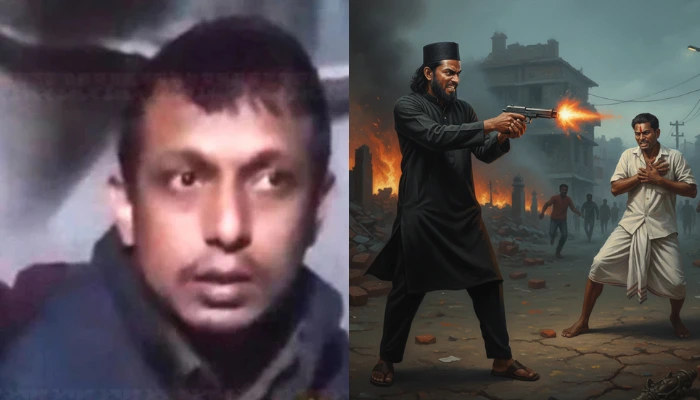
Case Summary
In the Bhaluka sub-district located in the Mymensingh district of Bangladesh, a 42-year-old Hindu man named Bajendra Biswas was murdered by a Muslim man, Noman Mia. The accused claimed that he "jokingly or casually" killed the victim with a shotgun. According to media reports, the deceased victim was a security guard and was shot dead inside a garment factory. The victim was posted as an Ansar member at Sultana Sweaters Limited. In Bangladesh, the Ansar is a uniformed auxiliary security force under the Home Ministry, deployed to protect government offices, industrial units, and sensitive installations. On 29 December 2025, the victim was killed by Noman Mia. The accused also worked as an Ansar member at the same factory. According to police and eyewitnesses, the two security guards, the victim and the accused, were present at the Ansar barracks on the factory premises. During a conversation, Noman Mia, "jokingly or casually", pointed a government-issued shotgun at Bajendra Biswas and shot him dead within moments. Biswas was rushed to the Bhaluka Upazila Health Complex, where the doctors also declared him dead. Regarding this incident, the police station in-charge Md Jahidul Islam said the accused had been arrested, and the shotgun used in the incident had been seized. The body had been sent to Mymensingh Medical College Hospital for post-mortem examination. A fresh wave of anti-Hindu violence prevailed across Bangladesh following the death of Sharif Osman Bin Hadi. This escalation occurred against the backdrop of ongoing anti-Hindu violence that had persisted since the ouster of the Sheikh Hasina government in August 2024, during which Hindu homes, temples, and religious spaces were repeatedly attacked, and the Hindu community faced intimidation, arson, and mob attacks. In the aftermath of Hadi’s death, Hindu homes were selectively targeted and set ablaze in multiple localities by Muslim mobs, forcing families to flee and rendering many homeless. The violence was not sporadic but patterned, with Muslim mobs targeting Hindu neighbourhoods, properties, and religious symbols with impunity. One of the many victims of this wave of violence was a Hindu man named Dipu Chandra Das, who was brutally lynched by a Muslim mob over false allegations of blasphemy. Such targeting of innocent Hindus over fabricated charges illustrated the vulnerability of the Hindu minority under conditions of rising communal hostility. Posters and written materials calling for the extermination of Hindus were displayed in public spaces, signalling an alarming normalisation of genocidal rhetoric. Combined with acts of physical violence, arson, and vandalism, these developments demonstrated a coordinated campaign designed to terrorise the Hindu community and assert Islamic dominance. Notably, Sharif Osman Bin Hadi was a Muslim political activist and student leader known for his anti-Hindu and anti-India stance. He was actively involved in the political unrest that followed the fall of Sheikh Hasina’s government and was killed in Dhaka in December 2025 during clashes, after which Hindus were blamed and subsequently targeted.
Why it is Hate Crime ?
This case has been added to the tracker under the primary category- Attack resulting in death. The subcategory selected is- Attacked for Hindu identity. In several cases, Hindus are attacked merely for their Hindu identity without any perceived provocation. A classic example of this category of religiously motivated hate crime is a murder in 2016. 7 ISIS terrorists were convicted for shooting a school principal in Kanpur because they got ‘triggered’ seeing the Kalava on his wrist and tilak that he had put. In this, the Hindu victim had offered no provocation except for his Hindu religious identity. The motivation for the murder was purely religious, driven by religious supremacy. Such cases where Hindus are targeted merely for their religious identity would be documented as a hate crime. Under this category, cases where the attack led to the death of the Hindu victim/s would be documented. This case is a clear instance of a religiously motivated hate crime against Hindus, as a Hindu man was killed by a Muslim man in Bangladesh. The incident unfolded amidst the ongoing religious persecution of Hindus in the country. It exemplifies deep-seated hatred rooted in the victim's Hindu faith within a nation rife with anti-Hindu hostility. While some may argue that the case details do not explicitly indicate a religious motive. However, the broader context of anti-Hindu persecution in Bangladesh cannot be ignored. When there is an ongoing ethnic cleansing based on religious identity, every crime in and of itself is assumed to be motivated by the same religious animosity, even if there is a lack of a specific religious marker in the immediate crime. During an ongoing ethnic cleansing, the dehumanisation of people based on their religious identity and the normalisation of religious hostility drive the crimes committed against them, even when there is a lack of stated religious motive. For the purpose of documenting the 2024 ethnic cleansing of Hindus in Bangladesh and the subsequent ongoing persecution following the death of Osman Hadi, the Hinduphobia Tracker assumes religious motivation from the outset. If any case is proven beyond a reasonable doubt to stem from motivations other than religious hostility, it will be removed from the hate crime database post-facto. In this case, Bajendra Biswas suffered a brutal murder at the hands of his Muslim colleague, Noman Mia, in Bangladesh. The killing occurred amidst widespread persecution of Hindus that erupted after the death of Sharif Osman Bin Hadi, an anti-Hindu and anti-India activist. Following Hadi's death, Muslim mobs launched a violent rampage, selectively targeting Hindus by killing them, torching their homes, issuing death threats and genocidal calls, and desecrating Hindu temples. This series of brutal anti-Hindu attacks also includes the horrific lynching and burning of Dipu Chandra Das, another Hindu man targeted over a false blasphemy allegation by a Muslim mob in Mymensingh district. Amidst this relentless religious persecution, Noman Mia's claim of shooting Bajendra Biswas "jokingly or casually" with a government-issued shotgun rang implausible, revealing that the Hindu victim faced targeted killing for his religious identity. If this were merely a crime of opportunity devoid of religious animosity, the Muslim accused could have killed any colleague, including one from his own community. However, he chose to particularly murder Bajendra Biswas, a Hindu man, amidst the ongoing anti-Hindu pogrom, demonstrating deep-seated religious profiling and hatred that defined this as a religiously motivated hate crime. When Hindus face such brutal killing solely for their religious identity, such acts send a chilling message to the remaining Hindu minority in the area that they could be killed and persecuted at any moment. This instils pervasive fear and intimidation, and escalates tensions among Bangladesh's vulnerable Hindu community. Given that this case meets the parameters of a religiously motivated crime, it is being added to the Hinduphobia Tracker's hate crime database.
Victim Details
Total Victim
1
Deceased
1
Gender
- Male 1
- Female 0
- Third Gender 0
- Unknown 0
Caste
- SC/ST 0
- OBC 0
- General 1
- Unknown 0
Age Group
- Minor 0
- Adult 1
- Senior Citizen 0
- Unknown 0


Case Status
Arrested


Perpetrators Details
Perpetrators
Muslim Extremists
Perpetrators Range
One Person
Perpetrators Gender
male
 Sources




