Hindu villagers manipulated, brainwashed and offered inducements for religious conversion by Christian missionaries
 Kanker, Chhattisgarh, India
  27 December, 2010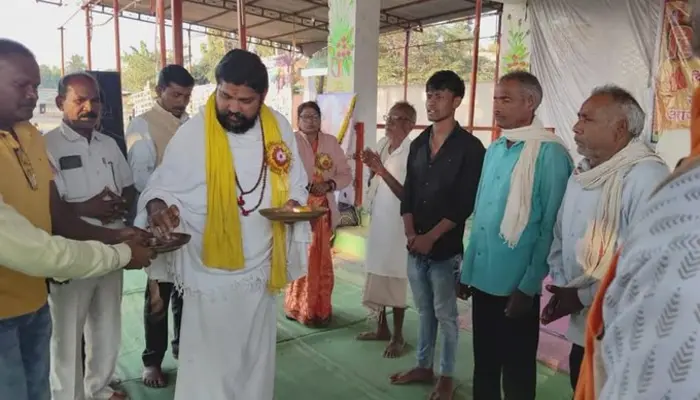
Case Summary
In the Haradula village of Kanker district, Chhattisgarh, eight Hindu families were manipulated, brainwashed and offered inducements for religious conversion by Christian missionaries. According to reports, the Hindu families were converted to Christianity around fifteen years ago. The missionaries converted Hindu families through inducements, persuasion and exploitation of poverty and lack of awareness. The Hindu villagers stated that external actors, including Christian missionaries, had previously entered the village and facilitated conversions, which had disturbed the social environment, and the return of these families had restored a sense of communal harmony and cultural continuity. Those who were convertedincluded Raghunath Sinha, Mukesh Baghel, Hiralal Rajak, Lakshman Sonwani, Mukund Rajak and Shriram Sonwani. Villagers stated that long-term misinformation had been used to facilitate past conversions and emphasised their desire to move forward together while preserving traditional practices and cultural identity. On 28 December 2025, a Hindu religious gathering was organised in the village, where the converted Hindu families formally declared their return to their original faith. Rituals including worship, garlanding, tilak, aarti and the draping of saffron clothing were performed to mark their re-entry into Hinduism. The families were welcomed by villagers and advised to remain steadfast in their faith and avoid future inducements. The reconversion programme was guided by Balod-based social worker and Hindu saint Birendra Deshmukh, who stated that all eight families had collectively returned to Hinduism with the support of the village community, some after many years. He personally welcomed the heads of the families, explained the significance of Hindu traditions and encouraged other families who had separated from the faith to consider returning. The event concluded with an appeal to maintain unwavering faith in Sanatan Dharma and cultural traditions.
Why it is Hate Crime ?
The primary category selected in this case is- Predatory Proselytisation. The subcategory selected is- Conversion/attempts to convert by inducement. Predatory Proselytisation is not just limited to threat, harassment, force and violence, but it also has contours of stealth. In several cases, the Hindu victim is exploited to convert, with non-Hindus taking advantage of their poverty. In such cases, the Hindu victim who is suffering financially is offered monetary benefits, including lucrative offers for jobs, health treatment, education, etc, to induce the victim into changing his/her religion. In such cases, the religious identity of the victim and the aim to disenfranchise him from his faith form the heart of the crime. Also, taking advantage of and exploiting an individual’s economic vulnerabilities is widely acknowledged as exploitation, forms of which are often penalised by law. Such cases therefore are considered religiously motivated hate crimes since the victim’s religious identity forms the very heart of the crime itself. The other subcategory selected is- Proselytisation by grooming, brainwashing, manipulation or subtle indoctrination. The tertiary category selected is- Pattern of targeting Hindus. Religious brainwashing essentially means the often subtle and forcible indoctrination to induce someone to give up their religious beliefs to accept contrasting regimented ideas. Religious grooming or brainwashing also involves propaganda and manipulation. It involves the systematic effort, driven by religious malice and indoctrination, to persuade “non-believers’ to accept allegiance, command, or doctrine to and of a contrasting faith. Cases of such grooming or brainwashing are far more nuanced than direct threats, coercion, inducement and violence. In such cases, it is often seen that there is repeated, subtle and continual manipulation of the victim to induce disaffection towards their own faith and acceptance of the contrasting faith of the perpetrator. While subtle indoctrination is widely acknowledged as predatory, an element which is often understated in such conversions or the attempts of such conversion is the role of loyalty and trust which might develop between the perpetrator and the victim. Fiduciary relationships are often abused to affect such religious conversion. For example, an educator transmitting religious doctrine of a competing faith to a Hindu student. The Hindu student is likely to accept what the teacher is transmitting owing to existence of the fiduciary relationship. The exploitation of the fiduciary relationship to religiously indoctrinate victims would also be included in this category. Since the underlying animosity towards the victim’s faith forms the basis of predatory proselytization, such cases are considered religiously motivated hate crimes. This case has been added to the tracker because eight Hindu families were manipulated, brainwashed and offered inducements for religious conversion by Christian missionaries. The conversions were not the result of informed or voluntary religious choice but occurred in a context of vulnerability, where poverty, lack of awareness and dependence were exploited to push Hindu families away from their ancestral faith. Such methods demonstrated a clear power imbalance and an intent to engineer religious change rather than offer spiritual guidance. Offering incentives or making false promises, especially when directed at vulnerable individuals in need, shows that these incentives are not acts of kindness or charity. Instead, they are calculated moves to exploit vulnerable Hindus because of their religion. By providing inducements in exchange for conversion, the accused were effectively blackmailing those who might have been desperate for assistance or hope. Such instances are seen in many cases where members of Christian missionary groups target socially and economically vulnerable Hindus to further their agenda of religious conversions. This form of coercion strips people of their agency and dignity and results in coerced conversions. These are not random or isolated incidents, but rather cases deeply rooted in religious animosity towards Hindu victims. This case reflected a broader and recurring pattern in which socially and economically vulnerable Hindus were singled out by organised missionary networks for conversion. The nature of the conversion efforts and the wider impact on the Hindu community all indicated a targeted action against Hindus as a collectivity. When individuals or groups focused their efforts on converting members of a particular religion, they demonstrated a fundamental disregard for the Hindu faith. Conversion, especially when not based on personal conviction but rather on external persuasion or pressure, constituted not simply sharing a different belief system. It amounted to an attempt to undermine the values, traditions, and identity of the Hindu community. The Christian faith, by its very theological foundations, places a strong emphasis on proselytisation. In pursuit of conversion objectives, Christian evangelists often employ unethical means, ranging from psychological pressure and misinformation to inducements such as money or jobs. These tactics are designed not as acts of charity but as tools to engineer religious change under the guise of social upliftment, particularly among vulnerable and underprivileged communities. Since such predatory actions stem from religious hostility towards the victim's faith, this case has been added to the tracker. Disclaimer: In this case, it is mentioned that members of 8 families were converted to Christianity. However, the exact number of individuals involved in the conversion is not specified. Due to this lack of clarity, we have relied on the most recent Indian census data, which indicates that the average family size in India is approximately 4.8 members per household. To ensure a standardised estimation, we have opted to consider an average of 5 members per family. Based on this approach, the estimated total number of victims in this case is calculated as 40 individuals. Disclaimer: It is important to clarify that none of the media sources covering this case have specified the exact date when the victims were converted, though it is mentioned they were converted 15 years ago. ordeal began. Thus, to document this case, we have used an indicative date—28 December 2010—as a placeholder to represent the date when they were converted. While media coverage of the incident emerged on 28 December 2025, the Hinduphobia Tracker records the incident based on when the victim’s ordeal began, not when it was reported.
Victim Details
Total Victim
40
Deceased
0
Gender
- Male 0
- Female 0
- Third Gender 0
- Unknown 40
Caste
- SC/ST 0
- OBC 0
- General 0
- Unknown 40
Age Group
- Minor 0
- Adult 0
- Senior Citizen 0
- Unknown 40


Case Status
Unknown


Perpetrators Details
Perpetrators
Christian Extremists
Perpetrators Range
Unknown
Perpetrators Gender
unknown
 Sources




