Hindu tribals targeted to convert to Christianity by promising financial rewards in Dwarka, Gujarat
 Devbhumi Dwarka, Gujarat, India
  27 September, 2025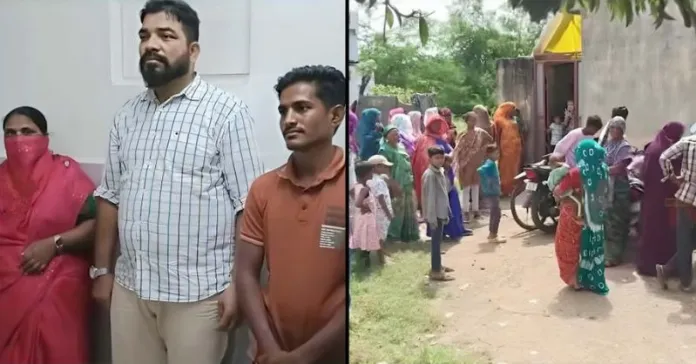
Case Summary
Hindu tribals were targeted in Jam Khambhalia, Devbhoomi Dwarka, Gujarat, where a Christian couple and their associate attempted to convert them to Christianity by offering financial inducements. The incident was exposed on 28 September 2025, when members of the Vishwa Hindu Parishad (VHP) intervened after receiving information that conversion activities were taking place in a residential building behind Shrinathji School in Shaktinagar. According to the FIR, around 25 to 30 Hindus, including women, were assembled in the house where the accused, identified as Deepak Raghuvir Singh, his wife Deepaben Deepakbhai Biswakarma (both Nepali origin), and Mukesh Subhashbhai Ajnar from Madhya Pradesh, were persuading them to embrace Christianity by promising financial rewards. Many of those present were labourers belonging to the tribal communities of Alirajpur, Dhar, and Jhabua districts of Madhya Pradesh, now residing in Khambhalia and nearby villages. A list attached to the FIR documented the names, ages, occupations, and addresses of 27 Hindus who had been brought to the site by Mukesh Ajnar under the pretext of prayers. VHP officials, including regional vice-president Kiranben Kataria, personally witnessed the attempt to convert these villagers through monetary inducements. Following the complaint, Khambhalia police arrested the three accused and booked them under Section 4 of the Gujarat Freedom of Religion Act, 2003, and Section 54 of the Bharatiya Nyaya Sanhita.
Why it is Hate Crime ?
The primary category in this case is: Predatory Proselytisation. The subcategory under this is: Conversion/ attempts to convert by inducement. Predatory Proselytisation is not just limited to threat, harassment, force and violence, but it also has contours of stealth. In several cases, the Hindu victim is exploited to convert, with non-Hindus taking advantage of their poverty. In such cases, the Hindu victim who is suffering financially is offered monetary benefits, including lucrative offers for jobs, health treatment, education, etc, to induce the victim into changing his/her religion. In such cases, the religious identity of the victim and the aim to disenfranchise him from his faith form the heart of the crime. Also, taking advantage of and exploiting an individual’s economic vulnerabilities is widely acknowledged as exploitation, forms of which are often penalised by law. Such cases therefore are considered religiously motivated hate crimes since the victim’s religious identity forms the very heart of the crime itself. This case has been added to the tracker because it demonstrates a textbook instance of predatory proselytisation through inducement, where vulnerable Hindu tribals were targeted and manipulated into abandoning their faith in exchange for promises of financial reward. The incident in Jam Khambhalia, Dwarka, Gujarat, is not an isolated social interaction but a deliberate and organised effort to exploit poverty and displacement for religious conversion. The accused, including a Christian couple of Nepali origin and their associate from Madhya Pradesh, specifically identified Hindu tribals, migrant labourers from Alirajpur, Dhar, and Jhabua districts, and attempted to detach them from their ancestral faith by offering monetary gains. The defining element that makes this incident a hate crime against Hindus is the centrality of the victims’ religious identity. The individuals were not targeted because of their economic condition alone; their poverty was merely the vulnerability exploited. The end goal was to ensure their removal from Hindu society and assimilation into another religious fold. This act, therefore, was not benevolent assistance but a systematic attempt to disenfranchise them from their cultural and spiritual heritage. By offering inducements under the guise of prayers, the perpetrators introduced stealth into their strategy, creating an environment where faith was commodified and transactional, stripping the victims of their right to freely practise their religion without interference. Exploiting economic hardship to coerce or induce a change of faith is regarded as a violation of religious freedom and human dignity. Within Indian law, inducement is specifically recognised as an illegitimate method of proselytisation, precisely because it takes advantage of the most vulnerable members of society, leaving them unable to exercise genuine choice. The Gujarat Freedom of Religion Act, under which this case has been registered, explicitly treats such inducement-based conversions as criminal acts, underscoring the seriousness of this exploitation. Framing this as a hate crime is important because the perpetrators’ actions were not random but rooted in religious malice against Hindu identity. The targeting of Hindu tribals reflects an intent to weaken their social cohesion and cultural continuity, often leaving victims alienated both from their ancestral community and the promises made by those engineering their conversion. By attacking the religious foundation of a marginalised group, such actions perpetuate both spiritual dispossession and social division. This case thus represents a clear instance of how predatory proselytisation operates as a hate crime against Hindus: it exploits economic vulnerability, manipulates trust under false pretexts, and seeks to extinguish the victims’ religious identity as the ultimate objective. Disclaimer: The number of victims has been set to 30 as news reports state that around 25-30 people were present. Should more details emerge on the number of victims, details will be updated.
Victim Details
Total Victim
30
Deceased
0
Gender
- Male 0
- Female 0
- Third Gender 0
- Unknown 30
Caste
- SC/ST 0
- OBC 0
- General 0
- Unknown 30
Age Group
- Minor 0
- Adult 0
- Senior Citizen 0
- Unknown 30


Case Status
Arrested


Perpetrators Details
Perpetrators
Christian Extremists
Perpetrators Range
From 2 To 5
Perpetrators Gender
both
 Sources




