Hindu students face suspension on wearing Kalava and Tilak in a Missionary school, school forces students to follow Christian religious beliefs
 Sagar, Madhya Pradesh, India
  9 April, 2023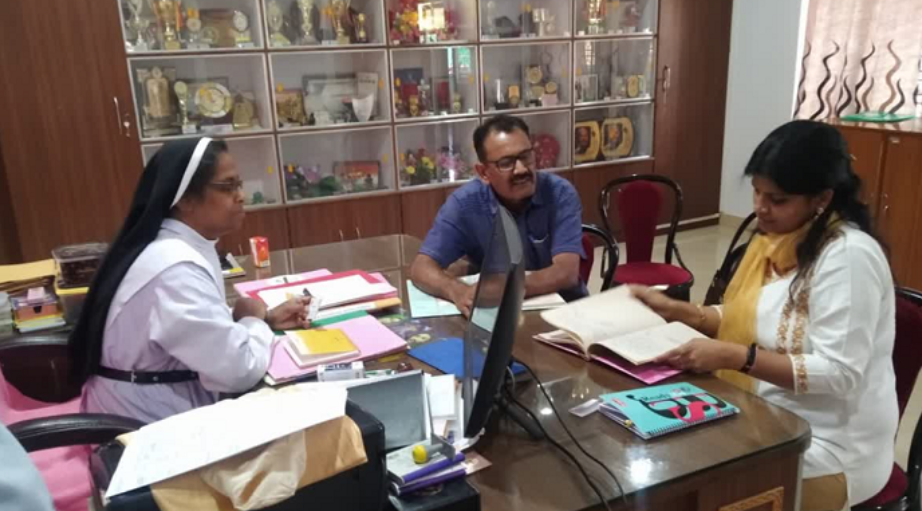
Case Summary
A Christian missionary school in Bina city that falls under the Sagar district of Madhya Pradesh came under scrutiny after students complained that they were forced to follow Christian religious beliefs at the school. The teachers do not allow them to wear Tilak and Kalava at school. Wearing these land them in suspension, said the students. The teachers at the school namely Dominka Mam and Sister Grace did not allow the students to wear Kalava and Tilak. They were asked to remove the tilak before entering the school. The students also stated that they were forced to recite a prayer to God Jesus, named “Oh God” before lunch. The students were also forced to celebrate Christian festivals irrespective of their being Hindu. The school also came under investigation for holding a suspicious human embryo and indulging in “irregularities” with the Right to Information Act’s 2009 implementation at the school.
Why it is Hate Crime ?
Distinct elements in this particular case demonstrate that the crime was committed while harbouring a bias against the Hindu faith. Because of the case's specifics, this case has been placed under two prime categories: Restriction/ban on Hindu practices and Predatory Proselytisation. To break down the case further, the sub-category- Restriction on expression of Hindu identity has been chosen under the prime category- Restriction/ban on Hindu practices. An example of the state-affected prejudicial and targeted orders against the Hindu community would be a government denying the right of a Hindu or a group of Hindus to hold a religious procession owing to the animosity of non-Hindu groups. Denial of the religious right of the Hindus to assuage the non-Hindu group which harbours animosity to a point where it could lead to violence against Hindus is not only a failure of law and order but is a prejudicial order against Hindus, denying them their fundamental rights to express their religious identity. An example of a hate crime against Hindus by a non-Hindu would be a non-Hindu institution forcing its Hindu employees to abandon religious symbols that a Hindu would wear as an expression of faith owing to inherent prejudice against the faith professed by the victim or a non-Hindu group of people restricting a Hindu group from constructing a place of worship simply because the demography of the area in which the temple is being built is dominated by non-Hindus. Such actions are driven by religious animosity and/or prejudice against Hindus and their faith and would therefore be categorized as a hate crime. Further, as per case details, the sub-category- Proselytisation by brainwashing, manipulation or subtle indoctrination and tertiary category- Conversion of minor, have been chosen under the prime category- Predatory Proselytisation. Religious brainwashing essentially means the often subtle and forcible indoctrination to induce someone to give up their religious beliefs to accept contrasting regimented ideas. Religious brainwashing also involves propaganda and manipulation. It involves the systematic effort, driven by religious malice and indoctrination, to persuade “non-believers’ to accept allegiance, command, or doctrine to and of a contrasting faith. Cases of such brainwashing are far more nuanced than direct threats, coercion, inducement and violence. In such cases, it is often seen that there is repeated, subtle and continual manipulation of the victim to induce disaffection towards their own faith and acceptance of the contrasting faith of the perpetrator. While subtle indoctrination is widely acknowledged as predatory, an element which is often understated in such conversions or the attempts of such conversion is the role of loyalty and trust which might develop between the perpetrator and the victim. Fiduciary relationships are often abused to affect such religious conversion. For example, an educator transmitting religious doctrine of a competing faith to a Hindu student. The Hindu student is likely to accept what the teacher is transmitting owing to existence of the fiduciary relationship. The exploitation of the fiduciary relationship to religiously indoctrinated victims would also be included in this category. Since the underlying animosity towards the victim’s faith forms the basis of predatory proselytization, such cases are considered religiously motivated hate crimes. In this case, the Christian Missionary school teachers of the school displayed deep disdain for the Hindu faith by forcefully removing the tilak and sacred threads (Kalavas) from Hindu students' foreheads and wrists, respectively. In Hinduism, the Tilak and Kalava hold deep religious, cultural, and spiritual significance. It symbolises protection, blessings, unity, and commitment to spiritual and ethical principles. Its use across various rituals and ceremonies underscores its importance in the Hindu way of life, and by forcefully removing the tilak and cutting off the Kalava, the teachers insulted the Hindu faith and displayed their deep disdain towards the religion. Furthermore, the teachers also forced the students to follow Christian religious beliefs at the school. The students testified that they were forced to recite a prayer to Jesus, named “Oh God” before lunch. It is evident from the details that the Hindu victims were minors, which essentially means that the element of consent and genuine change of conscience was missing ab initio. The accused, who were teachers in this case, subtly tried to influence the impressionable minds of the children by forcing them to follow Christian religious beliefs. Exploiting vulnerabilities for the explicit purpose of conversion is purely based on animosity towards the victim's faith. Since both elements present in this case stem from hatred towards the Hindu faith, this case has been categorised as a religiously motivated hate crime.


Case Status
Complaint filed


Perpetrators Details
Perpetrators
Christian Extremists
Perpetrators Range
N/A
Perpetrators Gender
unknown
 Sources




