Communal clashes erupt after Islamists attack a Hanuman Janmotsav rally as its passes near a masjid, Hindus called "kafirs"
 Sambalpur, Odisha, India
  11 April, 2023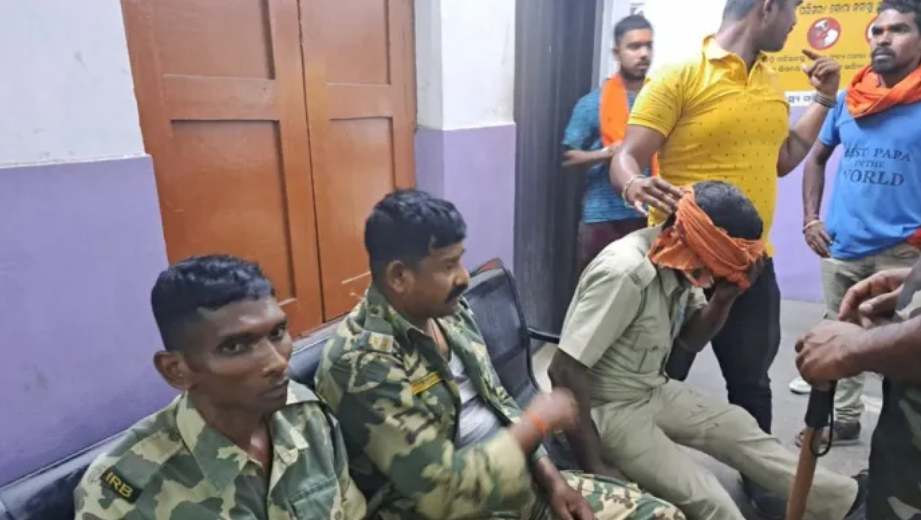
Case Summary
On April 12, a bike rally organised by ‘Hanuman Jayanti Samanyoy Samiti’ and Bajrang Dal came under violent stone pelting when it was passing near a masjid in the Dhanupali area, triggering clashes. The incident happened two days before Hanuman Janmotsav which is observed on April 14, on the day of Sankranti. The violence soon spread, resulting in vandalism, arson and many incidents of clashes. As per the FIR filed by complainant Dhirendra Kumar Swain, who was stationed at Motijharan Chowk along with Sub-Inspector Dharmendra Bhoi to maintain law and order during the Hanuman Jayanti procession, the procession was chanting slogans like ‘Jai Shri Ram’, ‘Jai Bajrang Bali’ and that was when the Hindu procession came under attack from around 200 Islamists. As per the FIR, the Islamists attacked the members of the rally with iron rods, lathis, and swords, with the intention to kill. During the attack, apart from shouting obscenities, Islamists were shouting ‘kafir log’, ‘sale logo ko kaat denge’, ‘salo ko India wapas nehi jaane denge’, etc. In an official statement, the BJP stated that a peaceful procession by Hindus came under repeated attacks in Sambalpur by a particular community and the local administration was unable to prevent it. In the subsequent incidents of violence, a tribal man named Chandramani Mirdha was brutally killed by goons while many Hindu leaders and police personnel were injured. The city police arrested around 85 persons. Over the stone pelting incident of April 12, and April 14, and incidents of vandalism, 6 more persons were arrested on April 17. The police FIR copy in the incident states that over 150-160 people were involved in the attacks.
Why it is Hate Crime ?
This particular case has been classified as a religiously motivated hate crime under two subcategories of the prime category 'Attack not resulting in death' because of the various distinct components that demonstrate the perpetrator's bias against the Hindu faith and their deliberate attempt to harm the Hindus. The first sub-category under 'Attack not resulting in death' relevant in this case is 'Attack on religious procession'. The outward celebration and display of religious symbols in an intrinsic part of Hinduism. Religious processions on various festivals are age-old traditions and a way to manifest faith and form a part of the religious practices of Hindus. On several occasions, such religious processions come under attack by non-Hindu mobs, in a manifestation of their animosity towards Hinduism and their practices. The reasons cited for such violent attacks are many and range from crossing a non-Hindu resident-dominated area to playing loud music, crossing from an area where there is a religious structure of another faith etc. The violent attacks are triggered by the outward display of religiosity by Hindus. The attacks are mainly a manifestation of religious supremacist doctrine which believes that idolatry, essentially the Hindu faith, is one that deserves to be annihilated since the very tenets of Hinduism, its practices and traditions are considered a sin in those doctrines. Since these attacks emanate from intrinsic and doctrinal animosity towards Hindus and Hinduism, it is considered a religiously motivated hate crime under this category. The second sub-category relevant here is, 'communal clash'. Communal clash is a form of collective violence that involves clashes between groups belonging to different religious identities. For a communal clash between Hindus and non-Hindus to qualify as a religiously motivated hate crime, the trigger of the violence itself would have to be anti-Hindu in essence. For example, if there is a Hindu religious procession that comes under attack from a non-Hindu mob and after the initial attack, Hindus retaliate in self-defence, leading to a communal clash between the two religious communities. While at a later stage, both communities are involved in the clash/violence, the initial trigger of the violence was by the non-Hindu mob against the Hindus and therefore, it could safely be termed as an anti-Hindu violence. Further, the trigger would also have to be religiously motivated. In the cited example, the attack by the non-Hindu mob was against religious processions and therefore, can be concluded to be religiously motivated. In some cases, the trigger may be non-religious, however, it develops into religious violence against Hindus at a later stage. In such cases too, the foundational animosity towards Hindus becomes the motivating factor of the crime and therefore, it would be classified as a religiously motivated hate crime against Hindus under this category. In this case, the Hindu men were brutally attacked by Islamists for celebrating Hanuman Jayanti, a significant Hindu festival that marks the birth of Lord Hanuman. It is important to note here that there was no sort of provocation from the Hindu side. In fact, the Muslims took offence to the chanting of Jai Shri Ram and Jai Bajrang Bali slogans by the Hindus and launched a vicious attack on their religious procession. The Hindus were repeatedly called "kafirs” during the attack, a derogatory connotation used by Muslims to express contempt, hatred, or disdain for any non-believer in Islam, particularly Hindus. It is important to note that there was no initial provocation from the Hindu side. In fact, it was the Islamists who were offended by the Hindus celebrating their festival. Given that the fundamental motivation behind these actions is contempt for the Hindu religion, this instance has been added to the tracker under the following category.
Victim Details
Total Victim
10
Deceased
1
Gender
- Male 1
- Female 0
- Third Gender 0
- Unknown 9
Caste
- SC/ST 1
- OBC 0
- General 0
- Unknown 9
Age Group
- Minor 0
- Adult 10
- Senior Citizen 0
- Unknown 0


Case Status
Arrested


Perpetrators Details
Perpetrators
Muslim Extremists
Perpetrators Range
Unknown
Perpetrators Gender
unknown
 Sources




