Muslim mob pelts stones at Hindus near a mosque after idol immersion on Ram Navami
 Bhagalpur, Bihar, India
  30 March, 2023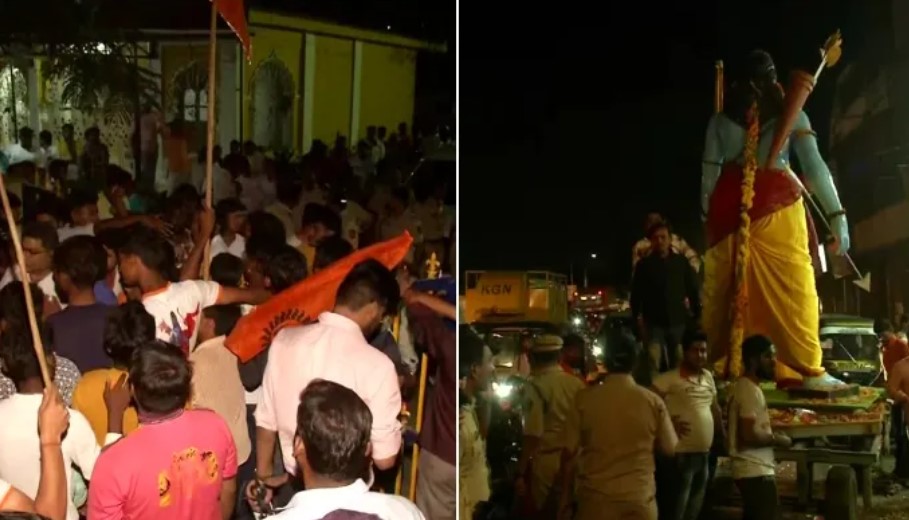
Case Summary
A scuffle broke out between people belonging to the Hindu and Muslim communities on Ram Navami in Kharik, Naugachhia in Bihar's Bhagalpur district. Stones were pelted on Hindu devotees while returning from the idol immersion. One Hindu woman was injured in the ensuing ruckus. Miscreants set ablaze many houses and shops. Section 144 was imposed in the town after this violence. More than 27 people have been arrested in this case. According to a victim, the entire incident was carried out by a group of approximately 50 to 60 individuals who were armed with petrol bombs. These bombs were set alight and thrown into shops and warehouses. The family of the victims also confirmed that the firing took place near the masjid. The Bihar Police had, however, held the Hindus responsible for the Ram Navami violence that took place. Police claimed that a WhatsApp group was created to coordinate the violence. Police held the local Bajrang Dal leader Kundan Kumar responsible for the violence.
Why it is Hate Crime ?
There are multiple sub-categories under the primary category 'attack not resulting in death' that has been selected. The first is 'attack on religious procession'. The outward celebration and display of religious symbols in an intrinsic part of Hinduism. Religious processions on various festivals are age-old traditions and a way to manifest faith and form a part of the religious practices of Hindus. On several occasions, such religious processions come under attack by non-Hindu mobs, in a manifestation of their animosity towards Hinduism and their practices. The reasons cited for such violent attacks are many and range from crossing a non-Hindu resident-dominated area to playing loud music, crossing from an area where there is a religious structure of another faith etc. The violent attacks are triggered by the outward display of religiosity by Hindus. The attacks are mainly a manifestation of religious supremacist doctrine which believes that idolatry, essentially the Hindu faith, is one that deserves to be annihilated since the very tenets of Hinduism, its practices and traditions are considered a sin in those doctrines. Since these attacks emanate from intrinsic and doctrinal animosity towards Hindus and Hinduism, it is considered a religiously motivated hate crime under this category. The second is 'attack against Hindu devotees'. Hindu devotees are a few of the easiest targets of religiously motivated hate crimes because during the festival/procession/puja etc, for non-Hindus it is easy to profile their victims on the basis of religion. Hindu devotees come under attack on several occasions by individual non-Hindus or mobs of non-Hindus owing to their animosity against Hinduism, its symbols and tradition/practices. There are several instances of Hindu devotees being attacked while they worship in temples or temporary religious structures, during religious processions, doing bhajan/kirtan/puja in their own homes, in the residential society etc. These attacks are perpetrated by non-Hindus primarily because of their animosity towards Hindus and their faith. In some cases, the trigger for the violence may be non-religious, however, there are two elements that make these hate crimes. First, the Hindus who come under attack are attacked violently while indulging in religious activity. Whether they are in a place of worship or not is immaterial to the crime. When individuals are attacked while indulging in religious practices, the attack in itself is a hindrance to their freedom to practice religion and therefore constitutes a hate crime. Secondly, religious supremacist doctrines and ideologies deem religious practices of Hindus to be offensive ab initio since they are considered “sinful” by these ideologies, worthy to be annihilated by force or coercion. Driven by these religious supremacist ideologies and doctrines, the attacks against Hindu devotees stem from intrinsic animosity towards Hinduism. In some cases, the trigger for the violence may be non-religious, however, it develops into a religiously motivated crime during the course of the violence. Since these attacks stem from animosity towards Hindus and Hinduism, they are considered religiously motivated hate crimes under this category. The third is 'attacked for crossing Muslim area'. One of the reasons that Hindus get attacked unprovoked specifically by Islamists is for crossing ‘Muslim areas’. Essentially, Muslim mobs often attack Hindus crossing or present in certain areas which have a majority Muslim population. It has often been cited as one of the reasons to blame Hindus for attacks against themselves, signalling that Hindus displaying religious symbols, taking our religious processions or crossing any area which is dominated by Muslim residents is a provocation in and of itself. These areas are mostly ghettoized areas where mobs mobilize quickly to attack Hindus for a variety of reasons like playing music during a religious procession, crossing a mosque, wearing a tilak or any other religious symbol in a Muslim-dominated area, praying at a local temple in that area etc. There have been cases where the few local Hindus of that area have been attacked on their way to the Temple for prayers as well, simply because the area is considered a Muslim-dominated area. Several times, it is entirely possible that the immediate trigger for the violence against Hindus was non-religious in nature, however, the violence became religiously motivated in nature because the area was Muslim dominated and the residents on the whole harboured animosity towards Hindus, evidenced from the actions of the mob, the slogans, and the nature of the attack. Such crimes are motivated by the religious identity of the victims and are therefore classified as hate crimes under this category. In this instance, Hindus were taking out a Shobha Yatra on the occasion of Ram Navami, a significant Hindu festival that celebrates the birth of Lord Ram, one of the most revered Gods in Hinduism. The Islamists attacked the Hindu devotees while they were returning after the idol immersion ceremony. Notably, there was no provocation from the Hindu side. It was the Muslim mob that began throwing stones at the Hindus according to the victims and eyewitnesses. The Islamists armed with petrol bombs set fire to shops and warehouses. Victims' family members confirmed that the firing took place near the masjid. Though the Bihar police had pinned the blame for the violence on Hindus, the testimony of the victims and their family members confirmed that the assault was indeed spearheaded by the Muslim side, which is why this case has been included in the hate tracker. It is pertinent to note in this case that the police had, instead of blaming the Muslim mob which launched an attack against Hindus, blamed the Hindus who became victims. The police, in many such cases, where the motive behind the crime is obvious but not explicitly mentioned, deny that the crime committed was in any way motivated by a religious bias or say that there was ‘no communal angle’ to the crime. Several factors are generally at play here. Many a time the police downplay incidents of low-level communal crime because it is their jurisdiction that comes under question. The police also often say that there was ‘no communal angle’ to a crime when there was one because they wish to ensure that owing to the crime already committed, there is no further flare up in the area. Likewise, the Left media and the leftist elite are also inclined to emphasise this "no communal angle" trope, especially wherever the victim of the crime is a Hindu. However, to determine whether such cases are religiously motivated hate crimes or not, one needs to understand what is a ‘communal angle’ in a crime. When we hear the phrase ‘communal angle’, the instant image that we have in mind is that of what happened during the Delhi Riots. There are crimes where the communal angle are glaringly obvious, like the Delhi Riots, and there are others, where the trigger of the communal crime could be extremely different and even seemingly benign. Take the example of Lotan Nishad for example. In April 2020, Lotan Nishad was sitting at a tea shop in the village at around 9.30 am. While reading the morning newspaper, he got into a verbal confrontation, over the role of Tablighi Jamaat in transmitting the Wuhan Coronavirus, with some people sitting there. Mohammad Sona, who was present there, began assaulting the victim. After some time Sona brought a gun and fired at him from close range. Nishad fell to the ground and started bleeding. He died. Immediately, after a statement by the police, the ‘liberal’ ecosystem began to peddle the ‘no communal angle’ trope. However, only a police statement or a media report, for instance, cannot be enough to determine whether there is a communal angle present in the crime that has been committed. In fact, to determine whether the crime is communal in nature or not, we need to give emphasis to the ground realities. For example in the case of Rinku Sharma, the Bajrang Dal activist who was mercilessly stabbed in his house in front of his family members in Delhi’s Mangolpuri area in the year 2021, the leftist media and the leftist ecosystem had tried to peddle that there was no communal angle to the crime. Even the police denied that the crime was communal in nature. However, Opindia spoke to several people who are on the ground with the family of Rinku Sharma and we were told that the communal tension in the area is palpable. The family of Rinku Sharma has said that the Muslims of the area held a grudge against Rinku ever since he celebrated the Ram Mandir verdict. Like the case of Rinku Sharma, those cases where even if the police have denied a communal angle or the leftist media have gone on an overdrive to peddle the ‘no communal angle’ trope, the ground reality, like the victim’s family or relative's testimonies, make it clear that there was an obvious religious bias that led to the crime, will be documented in this tracker. In this case, the police have claimed that the Hindus created a group to coordinate the violence. However, from the facts available, it is clear that it is the Muslim mob that initiated the attack against Hindu devotees and the religious procession. The average Hindus who testified also said that the Muslim mob was armed with petrol bombs - that would not have happened spontaneously had the Hindus coordinated the attack. For that reason, based on the testimony of local Hindu victims, this case is being added to the hate crime database despite police statement.


Case Status
Complaint not filed


Perpetrators Details
Perpetrators
Muslim Extremists
Perpetrators Range
Unknown
Perpetrators Gender
male
 Sources




