Hindu man brutallly killed by Muslims during a spat over music in Durga Puja procession outside a mosque
 Bahraich, Uttar Pradesh, India
  13 October, 2024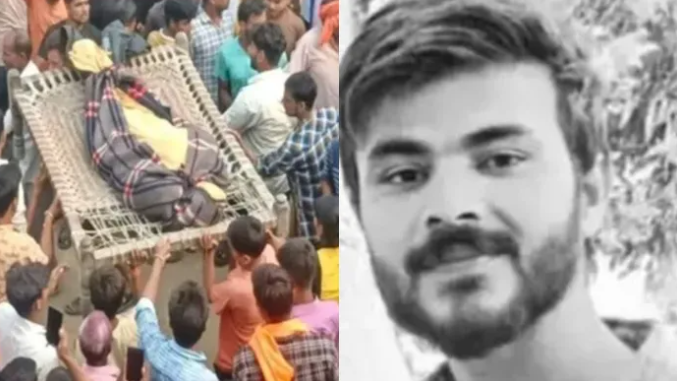
Case Summary
On 13th October, a clash erupted between two communities during the immersion of a Devi Durga idol in Rehua Mansoor village, Bahraich, Uttar Pradesh. The conflict began when Muslims objected to the DJ music being played in the procession. Tensions escalated, resulting in stone pelting and gunfire from the Muslim side, leading to the death of a Hindu man, 22-year-old Ram Gopal Mishra. He was part of the idol immersion group when he was shot at close range, and several others were injured by stones thrown during the clash. The incident unfolded when the immersion procession, heading towards Gauriya Ghat, passed a mosque in the Maharajganj area. Chanting religious slogans, the group was asked by Muslims near the mosque to stop the DJ music. A heated argument followed, and soon, stones were thrown at the procession and idols. Hindus requested the police to arrest the culprits, but the situation worsened as more members of the Muslim community gathered. Amid the chaos, someone from Abdul Hameed’s residence fired shots, hitting Ram Gopal Mishra. Gopal was dragged inside Abdul Hameed’s house by the Muslim mob and subjected to extreme violence and excessive cruelty. He was rushed to the Medical College in Bahraich but succumbed to his injuries. The post-mortem report later confirmed that Ram Gopal Mishra died from multiple gunshot wounds, with seven pellets recovered from his body, which had 40 entry wounds and 2 exit wounds. The report also revealed several injuries to his face, neck, and arms. Additionally, Mishra’s family noted that his fingernails and toenails had been ripped off, and his body bore signs of horrific torture, including knife cuts to his stomach and bullet wounds from the chest to the neck. Mishra’s siblings, Harimilan and Preeti, confirmed that their brother had been brutally murdered by Islamists. They stated that Muslims dragged Ram Gopal into their house and killed him, while the police stood by as silent spectators. His sister Preeti stated, "They killed my brother like an animal, shooting him fifteen times and cutting his body with knives." In addition to Ram Gopal, another man, Saroj Tiwari, was hospitalised after being injured by stone pelting. Mishra’s death sparked outrage, and his family, along with others in the procession, blocked the road outside the medical college, placing his body on the road in protest. Idol immersions were halted in the area, with damaged idols left at road junctions due to the stone pelting. Ram Gopal had been married just two months before the attack. Abdul Hameed, along with his sons Sarfaraz and Faheem, and others, including Sahir Khan and Talib, were named as the main culprits in the case. On 17th October, police shot two of the accused, Sarfaraz and Talib, as they attempted to flee to Nepal. Both were injured in the legs. On December 15, 2025, the court held 10 Muslim men guilty of brutally killing the Hindu youth. The judge said, Gopal was subjected to “extreme violence and excessive cruelty” where “humanity groaned, social order crumbled and reached the brink of disintegration”. Calling the crime “demonic," the court added that the Hindu youth's upper part became “sieve-like”.
Why it is Hate Crime ?
This case has been added as a religiously motivated hate crime under the prime category- Attack resulting in death, of the tracker. Under this, three sub-categories have been chosen as per the case details. The first is- Attack on religious procession. The outward celebration and display of religious symbols in an intrinsic part of Hinduism. Religious processions on various festivals are age-old traditions and a way to manifest faith and form a part of the religious practices of Hindus. On several occasions, such religious processions come under attack by non-Hindu mobs, in a manifestation of their animosity towards Hinduism and their practices. The reasons cited for such violent attacks are many and range from crossing a non-Hindu resident-dominated area to playing loud music, crossing from an area where there is a religious structure of another faith, etc. The violent attacks are triggered by the outward display of religiosity by Hindus. The attacks are mainly a manifestation of religious supremacist doctrine which believes that idolatry, essentially the Hindu faith, is one that deserves to be annihilated since the very tenets of Hinduism, its practices, and traditions are considered a sin in those doctrines. Since these attacks and the deaths due to the attacks emanate from intrinsic and doctrinal animosity towards Hindus and Hinduism, it is considered a religiously motivated hate crime under this category. The second sub-category is- Attack for Hindu identity. In several cases, Hindus are attacked merely for their Hindu identity without any perceived provocation. A classic example of this category of religiously motivated hate crime is a murder in 2016. 7 ISIS terrorists were convicted for shooting a school principal in Kanpur because they got ‘triggered’ seeing the Kalava on his wrist and tilak that he had put. In this, the Hindu victim had offered no provocation except for his Hindu religious identity. The motivation for the murder was purely religious, driven by religious supremacy. Such cases where Hindus are targeted merely for their religious identity would be documented as a hate crime. Under this category, cases where the attack led to the death of the Hindu victim/s would be documented. The third category relevant here is- Communal clash. Communal clash is a form of collective violence that involves clashes between groups belonging to different religious identities. For a communal clash between Hindus and non-Hindus to qualify as a religiously motivated hate crime, the trigger of the violence itself would have to be anti-Hindu in essence. For example, if there is a Hindu religious procession that comes under attack from a non-Hindu mob, and after the initial attack, Hindus retaliate in self-defence, leading to a communal clash between the two religious communities. While at a later stage, both communities are involved in the clash/violence, the initial trigger of the violence was by the non-Hindu mob against the Hindus and therefore, it could safely be termed as an anti-Hindu violence. Further, the trigger would also have to be religiously motivated. In the cited example, the attack by the non-Hindu mob was against a religious procession and therefore, can be concluded to be religiously motivated. In some cases, the trigger may be non-religious, however, it develops into religious violence against Hindus at a later stage. In such cases too, the foundational animosity towards Hindus becomes the motivating factor of the crime and therefore, it would be classified as a religiously motivated hate crime against Hindus. Under this category, cases where the attack led to the death of the Hindu victim/s would be documented. In this case, the Muslim mob launched an unbridled attack on Hindu devotees while they were crossing an area, which the Muslims declared to be theirs as people of their religious community predominantly occupy it. In the attack, a Hindu youth Ram Gopal Mishra was shot at close range, alongside others injured by thrown stones. The brutality of the attack, as revealed by the post-mortem report, showed signs of torture, with multiple gunshot wounds and knife injuries on Mishra’s body. His family described the scene, recounting how he was reportedly dragged into a residence and murdered while police stood by. This heinous act reflects a distinct pattern of aggression against Hindus participating in religious practices. Notably, there was no provocation from the Hindu side. The trigger for the attack on the procession was the DJ music being played by the Hindu devotees as the procession passed through the mosque. The members of the Muslim community were the ones who initiated the attack by hurling stones at the Hindu devotees, who then attacked in self-defence and reprisal. Obviously, it was not the music played by the Hindu devotees that actually triggered the Islamists, in fact, that was only an excuse used by the perpetrators to target the procession because of the participants' religious identity. Such attacks are a form of symbolic aggression against the Hindu community that stems from an innate hatred for Hinduism. Given that the fundamental motivation behind these actions is contempt for Hindus and their religion, this instance has been added to the tracker under the following category.
Victim Details
Total Victim
2
Deceased
1
Gender
- Male 2
- Female 0
- Third Gender 0
- Unknown 0
Caste
- SC/ST 0
- OBC 0
- General 0
- Unknown 2
Age Group
- Minor 0
- Adult 2
- Senior Citizen 0
- Unknown 0


Case Status
Perpetrator held guilty by court


Perpetrators Details
Perpetrators
Muslim Extremists
Perpetrators Range
From 5 to 10
Perpetrators Gender
male
 Sources




